Showing posts with label Qing Dynasty. Show all posts

22 February 2023

Ships of Zhezhi during the Ming period

UPDATED DECEMBER 31, 2025


While not as prominent as the formidable Fu Chuan (福船) and Guang Chuan (廣船), warships from Zhezhi (浙直)—that is, the regions of Zhejiang and Nanzhili (南直隸, present-day Jiangsu, Anhui, and Shanghai)—were nevertheless a critical backbone of Ming naval power. 

Being adapted to the complex mix of riverine environments of the Yangtze estuary and the shallow coastal and archipelagic waters of the southeastern seaboard, including the numerous islets of the Zhoushan archipelago, ships from Zhezhi exhibited a greater variety in designs, although they were generally characterised by their relatively small size (compared to the Fu Chuan and Guang Chuan), flat bottoms, and use of cloth sails.

Cang Shan Chuan (蒼山船, lit. 'Mount Cang's ship')

Drawing of a Cang Shan Chuan, from 'Bing Lu (《兵錄》)'.
Cang Shan Chuan, also known as Cang Shan Tie (蒼山鐵, lit. 'Mount Cang's iron') and often shortened to Cang Chuan (蒼船), was the most representative ship of Zhezhi. It originated from Zhejiang Province, in particular Taiping County (太平縣, present-day Wenling City).

Being an extinct ship type, much less is known about the Cang Shan Chuan than about other Chinese ships like the Four Great Ancient Ships, although information gleaned from written materials reveals that Cang Shan Chuan had a V- or S-bottom hull that was narrower than the Fu Chuan but wider than the Sha Chuan (沙船), as well as wide prow and stern. It had two decks, the lowest level of the ship served as its ballast, while the main deck right above served as accommodation for the ship crew. All nautical operations of the Cang Shan Chuan, as well as primary fighting compartment of the militarised version of the ship, were located on its main deck, although a reinforced superstructure could still be installed for better protection. A true hybrid sail-and-yuloh ship, the Cang Shan Chuan typically featured cloth sails, and also came equipped with ten yuloh sculling oars, each sculled by four oarsmen. Unusually, all of its yulohs were mounted at the port and starboard quarters, rather than being evenly spread over the entire length of the ship.

Originally built as a fishing vessel, Cang Shan Chuan quickly gained favour in the Ming navy during the Wokou campaign due to its general robustness (which also gave rise to its "iron" moniker), all-weather mobility, and ability to traverse shallow waters unreachable by Fu Chuan. Unfortunately, being one of the smallest Ming warships, the Cang Shan Chuan was seen as merely on par, rather than superior to, Japanese warships, and therefore ill-suited for direct ramming attack and boarding action, as it could neither plough through Japanese ships like its larger cousins from Fujian and Guangdong, nor carry enough combatants to overwhelm the dangerous Japanese warriors in close combat. Nevertheless, Cang Shan Chuan excelled in the roles of patrolling, scouting, rescue operations, providing harassing firepower, pursuing fleeing ships, as well as picking dead bodies out of water after a naval engagement. 

Chong Mu Chuan (艟𦪞船)

Drawing of a Chong Mu Chuan, from 'Deng Tan Bi Jiu (《登壇必究》)'.
Chong Mu Chuan was essentially an upsized Cang Shan Chuan that had its bamboo palisades removed (presumably to cut down on weight). Devised by famous Ming commander Qi Ji Guang (戚繼光) to better combat the Wokou, Chong Mu Chuan's greater size allowed it to overpower Japanese ships more easily without sacrificing the great mobility of the smaller Cang Shan Chuan.

Tie Tou Chuan (鐵頭船, lit. 'Iron-headed ship')

Drawing of a Tie Tou Chuan, from 'Liang Zhe Hai Fang Lei Kao Xu Bian (《兩浙海防類考續編》)'.
Tie Tou Chuan was a newer and slightly downsized version of the Chong Mu Chuan.

Similar to the Cang Shan Chuan it was based on, Tie Tou Chuan was described as being smaller and narrower than a Fu Chuan yet wider than a Sha Chuan, having a draught of four to five chi, a wide prow and stern, hybrid sail-and-yuloh propulsion with its six yulohs mounted at the port and starboard quarters, general robustness, all-weather mobility, and suitability for both shallow and deep waters.

Ba Jiang Chuan (八槳船, lit. 'Eight oar boat')

Drawing of a Ba Jiang Chuan, from 'Wu Bei Zhi (《武備志》)'.

The second-most representative ship of Zhezhi, the Ba Jiang Chuan was a agile vessel fitted with sixteen oars, eight on each side, a stern-mounted yuloh, and (presumably) two masts. While poorly suited for direct combat, it excelled patrolling, scouting, and harassing enemy ships.

Shao Chuan (哨船, lit. 'Sentry ship')

Drawing of a Shao Chuan, from 'Liang Zhe Hai Fang Lei Kao Xu Bian (《兩浙海防類考續編》)'.

Shao Chuan was an oceangoing sail-and-yuloh ship characterised by its V-bottom hull, high and pointed prow, wide stern, huge and tall sails, and large number of equipped yulohs. Originally used by fishermen from Ouhai (甌海) for deep-sea fishing, the ship's superb handling, speed, and agility also made it an excellent military vessel.

Ke Shao Chuan (殼哨船, lit. 'Shell sentry ship')

Drawing of a Ke Shao Chuan, from 'Liang Zhe Hai Fang Lei Kao Xu Bian (《兩浙海防類考續編》)'.

Ke Shao Chuan, also known as Ke Chuan (殼船, lit. 'Shell ship') and Ke Cao (殼艚, lit. 'Shell barge'), was, as its name suggests, an oceangoing fishing ship commonly used by clam-diggers from Wenzhou, characterised by its slender hull with minimal sheer and a V-bottom, as well as a wide stern.

Owing to the nature of clam-digging activities, these fishing vessels frequently fell prey to Wokou hijacking, the pirates preferring them over their own Japanese craft. Ming authorities eventually began to modify small Shao Chuan (see above) into decoy Ke Shao Chuan and mingle them with the ordinary fishing fleet to ambush the pirates.

Wang Suo Chuan (網梭船, lit. 'Net shuttle boat')

Drawing of a Wang Suo Chuan, from 'Liang Zhe Hai Fang Lei Kao Xu Bian (《兩浙海防類考續編》)'.
Wang Suo Chuan was a small fishing boat commonly used by fishermen from Dinghai (定海), Linhai Garrison (臨海衛), Guanhai Garrison (觀海衛), and Xiangshan County (象山縣) to fish at Xiabashan (下八山, part of the Zhoushan archipelago). It was the smallest of Zhezhi's fishing vessels, characterised by a hull that resembled a weaving shuttle, a bamboo mast, and a cloth sail. Despite its extremely small size (only fit for two or three crew members) and shallow 7–8 cun draught, the Wang Suo Chuan was surprisingly seaworthy, able to traverse open ocean just as well as the narrowest brooks and channels—not to mention that this shallow draught, combined with the vessel’s lightweight construction, allowed the boat to be readily dragged ashore by its small crew, offering a reliable way to evade severe weather.

While poorly suited for direct combat, the Wang Suo Chuan excelled in patrolling, scouting, and harassing enemy ships. Furthermore, thanks to its low cost, hundreds of Wang Suo Chuan—each carrying one or two matchlockmen—could be amassed easily to swarm a single ship.

Niao Zui Chuan (鳥嘴船, lit. 'Bird's beak ship')

Drawing of a Niao Zui Chuan, from 'Wu Bei Zhi (《武備志》)'.
Niao Zui Chuan was a small fishing ship originating from Wenzhou (溫州), Taizhou (台州), Songmen (松門), and Haimen (海門) of Zhejiang Province. The ship was characterised by a distinctive prow that resembled a bird's beak. Normally propelled by sail, it could also be sculled by its single stern-mounted yuloh when there was no wind.

Shui Ju Chuan (水艍船)

Drawing of a Shui Ju Chuan, from 'Shui Shi Ji Yao (《水師輯要》)'.
Shui Ju Chuan was a new type of Zhejiang warship that came into prominence in the final years of the Ming Dynasty and remained in use well into Qing period. It appeared to be a downsized version of the Gan Zeng Chuan (趕繒船), possibly as a result of transmission Fu Chuan technology into Zhejiang, or a fusion of the two shipbuilding traditions. Shui Ju Chuan was primarily equipped with breech-loading swivel guns and heavy matchlocks instead of heavier ordnance like its larger cousin.

8 November 2022

Patreon post: Auxiliary armours of Qing brigandine


This is a companion article to my Japanese armour post post, exploring various lesser-known auxiliary armours of Qing brigandine. As of now, it is available to my patrons for one month early, but it is opened to public now!

The article can be accessed here. If you like my work, please support me via Patreon!

30 October 2022

Niao Chuan (鳥船)

A replica Zhejiang Niao Chuan built in 2003. Although seaworthy, the replica's sails appear much smaller than historical ships.
The last of the "Four Great Ancient Ships" of China, Niao Chuan is perhaps the least known of the four, owing to its confusing history and relatively short (but no less crucial) period of military significance. 

Niao Chuan first came into prominence in the early 17th century, during a period when a beleaguered Ming Dynasty was facing unprecedented threats from the sea due to the rise of powerful Chinese pirate lords and the arrival of Dutch East India Company with their powerful great ships. Being one of the few Junk-type ships capable of meeting the new challenge, Niao Chuan quickly displaced older types of war junks and became the premier warship favoured by Ming navy and pirate lords alike, and later also adopted by the ascending Qing Dynasty. 

Unfortunately, Niao Chuan's heyday ended almost as quickly as it came. After the downfall of Ming Dynasty, the Dutch were evicted from Formosa by Ming loyalist Koxinga, whose kingdom he founded was in turn defeated by the Qing. With naval threats subsiding, Niao Chuan was also retired from active military service, although it continued to play an important role as an armed merchant ship long after.

1 May 2020

Chinese arming garments: A preliminary look

UPDATED MAY 8, 2022


A recent comment from my other blog post reminds me that I have yet to write anything about Chinese arming garments, so this is the blog post that aims to provide some insight into various garments worn under and over Chinese armour. Unfortunately, there are very few written records and archaeological finds of Chinese armour padding, so I have to turn to period novels like Romance of the Three Kingdoms and Water Margin (both of which reflect the fashion of author's time) and other pictorial sources for reference. As such, be warned that this blog post is only a preliminary look and very much incomplete, although it is the best I can come out with until more information surfaces.

A divine messenger wearing the full suite of kerchief (light yellow) over Fu Tou (black), neckerchief (light yellow), Zhan Pao (green), Xiu Shan (red with blue border), Guo Du (light blue) and Han Yao (embroidered), but without visible armour. From 'San Jie Chi Fu Si Zhi Shi Zhe (《三界持符四直使者》)'.

5 March 2019

Telling apart Chinese polearms: a quick visual guide

UPDATED JANUARY 10, 2025


(Note: The descriptions below correspond to the items in the image from left to right, in the same order they appear.)

1. Ancient Chinese polearms (Shang to Han Dynasty)

1.1 Common polearms

Various ancient Chinese polearms. It should be noted that these weapons are not to scale with each other. For example, the head of a Shu is much smaller than other polearms.

18 August 2016

Ming, Qing and Japanese armour components: A brief introduction and analysis

UPDATED NOVEMBER 10, 2022


Ming Qing Japanese Armour Glossaries
Left: An unnamed Ming Jin Yi Wei (錦衣衛, lit. 'Brocade-clad guard') in parade gear. Middle: Fu De (富德), a Manchu commander of Plain Yellow Banner. Right: Yamanaka Yukimori (山中幸盛) with his characteristic crescent moon crested helmet.
This blog post is intended to be an introductory article to Chinese armours of Ming and Qing period, their individual components, as well as a comparison between their similarities and differences. I also included a Japanese armour to the analysis in the hope that it can highlight the design considerations that went into each of these armours.

22 May 2016

Famous Military Unit of the Ming Dynasty — Tu Bing (土兵)

UPDATED DECEMBER 7, 2022


Ming Dynasty auxiliary light infantry
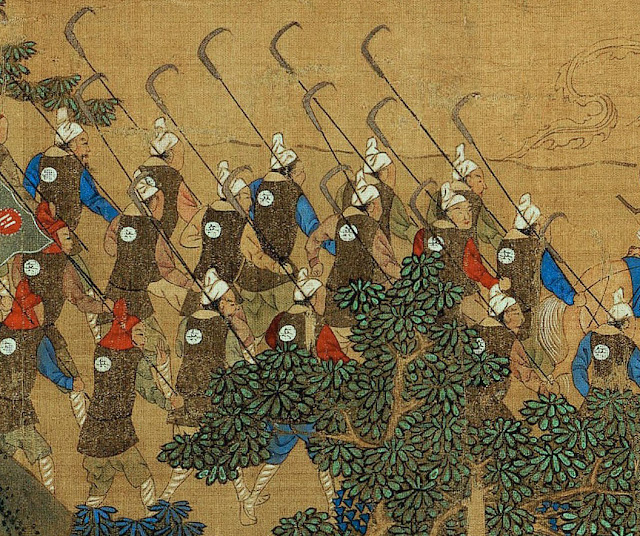
Section of the scroll painting 'Wakō-zukan (《倭寇図巻》)', depicting Ming troops wearing white headscarves and armed with pole sickles, matching with what's been known about Tu Bing's appearance.

10 November 2015

Gun Bei (滾被)

Chinese Blanket Shield
Drawing of an ornate Qing Dynasty Gun Bei, from 'Huang Chao Li Qi Tu Shi (《皇朝禮器圖式》)'.
Gun Bei (滾被, lit. 'Rolling blanket') was an unusual equipment used by the Ming army. A literal two cun thick cotton blanket used as a handheld version of Ruan Bi (軟壁), Gun Bei was usually deployed in front of the main body of an army to screen it against arrows, stones, or even arquebus shots. Using Gun Bei was such a risky prospect (as it did not always stop the projectiles) that the soldier would earn double pay.

Gun Bei was usually used in conjunction with a pair of sabres.

24 September 2015

Unique weapon of the Ming Dynasty — Zhu Ge Nu (諸葛弩)

Repeating crossbow is one of the unique inventions of China. Although the invention is commonly attributed to Zhu Ge Liang (诸葛亮), the basic design actually predates him by several centuries.

Liang Shi Bing She Lian Fa Nu (兩矢并射連發弩, lit. 'Double-shot rapid fire crossbow')

Chu State Repeating Crossbow
Earliest surviving example of a repeating crossbow, excavated from a Chu tomb. Currently kept at Jingzhou Museum.

6 August 2015

San Yan Chong (三眼銃)

Chinese three-eye-gun
A typical San Yan Chong.
Perhaps the most iconic handheld firearm of Ming army, San Yan Chong (三眼銃, lit. 'Three-eyed gun') was an iron handgonne that had three short barrels arranged in a triangular layout. It allowed the gunner to discharge three shots in quick succession before needing to reload, thereby compensating for its short range and lack of accuracy somewhat. San Yan Chong was the preferred firearm of Northern cavalry, particularly those from Liaodong Defense Region.

27 April 2015

Breech-loading cannons of the Ming Dynasty

UPDATED MAY 7, 2022, minor update DECEMBER 31, 2025


Large Fo Lang Ji from the Nanjing City Wall Museum.
Fo Lang Ji (佛郎機, lit. 'Frankish engine'), named after the Chinese name for Portuguese people (itself a Chinese transcription of related terms farang/farangi/ferenggi, used in the Muslim world to refer to White Europeans), was the Chinese version of breech-loading swivel gun, which they reverse-engineered from the Portuguese. 

Fo Lang Ji actually entered Chinese arsenal surprisingly early—the weapon came to the attention of the Ming court in October 1517, after a translator working on a Portuguese ship (likely a part of Fernão Pires de Andrade's fleet, which visited China in the same year) gifted a cannon and gunpowder formula to Gu Ying Xiang (顧應祥) during an anti-piracy operation. However, Imperial prince Zhu Chen Hao (朱宸濠) already manufactured some Fo Lang Ji in secret as early as May 1517 in preparation for his rebellion two years later, suggesting that the general populace may have learnt of this weapon well before the Ming court. In any case, after Sino-Portuguese relations turned sour, Ming navy sent to evict the Portuguese from Guangdong quickly found itself at the receiving end of this devastating weapon during Battle of Tunmen in 1521. In the ensuing blockade, Deputy Marine Commissioner (海道副使) Wang Hong (汪鋐), through military inspector He Ru (何儒) acting as an undercover agent, successfully enticed two Chinese sailors working for the Portuguese to defect. With the technical know-how acquired from these defectors, Wang Hong successfully reverse-engineered the Fo Lang Ji in a little under 40 days, then proceeded to use the new weapon to defeat the Portuguese. 

After the conflict, Wang Hong became a fervent advocate of the Fo Lang Ji and wrote several memorials to the throne to promote the weapon. In 1523, Beijing arsenal began to manufacture the Fo Lang Ji on an official basis, soon followed by Nanjing arsenal in 1524. By 1529, a mere seven years after the initial production run, virtually the entire country had been equipped with this new weapon. The Fo Lang Ji quickly supplanted older Chinese cannons and became the most important artillery piece in the Ming arsenal. 

Fo Lang Ji (佛郎機)

A standard Fo Lang Ji swivel gun, from 'Lian Bing Za Ji (《練兵雜紀》)'.
While the basic design of Fo Lang Ji was virtually unchanged from its Portuguese predecessor, Chinese gunsmiths created a great number of variant designs of nearly every size, power, and platform imaginable, ranging from downsized handheld guns, to standard-sized models mounted on small gun carriages or saddle frames similar to zamburak, to heavier piece mounted on war carts, warships and gun emplacements.

Ying Zhua Fo Lang Ji (鷹爪佛狼機, lit. 'Eagle talon Frankish engine')

Drawing of a Ying Zhua Fo Lang Ji, from 'Wu Bei Ji Yao (《武備集要》)'.
Ying Zhua Fo Lang Ji was simply a small Fo Lang Ji mounted on a three chi tall iron spiked tripod (which gave the weapon its name).


Fei Shan Shen Pao (飛山神砲, lit. 'Flying mountain divine cannon')

Fei Shan Shen Pao
Drawing of a Fei Shan Shen Pao, from 'Lian Bing Za Ji (《練兵雜紀》'.
Fei Shan Shen Pao was a medium-weight Fo Lang Ji with two pair of trunnions.

Wu Di Da Jiang Jun (無敵大將軍, lit. 'Invincible great general')

Chinese Giant Breechloading Cannon
Drawing of a Wu Di Da Jiang Jun, from 'Lian Bing Za Ji (《練兵雜紀》)'.
Wu Di Da Jiang Jun was a heavy breech-loading cannon primarily designed for close range anti-personnel purpose. A single blast from this cannon could rain death over a very large area in a manner not unlike a giant shotgun—each of its three chambers were loaded with one heavy stone ball and a whopping 365 iron pellets—although the stone ball was still capable of pulverising walls and buildings.

Weighing one thousand and fifty jin (619.5 kg or 1,366 lbs), Wu Di Da Jiang Jun was one of the heaviest cannons in Ming arsenal until the advent of Hong Yi Pao (紅夷砲). Regrettably, while it was undoubtedly devastating, Wu Di Da Jiang Jun was actually slightly underpowered for a cannon of this size due to its breech-loading nature, relatively short barrel, and the fact that its projectile weight and black powder load were limited by the size of its chamber. These shortcomings eventually led to the development of lighter and more powerful Ye Gong Shen Chong (葉公神銃).

Wu Di Shen Fei Pao (無敵神飛砲, lit. 'Invincible divine flying cannon')

Chinese Breech-loading Gun
Drawing of a Wu Di Shen Fei Pao, from 'Ji Xiao Xin Shu (《紀效新書》)'.
Wu Di Shen Fei Pao, sometimes shortened to Shen Fei Pao (神飛砲, lit. 'Divine flying cannon'), was a slightly shortened naval variant of Wu Di Da Jiang Jun. Each of its three chambers were loaded with a heavy stone ball and 200 iron pellets, although iron pellets were sometimes omitted to increase the power of stone ball.

Like its land-bound counterpart, Wu Di Shen Fei Pao was the heaviest naval artillery available to Ming navy until the advent of Hong Yi Pao.

Shen Fei Pao (神飛砲, lit. 'Divine flying cannon')

Drawing of a Shen Fei Pao, from 'Jun Qi Tu Shuo (《軍器圖說》)'.
Recorded in seventeenth century military treatise Jun Qi Tu Shuo (《軍器圖說》)', Shen Fei Pao appears to be a streamlined and more powerful version of Wu Di Da Jiang Jun/Wu Di Shen Fei Pao, lacking the iron rings used for lifting the cannon found on Wu Di Da Jiang Jun, but came with gunsight-equipped, wrought iron chambers.

The largest "Mark 1" Shen Fei Pao was 8 chi (256 cm or 8'5") in length and 1,000 jin (590 kg or 1300 lbs) in weight. Its five chambers were 1 chi 5 cun (48 cm or 1'7") in length, 80 jin (47.2 kg or 104 lbs) in weight, and had a bore size of 7 cun (22.4 cm or 8.8"). They were typically loaded with either a heavy 25 jin (14.75 kg or 32.5 lbs) stone ball, or 200 stone pellets plus 500 iron pellets (but not both at the same time unlike Wu Di Da Jiang Jun/Wu Di Shen Fei Pao), propelled by 5 jin (2.95 kg or 6.5 lbs) of black powder.

Other variants

There were also many known models of Fo Lang Ji without accompanying illustrations. Examples include Ma Shang Fo Lang Ji (馬上佛郎機, lit. 'Horseman's Frankish engine') designed to be used on horseback, Lian Zhu Fo Lang Ji Pao (連珠佛朗機砲, lit. 'Rapid fire Frankish engine'), an iron double-ended Fo Lang Ji with shortened barrels, as well as Liu Xing Pao (流星砲, lit. 'Shooting star cannon'), a type of brass Fo Lang Ji with rectangular-shaped open breech and lengthened barrel.

18 April 2015

Wu Gong Chuan (蜈蚣船)

Ming Dynasty Galley
Drawing of a Wu Gong Chuan, from 'Chou Hai Tu Bian (《籌海圖編》)'.

7 April 2015

Zhan Ma Dao (斬馬刀)

Like many Chinese weapons, the famous Zhan Ma Dao (斬馬刀, 'Horse-chopping sabre') has been subject to a lot of misinformations and misconceptions. Over the course of China's long history, the term had been applied to many different weapons, which led to confusion over the true origin and purposes of this weapon. 

However, upon closer inspection there are indeed traceable similarities between different iterations of Zhan Ma Dao/Jian. In general, they can be roughly grouped into three types:

Type A: Executioner's sword (Han–early Song period)

Very little is known about the horse chopper of this period. Based on its name ("Jian" instead of "Dao"), it is believed that the weapon was a double-edged sword, although its size and shape remain a mystery.

Han Dynasty Zhan Ma Jian (斬馬劍, lit. 'Horse-chopping sword')

Chinese Han Dynasty Two hander Sword
Five surviving Han period Jian. All swords in this photo, save for the second one from the top, are designed for two-handed use, the longest one being 146 cm in length. All swords are currently kept at Museum of the Mausoleum of the Nanyue King, Guangzhou, China. It should be noted that none of these swords are explicitly stated to be Zhan Ma Jian, although an actual example (if any survives) should look quite similar to these swords.
More properly known as Duan Ma Jian (斷馬劍, lit. 'Horse-severing sword'), this weapon was actually a sword of state, made specifically for the emperor for ceremonial purpose and to execute treacherous officials. The sword is believed to acquire its name from the White Horse Oath (白馬之盟), in which a white horse was ritually slaughtered and its blood wiped on the participants' lips as a symbolism of the oath of loyalty and upholding the bloodline of Han emperor Liu Bang (劉邦). 

Contrary to popular misconceptions, the original meaning of Zhan Ma Jian was "a sword that is sharp enough to chop through a horse" rather than "a sword specifically designed to cut down horse".

Sui and Tang Dynasty Mo Dao (陌刀)

While not explicitly described as a horse chopper, Tang Dynasty Mo Dao had been compared to Han Dynasty Zhan Ma Jian, and later Song Dynasty texts also liken the Zhan Ma Dao to this weapon. Mo Dao was primarily carried by barrier troops to execute cowardly or deserting soldiers, but performed just as well as a battlefield weapon. It was often used alongside other heavy weapons such as war axes, quarterstaves, and flails, in defence as well as during siege and assault. Mo Dao was also one of the preferred close combat weapons of Tang archers and crossbowmen (Ming Chinese continued this practice of arming ranged troops with heavy polearms).

Many Mo Dao users were exceptionally strong individuals, but the most famous one was probably Tang commander Li Si Ye (李嗣業), who used the weapon to great effect to stop the pursuing Abbasid army after Tang army suffered a defeat at Battle of Talas.

To date, no surviving Mo Dao has been discovered. Drawing upon descriptions found in various Tang Dynasty texts, Mo Dao seems to be a type of double-edged chopping polearm, up to one zhang (118.1 in or 300 cm) in length and fifteen jin (22.48 pounds or 10.2 kg) in weight. It is also speculated that Japanese ōmi-yari (大身槍) either descended from, or was related to, this weapon.

Type B: Cleaver type (Song–Qing period)

Whether a two-handed sword or a polearm, horse choppers of this period inevitably had a long (usually three chi or more) cleaving blade that ended in very steep clip point or so-called "reverse tanto" point (although many Song Dynasty swords had a blunt square point instead). The blade could be straight (Song period) or slightly curved (Ming and Qing period). 

Song Dynasty Zhan Ma Dao
Song Chinese Zhanmadao
Photo of a Song Dynasty sword that matches the description of Zi Zhi Tong Jian Chang Bian. Note that the sword edge is facing downward. Image taken from Thomas Chen's website but original source unknown. 
Song Dynasty Zhan Ma Dao represented the long and unbroken Chinese tradition of using large, two-handed war swords as battlefield weapon dating back as early as Warring States period. Xu Zi Zhi Tong Jian Chang Bian (《續資治通鑑長編》) describes the weapon as a large two-handed sword with a three chi (93.6 cm) blade, one chi (31.2 cm) hilt, and a large ring pommel.

Unlike earlier Zhan Ma Jian and Mo Dao, Song Dynasty Zhan Ma Dao was mass-produced for the rank and file (there was even a special bureau that produced nothing but Zhan Ma Dao). It was also really designed with the intention to cut down heavily armoured cavalry.

Ming Dynasty Zhan Ma Dao

Ming Chinese Zanbatō
A Zhan Ma Dao (left) and a Yan Yue Dao (偃月刀) (right), from 'Wu Bei Yao Lue (《武備要略》)'.
Sometimes known as Kan Dao (砍刀, lit. 'Chopping sabre'), Ming Dynasty Zhan Ma Dao was a glaive with a three chi (96 cm) blade, four chi (128 cm) shaft, and a butt spike. It could be distinguished from other Chinese glaives by its longer blade, clip point tip and lack of protrusion or hook on the back of the blade. This type of Zhan Ma Dao could be considered synonymous with Po Dao (朴刀), although not all Po Dao were Zhan Ma Dao.

Incidentally, Zhan Ma Dao was one of the few Chinese weapons that made an impression on contemporary Western observers. In his book titled Neglected Formosa ('t Verwaerlossde Formosa), Frederick Coyett described Koxinga's troops "wielded with both hands a formidable battle-sword fixed to a stick half the length of a man", a description that matches Zhan Ma Dao perfectly.

Although labelled as "Ming Dynasty" Zhan Ma Dao in this blog post, this type of polearm was used well into Qing period.

Type C: Ōdachi-inspired weapon (MingQing period)

Clearly inspired by Japanese ōdachi (大太刀), which was adopted by Ming Chinese as Chang Dao (長刀), this type of Zhan Ma Dao had a long, gently curved blade and hilt designed for two-handed use. While not specifically designed as anti-cavalry weapon, Chang Dao was indeed used as such by Chinese troops, although the name change only happened during Qing period.

(It should be noted that the name change was rather more like a military designation of an existing weapon, similar to how AR-15 was designated as M16 by the US military.)

Qing Dynasty Lu Ying Zhan Ma Dao

Chinese Zhanmadao
Drawing of a Qing Dynasty Zhan Ma Dao, from 'Huang Chao Li Qi Tu Shi (《皇朝禮器圖式》)'.
Lu Ying Zhan Ma Dao was one of the several types of two-handed sabres issued to Lu Ying (綠營, Green Standard Army). It was essentially a Qing iteration of Ming period Chang Dao with minor modifications on size and fittings.

For those interested to learn more about Qing period Chinese two-handed sabres, here is a very good article: Chinese long sabers of the Qing dynasty

Other similar weapons

Qing Dynasty "Zhan Ma Jian"

Chinese Zhanmajian
A truly monstrous sword that dwarfed many actual polearms in length, this weapon had a long and wavy "flamberge" style blade mounted on a wooden shaft that was only slightly shorter than the blade. Its blade alone was longer than most Chinese jian.

As the sword was a non-regulation weapon and only a handful survived, it did not have an official name. Nevertheless, the sword has been casually referred to as Zhan Ma Jian and certainly looks the part.

Japanese Zanbatō (ざんばとう or 斬馬刀)

Japanese zanbato
A modern nakamaki nōdachi being advertised as a zanbatō. Note the black wrapping at the lower third of the blade.
Contrary to popular misconception, there is no such thing as a Japanese zanbatō. "Zanbatō" is simply the Japanese pronunciation of Zhan Ma Dao and refers to the Chinese weapon. In fact, the term did not even enter common usage until 1970s.

In popular media, any sufficiently large Japanese sword, typically an ōdachi, nakamaki nōdachi (中巻野太刀, a nōdachi sword with the last portion of its blade wrapped in thin cord, which serves as a secondary grip similar to a zweihänder's ricasso/sub-hilt. It is the predecessor of nagamaki) or sometimes a bisentō (眉尖刀), can all be referred to as zanbatō.

5 April 2015

Po Dao (朴刀)

Chinese Pudao
An ornate Po Dao once belonged to Taiping general Luo Da Gang (羅大綱). Private Collection.
Po Dao was a type of Chinese sword or glaive with a cleaving blade that usually ended in a very steep clip point. Po Dao came in one-handed, two-handed, equal handle to blade ratio, polearm and even a "bifurcated weapon" form, although the term generally refers to polearm version in common usage. It should be noted that the weapon's name should be written as "朴刀", even in traditional Chinese. It cannot be written as "樸刀".

Humble Origin

The weapon known as Po Dao first appeared during Song Dynasty. At the time it was also known as Po Dao (潑刀), Bō Dao (撥刀), Bó Dao (博刀 or 膊刀) and many other names. Essentially a weaponised agricultural tool, Po Dao was not considered a "military grade" regulation weapon and commonly found in the hands of militias, bandits, outlaws and rebels alike (and thus enjoyed unusually high exposure in literature, dramas and plays, which tend to portray civilian rather than military life).

Horse Chopper

Ming Dynasty Podao
A Po Dao (highlighted), also known as Zhan Ma Dao, from 'Wu Bei Yao Lue (《武備要略》)'.
It is not known exactly when, or why, long-handled Po Dao came to be known as Zhan Ma Dao (斬馬刀), although this may be related to Song general and Chinese national folk hero Yue Fei (岳飛) and his elite army, the Yue Jia Jun (岳家軍, lit. 'Army of House Yue'). Yue Fei and his army famously wielded a weapon known as Ma Zha Dao (麻紥刀, lit. 'Linen-wrapped knife') to chop at vulnerable horse legs of the otherwise heavily armoured Jurchen cataphracts. While the length and form of Ma Zha Dao had been lost to the passage of time (although it is almost certainly a two-handed chopping polearm, a.l.a. Po Dao), Yue Fei's legendary exploits had profound influence on later Chinese military thinking. By Ming period, weapons such as Ma Zha Da Kang Dao (麻紥大砍刀, lit. 'Linen-wrapped great chopping sabre') and Ma Zha Zhan Ma Dao (麻紮斬馬刀, lit. 'Linen-wrapped horse-chopping sabre') started to show up in Ming arsenal records, alongside regular Zhan Ma Dao. Polearm/glaive type Zhan Ma Dao also replaced Song-era two-handed swords as the most ubiquitous horse chopper.

Although Zhan Ma Dao had become a more recognisable name for Po Dao during Ming period, some Ming texts, such as the writings of general Yu Da You (俞大猷), still refers the weapon with its old name.

Cheng Zi Yi's modified Po Dao

Cheng Zi Yi modified Podao
Cheng Zi Yi's modified Po Dao and scabbard, from 'Wu Bei Yao Lue (《武備要略》)'.
Late Ming period military writer Cheng Zi Yi (程子頤) designed a two-handed sword version of Po Dao in order to make the weapon more compatible with Dan Dao Fa Xuan (單刀法選) techniques. By doing so, he effectively combined two types of Zhan Ma Dao (Type B and Type C) into one weapon.

The new weapon featured ridged cross-section and resembled both Dan Dao (單刀) and Song-era Zhan Ma Dao.

Qing Dynasty Po Dao

Qing Dynasty Glaives
Different types of Qing Dynasty Po Dao. Top left: Lu Ying Pu Dao. Top mid: Lu Ying Kuan Ren Pian Dao. Top right: Lu Ying Kuan Ren Da Dao. Bottom left: Lu Ying Chuan Wei Dao. Bottom mid: Lu Ying Hu Ya Dao. Bottom right: Tiao Dao. Images taken from 'Qin Ding Da Qing Hui Dian Tu 《欽定大清會典圖》' and 'Huang Chao Li Qi Tu Shi (《皇朝禮器圖式》)'.
After the fall of Ming, many elements of former Ming military were absorbed into Qing military system and reorganised into either Lu Ying (綠營, Green Standard Army) or Han Jun (漢軍, lit. 'Han army', ethnic Han bannermen). These Han Chinese soldiers retained most of their traditional weapons and equipment, only minimally modified to adapt to the new military regulation.

Under Qing military regulation, Po Dao was divided into several subtypes based on their length and blade profile:
  • Lu Ying Pu Dao (綠營撲刀, lit. 'Green Standard Army Pu Dao') was a rather short, one-handed version of Po Dao.
  • Lu Ying Kuan Ren Pian Dao (綠營寬刃㓲刀, lit. 'Green Standard Army broad bladed slicing sabre') was a Po Dao with a handle of about equal length to its blade.
  • Lu Ying Kuan Ren Da Dao (綠營寬刃大刀, lit. 'Green Standard Army broad bladed great glaive') was a standard polearm-length Po Dao.
  • Lu Ying Chuan Wei Dao (綠營船尾刀, lit. 'Green Standard Army stern sabre') was named due to the blade shape's similarity to the stern of a ship. It was a two-handed sword that had a longer and sharpened clip point tip for better thrusting capability. 
  • Lu Ying Hu Ya Dao (綠營虎牙刀, lit. 'Green Standard Army tiger tooth sabre') was a larger version of Chuan Wei Dao that had a roughly equal ratio of handle length to blade length.
  • Teng Pai Ying Tiao Dao (藤牌營挑刀, lit. 'Rattan Shield Regiment lifting glaive') was a polearm-length version of Chuan Wei Dao with narrower blade. Unlike other weapons in this list, this weapon was issued to Han Bannermen that specialised in rattan shield tactics.

Late Qing period Shuang Shou Dai (雙手帶) and Tai Ping Dao (太平刀)

Late Qing period Shuangshoudai
Mid-nineteenth century export painting depicting a militiaman armed with a Shuang Shou Dai. From Digital Collections of the New York Public Library. (Source: Kung Fu Tea)
As the once great Qing Empire aged and corruption began to run rampant, its hereditary military system also weakened and eventually collapsed. Militias and levies replaced professional soldiers as the main source of recruit, and brought with them many non-regulation weapons. Po Dao, which had its root in agricultural tool and civilian weapon, once again became one of the most common close combat weapons of the Qing army.

Late Qing period Po Dao were generally short polearms with roughly equal length handle and blade. As old regulations and names fall into disuse, these short polearms came to be known as Shuang Shou Dai (雙手帶, lit. 'Double hand carry'), even though the term originally referred to a type of two-handed sabre. After Taiping Rebellion broke out, this weapon gained yet another moniker "Tai Ping Dao (太平刀, lit. 'Taiping sabre')" due to its prevalence among Taiping rebels.

Republican long handled Da Dao (大刀) 

Second Sino-Japanese War Podao
Chinese soldiers during the Second Sino-Japanese War, armed with Shuang Shou Dai-type Da Dao.
Throughout the entire Second Sino-Japanese War, Chinese forces often found themselves severely underequipped and had to outfit their soldiers with all sort of sabres, cleavers, and glaives. With little standardisation going on, these weapons were lumped together and collectively called Da Dao (大刀, lit. 'Great sabre') or sometimes Kan Dao (砍刀, lit. 'Chopping sabre') regardless of their length, shape and size. Some Shuang Shou Dai also saw service in the war as Da Dao, and techniques of Shuang Shou Dai became the basis of Da Dao drills.

20 March 2015

Cotton and brigandine armours of the Ming Dynasty

Mian Jia (棉甲, cotton armour)

Ming Chinese Gambeson
Section of one of the pages of 'Rui Xi Xian Sheng Nian Pu (《瑞溪先生年譜》)', depicting a horseman wearing a long coat with cross hatch quilting pattern, possibly a cotton armour.

21 February 2015

Bamboo and wooden armours of the Ming Dynasty

Bamboo armour

Chinese Bamboo Helmet
A Qing period bamboo hat helmet, probably used by the militia. (Source: Trocadero)
Ming army never made use of bamboo body armour, except very rarely as helmet. Nevertheless, one peculiar group did find the bamboo armour useful—warrior monks from Shaolin Monastery. Since warrior monks were often recruited to aid government efforts in combating Wokou (倭寇), so some form of protection must be necessary.

10 November 2014

Matchlock firearms of the Ming Dynasty

UPDATED MAY 4, 2022, minor update NOVEMBER 10, 2023


Ming Tanegashima Matchlock
A Ming Dynasty matchlock arquebus found in Xuzhou.

Random Quotes & Trivia

GREAT MING MILITARY © , All Rights Reserved. BLOG DESIGN BY Sadaf F K.