Showing posts with label military unit. Show all posts

30 December 2025

Elite Unit of the Ming Dynasty — Biao Bing (標兵)

Armoured Ming cavalrymen, cropped from 'Ping Fan De Sheng Tu (平番得勝圖)'.
While Jia Ding (家丁) was perhaps the most famous Ming Dynasty elite unit, it was not the only one, nor were these semi-private soldiers the most numerous. In actuality, soldiers known as Biao Bing (標兵), an abbreviation of Biao Xia Zhi Bing (標下之兵, lit. 'Soldier under a marked banner'), vastly outnumbered the Jia Ding, and were the closest thing the Ming Dynasty had to a formal elite military formation.

Similar to Jia Ding, Biao Bing also had its root in the long-time practice of high-ranking commanders maintaining their own personal retinues, although it was primarily influenced by, and remained a part of, the Ying Bing System (營兵制). Biao Bing were soldiers that directly and exclusively answered to military overseers (and later Regional Commanders), which, given their high ranks, meant that Biao Bing were drawn from and maintained as the best and most elite soldiers.

Unlike Jia Ding, the founding of a Biao Bing regiment was subject to approval by the central government, and Biao Bing were answerable to the military overseer's position, rather than to the individual. Thus if a military overseer was transferred to another post, he did not take the Biao Bing with him; instead the soldiers answered to his replacement. For this reason, commanders that maintained their own Jia Ding generally avoided assigning their own Jia Ding into Biao Bing regiments.

The earliest Biao Bing regiments, respectively under the command of Supreme Commander of Military Affairs and Concurrently Director-general of Supplies in Xuanda and Shanxi (宣大總督) Weng Wan Da (翁萬達) and Supreme Commander of Military Affairs in the Three Frontiers of Shaanxi (三邊總督) Zeng Xian (曾銑), were founded in 1546, both as a response to the increasingly dire threat possessed by the dreaded Altan Khan necessitating military built-up and increase of battle-readiness along the Ming frontiers. After the establishment of Supreme Commander-led Biao Bing, various Grand Coordinators also followed suit, and later even Regional Commanders begun to raise their own Biao Bing regiments.

As the practice grew widespread, Biao Bing went from being an elite core to the backbone of the Ming army, prompting the need to distinguish various types of Biao Bing: regiments serving under Supreme Commanders or Overseers of the Armed Force were known as Du Biao Ying (督標營, "Overseer-marked regiment"), those led by Grand Coordinators were known as Xun Biao Ying (巡標營, . 'Coordinator-marked regiment"), while Biao Bing commanded by Regional Commanders were organised into Zhen Biao Ying (鎮標營, "Regional-marked regiment").

Recruitment

There were no standardised, codified criteria for recruiting Biao Bing, and they were recruited from a wide variety of sources—often with members of the same unit hailing from markedly different origins. Common sources included:

1. Exceptional soldiers handpicked from existing regiments

Because Biao Bing often served the highest-ranking military overseers of a given theatre—who naturally wanted the very best soldiers under their command—a common method of quickly raising a new Biao Bing regiment was to simply cream the best soldiers and leaders from existing units.

Occasionally, some Regional Commanders—who lacked the authority of military overseers—converted entire Zheng Bing Ying (正兵營) under their command into Biao Bing regiments.

2. Direct recruitment

Given that Biao Bing were more numerous than Jia Ding and organised as full regiments, continually skimming the best soldiers from existing units to raise yet more Biao Bing regiments quickly became impractical and self-defeating—especially once the practice became more common. As such, raising Biao Bing regiments from new recruits remained the preferred method.

3. Tong Shi (通事, lit. 'Translator/interpreter') and Ye Bu Shou (夜不收)

Specialist units such as Tong Shi and Ye Bu Shou were especially valued for their hardiness and their familiarity with local geography, customs, and cultures, making them excellent candidates for Biao Bing recruitment. However, their scarcity meant that Tong Shi and Ye Bu Shou could only supplement the Biao Bing, never constituting the bulk of the regiments’ numbers.

4. Jia Ding

Already elite-trained, Jia Ding naturally made excellent Biao Bing candidates, so attempts were made to recruit them as far back as the earliest conception of Biao Bing. This often came in the form of assigning disgraced commanders along with their Jia Ding into Biao Bing units. Nevertheless, due to conflicting loyalties and the fact that Jia Ding often refused to leave their liege's side for long, these attempts were met with varying success.

Equipment, organisation and tactics

Because Biao Bing were functionally the elite version of normal Ying Bing units, they were organized no differently from ordinary regiments. There was no limitation on arm of service, equipment, or origin of recruits, and no requirement that all members of the same Biao Bing regiment had to belong to the same troop type. They simply received better-quality training, superior equipment, higher status, and improved pay than their ordinary counterparts. Naturally, Biao Bing were more or less indistinguishable from regular Ming soldiers in appearance; only their chain of command sets them apart. 

Many powerful and famous military units in the history of the Ming Dynasty were in fact Biao Bing that exclusively answered to certain military overseers. Notable examples included the war cart regiment of Zeng Xian (曾銑) and the Biao Bing army of Sun Chuan Ting (孫傳庭) during the final years of the Ming Dynasty.

The Regiment's Finest

The Biao Bing served two primary functions, namely to act as an elite vanguard, as well as serving as exemplars to other soldiers. These functions often encompassed serving as military overseer's retinues and bodyguards, fighting in the thick of battle where enemy resistance was fiercest, demonstrating the highest standards of courage and discipline and leading by example, as well as reinforcing military overseer's authority and dominance in order to prevent and suppress potential insubordination and mutiny.

And Biao Bing's battlefield performance certainly lived up to to the elite quality demanded of soldiers entrusted with such functions. Soon after Biao Bing's inception, a contingent of roughly one hundred Biao Bing, who served under Wen Wang Da and were stationed at Bogegu (鵓鴿峪, lit. 'Rock dove valley'), came under attack by tens of thousands of Mongol cavalry . Outnumbered a hundred to one and losing one of their commanders early, these Biao Bing nevertheless fought a valiant last stand, killing nearly six times their own numbers before being overrun. Victory though it was, the Mongols were so shaken by the horrific casualties that they vented their anger by ripping open the bellies of all fallen Biao Bing and stuffing them with rocks—yet the reputation of these fearsome soldiers would still send shockwaves across the entire steppe.

The last stand at Bogegu was certainly not an isolated incident, and Biao Bing would continue to steadfastly serve as the backbone of the Ming military—sometimes even constituting the majority—until the dynasty’s downfall. In fact, even after Ming Dynasty fell into terminal decline, Biao Bing still retained much of their combat prowess. The Biao Bing of Sun Chuan Ting, for example, were instrumental in crushing the Shaanxi peasant rebellion and capturing rebel leader Gao Ying Xian (高迎祥) alive in a brilliantly executed ambush.  

19 October 2021

The bare-footed militia of Changning

A barefoot She man from Luoyuan County. Image cropped from 'Huang Qing Zhi Gong Tu (《皇清職貢圖》)'.

1 April 2020

Elite Unit of the Ming Dynasty — Jia Ding (家丁)

MINOR UPDATE NOVEMBER 24, 2025


Armoured cavalry escorting a commander and a mandarin. From 'Kang Wo Tu Juan (《抗倭圖卷》)'.
As Ming empire began to weaken, its once-mighty military machine based on Wei-Suo System (衛所制) also fell into disarray. Realising the worrying decline of the army's combat strength, some Ming commanders took it upon themselves to recruit and train better troops out of their own personal pockets. However, Ming Dynasty laws explicitly forbade its commanders to raise private armies, so these commanders exploited a loophole in the law—by categorising these private troops as Jia Ding (家丁), or "housemen/house servants", instead of soldiers. This was the origin of Jia Ding System.

14 March 2017

Special Unit of the Ming Dynasty — Jian Ye (尖夜)

Stone inscription detailing a sortie of Ye Bu Shou on Qinhuangdao Great Wall.

5 February 2017

Qi Ji Guang's Che Ying (車營) — Part 1

The Mongol Threat

It was no secret that the Mongols were formidable and extremely dangerous warriors. Being an all-cavalry army, their strength lay way beyond just simple mobility and deadly horse archery, but also their unpredictability and force concentration. It is quite unfathomable, at least to modern minds that are more exposed and accustomed to Western (particularly European) style of medieval warfare, that a nomadic people with but a small fraction of Chinese population and wealth could muster a vastly larger, better trained and better equipped army than the Chinese, yet for most of the Chinese-Mongol conflicts, Chinese soldiers frequently found themselves not only outmanoeuvred but also outnumbered. In fact, it was not unusual in any given conflict to have a Mongol force that fielded more horsemen than Chinese had footmen, even though a horseman was several times more expensive to train and maintain than a foot soldier.

The ability of the Mongols to concentrate their forces essentially forced the Chinese into passive defensive warfare—utilising fortresses and strongholds to balance out the force multiplier created through concentration of force. Yet due to their superior mobility the Mongols could strike at more places than Chinese could defend them, and at times of their choosing. It was under such circumstance that the Chinese invented and pioneered wagon fort tactics to defend against nomadic raids, as war carts served as "fortress that moves" that allowed Chinese troops to operate away from the protection of their fortresses.

Yet even war cart alone could not adequately defend against Mongol horsemen, whom were equally deadly in horse archery as they were in cavalry charge, and often had numerical advantage on their side. For most of China's history, Chinese troops had to rely on massed crossbows, whether handheld or vehicle-mounted, to repel these horsemen. While undoubtedly effective, Chinese crossbow was hard-pressed to match the Mongol bow.

Qi Ji Guang's Che Ying (車營, lit. 'Cart regiment')

Che Ying formed the war cart branch of the reformed Ji Defence Region army devised by Qi Ji Guang (戚繼光), and was arguably the most important unit of his reform. While it was intended to operate alongside the infantry, cavalry and logistic branch of the army, Che Ying was actually self-sufficient even when deployed alone.

Several types of war carts were used in Che Ying, which will be detailed below:

Pian Xiang Che (偏廂車, lit. 'Side cabin cart')

Ming Dynasty War Wagon
Drawing of a Pian Xiang Che, from 'Si Zhen San Guan Zhi (《四鎮三關志》)'.

22 July 2016

Famous Military Unit of the Ming Dynasty — Mao Hu Lu Bing (毛葫蘆兵)

Deer scrotum medicine bag
A Native American medicine bag made of deer scrotum, just to give a better idea of what a deer scrotum quiver might look like. (Source: Etsy)

15 June 2016

Famous Military Unit of the Ming Dynasty — Qi Jia Jun (戚家軍)

Qi Ji Guang Army
'Heng Yu Da Jie (《橫嶼大捷》)' painted by Ma Hong Dao (馬宏道) in 1988 to commemorate Qi Jia Jun's great victory at Battle of Heng Yu.
Perhaps the most famous, and the most elite military unit of Ming Dynasty, Qi Jia Jun (戚家軍, lit. 'Army of House Qi') was the army raised and trained by none other than renowned Ming commander Qi Ji Guang (戚繼光) himself. Troops of Qi Jia Jun hailed from Zhejiang province, particularly Yiwu County, and numbered about three to four thousand initially, but became much larger later on.

22 May 2016

Famous Military Unit of the Ming Dynasty — Tu Bing (土兵)

UPDATED DECEMBER 7, 2022


Ming Dynasty auxiliary light infantry
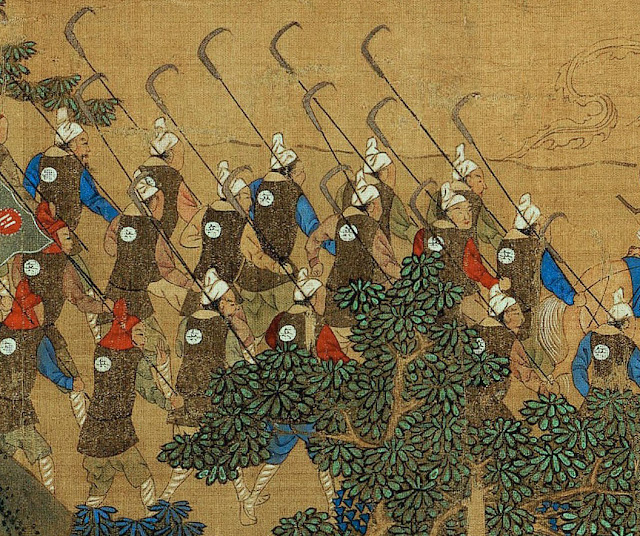
Section of the scroll painting 'Wakō-zukan (《倭寇図巻》)', depicting Ming troops wearing white headscarves and armed with pole sickles, matching with what's been known about Tu Bing's appearance.

28 February 2016

Xu Guang Qi's De Sheng Bing (得勝兵) — Part 1

Portrait of Xu Guang Qi currently kept at Guangqi Park, Shanghai.

22 December 2015

The ghost-faced warrior monks of the Shaolin Monastery

Shaolin Wushu Monk
Section of a mural depicting Shaolin warrior monks training with their weapons. From 'Shao Lin Wu Seng He Lian Tu (《少林武僧合練圖》)',  Shaolin Monastery, Henan province.

1 December 2015

Famous Military Unit of the Ming Dynasty — Bai Gan Bing (白桿兵)

UPDATED MAY 8, 2023


Bai Gan Bing (White Shaft Troop)
Qin Liang Yu and Bai Gan Bing, from 'Li Dai Ming Jiang Hua Pu (《歷代名將畫譜》)' by early Republican period painter Ma Tai (馬駘).
Bai Gan Bing (白桿兵, lit. 'White shaft troop') was an elite infantry unit under the leadership of Qin Liang Yu (秦良玉), the only formally Imperial-appointed female general in the entirely of China's history. Along with troops from Zhejiang, they formed the best infantry of the Ming Dynasty.

28 October 2015

Famous Military Unit of the Ming Dynasty — Tian Xiong Jun (天雄軍)

Tian Xiong Jun
Bust of Lu Xiang Sheng, Museum of Famous Historical Figures, Yixing.

5 June 2015

Famous Military Unit of the Ming Dynasty — Tie Ren (鐵人)

Age of Empire 3 Iron Troop
Aftermath of the Siege of Fort Zeelandia, depicting Chinese troops wearing heavy lamellar armour, possibly Tie Ren. Artwork taken from 'Reise nach Java, Formosa, Vorder-Indien und Ceylon' by Albrecht Herport, an artist, soldier of VOC, and witness of the battle.
Tie Ren (鐵人 or 銕人, lit. 'Iron man') were a type of elite heavy infantry that served the legendary Zheng Cheng Gong (鄭成功), known to the West as Koxinga. They were amongst the finest troops Ming loyalists had to offer. Formally known as Hu Wei Zhen (虎衛鎮, lit. 'Tiger Guard Garrison'), the formation of Tie Ren was inspired directly by the heavily armoured cavalry of the Qing Dynasty.

Recruitment and training

Tie Ren were only recruited from the strongest men: one must be able to walk three laps around a training field while carrying a three to five hundred jin stone lion (presumably in a manner not dissimilar to modern strongman's stone carry) in order to be eligible for recruitment.

Once recruited, Tie Ren underwent rigorous military training to better prepare them for war. They drilled twice a day in full gear (albeit without wearing their masks, as metal mask can get extremely hot under the sun) with sandbags tied to their legs, and underwent performance assessment every other day, with a particular emphasis on archery.

Equipment

Chinese scale armour
Fragmented iron scales salvaged from a sunken ship of Koxinga's fleet.
Tie Ren famously wielded Zhan Ma Dao (斬馬刀) as their weapon of choice. They were heavily armoured, wearing an iron helmet, an iron mask painted with terrifying visage, an armoured coat fastened with iron chains, an armoured skirt, armpit armours, armguards and iron boots. Because Tie Ren often served as marines and participated in amphibious assault and boarding action, they often discarded lower limb armours and removed trousers and footwears for ease of movement.
A short, single-edged sword (highlighted) that exhibits many characteristics unique to Southeast Asian dha, such as the very long, rounded hilt and small guard. From 'Jing Guo Xiong Lue (《經國雄略》)', written by Zheng Da Yu (鄭大鬱), a contemporary of Koxinga and follower of Zheng Zhi Long (鄭芝龍), Koxinga's father.
Other equipment of Koxinga's army (although not necessarily by Tie Ren themselves) included bows and arrows, grenadesrattan shields, Ai Pai (挨牌), Gun Bei (滾被), spears and pikes, and a type of sword known as Yun Nan Dao (雲南刀, lit. 'Yunnanese sabre'), presumably inspired by Southeast Asian dha. They also used a type of weapon known as Kuang (鋛) and Ri Ben Kuang (日本鋛), which seems to refer to Japanese yari (鑓).

Organisation and tactics

Tie Ren were organised into left and right Wu Wei Zhen, as well as left and right Hu Wei Zhen, which served a dual role of Koxinga's guards and crack troops. They numbered around three to five thousands initially, although subsequent recruitment increased this number to around ten thousands.

During battle, Tie Ren usually fought in mixed six-man squads consisted of two rattan shieldmen, two pikemen, two Tie Ren wielding Zhan Ma Dao as well as three supporting porters (although they were also armed with spears, they were not counted among the combatants). Each squad could be further divided into two three-man cells that operated independently. Sometimes, pikemen were omitted to include even more Tie Ren.

Every Tie Ren was also an archer. They were usually organised into archer contingent and close combat contingent with a ratio of 4:6.

Soldier par excellence

Such was the fearsome reputation of Tie Ren that they were highly respected by Koxinga's other troops and dreaded by their Manchu and Hollander enemies. They were known to be disciplined, fierce, and fearless to the point of recklessness, and demonstrated many impressive battlefield feats to back up this reputation. Tie Ren had withstood repeated cavalry charges by a superior number of Manchu heavy cavalry, utilised smoke screen to countercharge and defeat said cavalry, ignored seemingly delibilating arrow wounds, and weathered through severe Dutch bombardment without faltering. They were also noted for their skill in archery and ability to maintain good formation order by Dutch witnesses.

In spite of this fearlessness, Tie Ren were not headstrong nor suicidal. They were perfectly willing (and were disciplined enough to be able to) disengage and dive for cover when ordered, either to protect themselves from enemy gunfire, or to take advantage of fire support from nearby friendly artillery.

Nevertheless, while Tie Ren enjoyed prestigious position in Koxinga's army, they never completely shed their piratical roots, and would not hesitate to engage in pillage, rape and massacre when ordered.

9 April 2015

Famous Military Unit of the Ming Dynasty — Lang Bing (狼兵)

Ming Dynasty Wolf Brigade
Section of the Ming Dynasty scroll painting 'Kang Wo Tu Juan (《抗倭圖卷》)', depicting auxiliary troops armed with hook-like polearms. Other weapon such as Zhan Ma Dao (斬馬刀) can be seen in the illustration as well.
Lang Bing (狼兵, lit. 'Wolf troop') were a type of auxiliary infantry hailed from Guangxi region that were organised under the Tusi system. They were famous for their ferocity in battle, but also notorious for their lack of discipline and penchant for causing troubles.

The exact composition of Lang Bing was (and still is) a matter of debate, even during Ming period. Some considered only Tu Si troops from NandanDonglan, and Na Di (那地, near present-day Shanglin) to be "authentic" Lang Bing or Zhen Lang (真狼, lit. 'True wolf'), while others also counted Tu Si troops from Tianzhou and Gui Shun Zhou (歸順州, present-day Jingxi) among their ranks. The majority of Lang Bing consisted of Tong Ren (獞人, present-day Zhuang people) and Yao Ren (猺人, present-day Yao people). In fact, it is generally accepted that "Lang (狼, wolf)" in Lang Bing was derived from either Liang (俍) or Tong (峒), both archaic names of Zhuang people.

Lang Bing were frequently called to suppress ethnic minority conflicts and uprisings (even among their own people). By mid-Ming period, they also assisted Ming army to repel Wokou (倭寇) raids.

Equipment

Lang Bing were most famous for their skill in Yan Wei Pai (燕尾牌) and short sabres, although over the years they gruadually expanded their arsenal, adopting poisoned javelins, poisoned crossbows, spears as well as forks. By late-Ming period, they even had their own cavalry, arquebusiers, as well as specifically trained dogs to retrieve thrown javelins.

Lang Bing generally fought unarmoured.

Organisation and tactics

Under the Tu Si system, Lang Bing served as a reserve force that was only called upon in time of war. However, due to their high frequency of mobilisation, many Lang Bing were deployed to places far from their homeland and eventually settled there permanently. Some of these Lang Bing formed new communities and became new Tu Si, while others were either absorbed into regular army, or reorganised into semi-permanent garrisons that were more or less unofficial Wei-Suo (衛所).

Lang Bing had a very high qualification standard for their commanders. In theory, an officer qualified for commanding one thousand troops in other armies may only command one hundred Lang Bing, while an officer qualified for leading one hundred troops may only lead ten. This may be due to their indiscipline nature, requiring more experienced officers to handle them.

As lightly armoured swordsmen, Lang Bing relied on their ferocious charge to quickly close the distance and enter close combat as soon as possible, as they lacked the staying power of armoured troops.

Mixed reputation

Lang Bing often fought with such ferocity, it was said that twenty Lang Bing could easily overwhelm two hundred Wokou. However, due to their lack of discipline, Lang Bing were prone to break and flee if the battle went unfavourably for them. Their aggressiveness also made them more vulnerable to enemy ambush.

If left unchecked, Lang Bing often engaged in pillage, murder, rape, slavery and human trafficking at the place they were stationed.


Reference

Blog post updated with new and more accurate information taken from 明代的狼兵 on 逸佚居 (Traditional Chinese).

Random Quotes & Trivia

GREAT MING MILITARY © , All Rights Reserved. BLOG DESIGN BY Sadaf F K.