 |
| A barefoot She man from Luoyuan County. Image cropped from 'Huang Qing Zhi Gong Tu (《皇清職貢圖》)'. |
Showing posts with label distinctive unit. Show all posts
Showing posts with label distinctive unit. Show all posts
19 October 2021
The bare-footed militia of Changning
22 July 2016
Famous Military Unit of the Ming Dynasty — Mao Hu Lu Bing (毛葫蘆兵)
 |
| A Native American medicine bag made of deer scrotum, just to give a better idea of what a deer scrotum quiver might look like. (Source: Etsy) |
15 June 2016
Famous Military Unit of the Ming Dynasty — Qi Jia Jun (戚家軍)
 |
| 'Heng Yu Da Jie (《橫嶼大捷》)' painted by Ma Hong Dao (馬宏道) in 1988 to commemorate Qi Jia Jun's great victory at Battle of Heng Yu. |
22 May 2016
Famous Military Unit of the Ming Dynasty — Tu Bing (土兵)
UPDATED DECEMBER 7, 2022
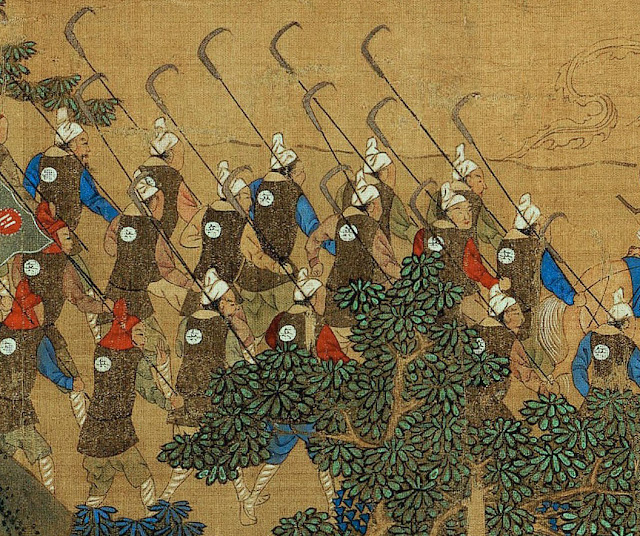
|
| Section of the scroll painting 'Wakō-zukan (《倭寇図巻》)', depicting Ming troops wearing white headscarves and armed with pole sickles, matching with what's been known about Tu Bing's appearance. |
22 December 2015
The ghost-faced warrior monks of the Shaolin Monastery
 |
| Section of a mural depicting Shaolin warrior monks training with their weapons. From 'Shao Lin Wu Seng He Lian Tu (《少林武僧合練圖》)', Shaolin Monastery, Henan province. |
1 December 2015
Famous Military Unit of the Ming Dynasty — Bai Gan Bing (白桿兵)
UPDATED MAY 8, 2023
 |
| Qin Liang Yu and Bai Gan Bing, from 'Li Dai Ming Jiang Hua Pu (《歷代名將畫譜》)' by early Republican period painter Ma Tai (馬駘). |
5 June 2015
Famous Military Unit of the Ming Dynasty — Tie Ren (鐵人)
MINOR UPDATE AUGUST 14, 2026
 |
| Aftermath of the Siege of Fort Zeelandia, depicting Chinese troops wearing heavy lamellar armour, possibly Tie Ren. Artwork taken from 'Reise nach Java, Formosa, Vorder-Indien und Ceylon' by Albrecht Herport, an artist, soldier of VOC, and witness of the battle. |
Recruitment and training
Tie Ren were only recruited from the strongest men: one must be able to walk three laps around a training field while carrying a three to five hundred jin stone lion (presumably in a manner not dissimilar to modern strongman's stone carry) in order to be eligible for recruitment.Once recruited, Tie Ren underwent rigorous military training to better prepare them for war. They drilled twice a day in full gear (albeit without wearing their masks, as metal mask can get extremely hot under the sun) with sandbags tied to their legs, and underwent performance assessment every other day, with a particular emphasis on archery.
Equipment
 |
| Fragmented iron scales salvaged from a sunken ship of Koxinga's fleet. |
 |
| A short, single-edged sword (highlighted) that exhibits many characteristics unique to Southeast Asian dha, such as the very long, rounded hilt and small guard. From 'Jing Guo Xiong Lue (《經國雄略》)', written by Zheng Da Yu (鄭大鬱), a contemporary of Koxinga and follower of Zheng Zhi Long (鄭芝龍), Koxinga's father. |
Organisation and tactics
Tie Ren were organised into left and right Wu Wei Zhen, as well as left and right Hu Wei Zhen, which served a dual role of Koxinga's guards and crack troops. They numbered around three to five thousands initially, although subsequent recruitment increased this number to around ten thousands.During battle, Tie Ren usually fought in mixed six-man squads consisted of two rattan shieldmen, two pikemen, two Tie Ren wielding Zhan Ma Dao as well as three supporting porters (although they were also armed with spears, they were not counted among the combatants). Each squad could be further divided into two three-man cells that operated independently. Sometimes, pikemen were omitted to include even more Tie Ren.
Every Tie Ren was also an archer. They were usually organised into archer contingent and close combat contingent with a ratio of 4:6.
Soldier par excellence
Such was the fearsome reputation of Tie Ren that they were highly respected by Koxinga's other troops and dreaded by their Manchu and Hollander enemies. They were known to be disciplined, fierce, and fearless to the point of recklessness, and demonstrated many impressive battlefield feats to back up this reputation. Tie Ren had withstood repeated cavalry charges by a superior number of Manchu heavy cavalry, utilised smoke screen to countercharge and defeat said cavalry, ignored seemingly delibilating arrow wounds, and weathered through severe Dutch bombardment without faltering. They were also noted for their skill in archery and ability to maintain good formation order by Dutch witnesses.In spite of this fearlessness, Tie Ren were not headstrong nor suicidal. They were perfectly willing (and were disciplined enough to be able to) disengage and dive for cover when ordered, either to protect themselves from enemy gunfire, or to take advantage of fire support from nearby friendly artillery.
9 April 2015
Famous Military Unit of the Ming Dynasty — Lang Bing (狼兵)
 |
| Section of the Ming Dynasty scroll painting 'Kang Wo Tu Juan (《抗倭圖卷》)', depicting auxiliary troops armed with hook-like polearms. Other weapon such as Zhan Ma Dao (斬馬刀) can be seen in the illustration as well. |
The exact composition of Lang Bing was (and still is) a matter of debate, even during Ming period. Some considered only Tu Si troops from Nandan, Donglan, and Na Di (那地, near present-day Shanglin) to be "authentic" Lang Bing or Zhen Lang (真狼, lit. 'True wolf'), while others also counted Tu Si troops from Tianzhou and Gui Shun Zhou (歸順州, present-day Jingxi) among their ranks. The majority of Lang Bing consisted of Tong Ren (獞人, present-day Zhuang people) and Yao Ren (猺人, present-day Yao people). In fact, it is generally accepted that "Lang (狼, wolf)" in Lang Bing was derived from either Liang (俍) or Tong (峒), both archaic names of Zhuang people.
Lang Bing were frequently called to suppress ethnic minority conflicts and uprisings (even among their own people). By mid-Ming period, they also assisted Ming army to repel Wokou (倭寇) raids.
Equipment
Lang Bing were most famous for their skill in Yan Wei Pai (燕尾牌) and short sabres, although over the years they gruadually expanded their arsenal, adopting poisoned javelins, poisoned crossbows, spears as well as forks. By late-Ming period, they even had their own cavalry, arquebusiers, as well as specifically trained dogs to retrieve thrown javelins.Lang Bing generally fought unarmoured.
Organisation and tactics
Under the Tu Si system, Lang Bing served as a reserve force that was only called upon in time of war. However, due to their high frequency of mobilisation, many Lang Bing were deployed to places far from their homeland and eventually settled there permanently. Some of these Lang Bing formed new communities and became new Tu Si, while others were either absorbed into regular army, or reorganised into semi-permanent garrisons that were more or less unofficial Wei-Suo (衛所).Lang Bing had a very high qualification standard for their commanders. In theory, an officer qualified for commanding one thousand troops in other armies may only command one hundred Lang Bing, while an officer qualified for leading one hundred troops may only lead ten. This may be due to their indiscipline nature, requiring more experienced officers to handle them.
As lightly armoured swordsmen, Lang Bing relied on their ferocious charge to quickly close the distance and enter close combat as soon as possible, as they lacked the staying power of armoured troops.
Mixed reputation
Lang Bing often fought with such ferocity, it was said that twenty Lang Bing could easily overwhelm two hundred Wokou. However, due to their lack of discipline, Lang Bing were prone to break and flee if the battle went unfavourably for them. Their aggressiveness also made them more vulnerable to enemy ambush.If left unchecked, Lang Bing often engaged in pillage, murder, rape, slavery and human trafficking at the place they were stationed.
Reference
Blog post updated with new and more accurate information taken from 明代的狼兵 on 逸佚居 (Traditional Chinese).
Subscribe to:
Posts (Atom)