|
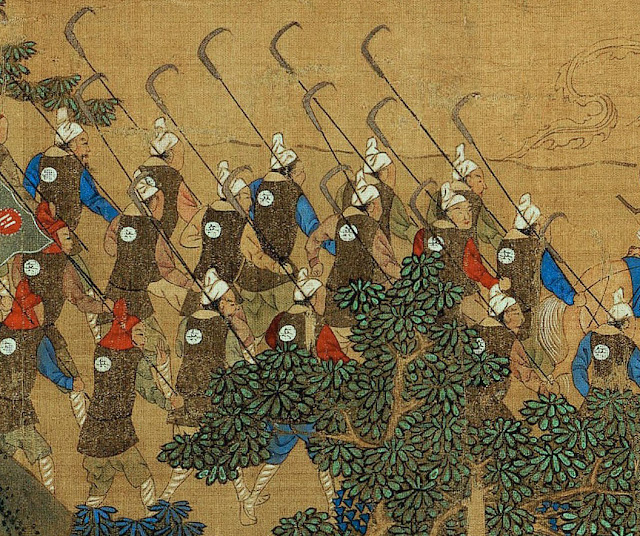
| Section of the Ming Dynasty scroll painting 'Kang Wo Tu Juan (《抗倭圖卷》)', depicting auxiliary troops armed with hook-like polearms. Other weapon such as Zhan Ma Dao (斬馬刀) can be seen in the illustration as well. |
Lang Bing (狼兵, lit. 'Wolf troop') were a type of auxiliary infantry hailed from
Guangxi region that were organised under the
Tusi system. They were famous for their ferocity in battle, but also notorious for their lack of discipline and penchant for causing troubles.
The exact composition of Lang Bing was (and still is) a matter of debate, even during Ming period. Some considered only Tu Si troops from
Nandan,
Donglan, and
Na Di (那地, near present-day
Shanglin) to be "authentic" Lang Bing or
Zhen Lang (真狼, lit. 'True wolf'), while others also counted Tu Si troops from
Tianzhou and
Gui Shun Zhou (歸順州, present-day
Jingxi) among their ranks. The majority of Lang Bing consisted of
Tong Ren (獞人, present-day
Zhuang people) and
Yao Ren (猺人, present-day
Yao people). In fact, it is generally accepted that "
Lang (狼, wolf)" in Lang Bing was derived from either
Liang (俍) or
Tong (峒), both archaic names of Zhuang people.
Lang Bing were frequently called to suppress ethnic minority conflicts and uprisings (even among their own people). By mid-Ming period, they also assisted Ming army to repel
Wokou (倭寇) raids.
Equipment
Lang Bing were most famous for their skill in
Yan Wei Pai (燕尾牌) and short
sabres, although over the years they gruadually expanded their arsenal, adopting
poisoned javelins,
poisoned crossbows,
spears as well as
forks. By late-Ming period, they even had their own cavalry, arquebusiers, as well as specifically trained dogs to retrieve thrown javelins.
Lang Bing generally fought unarmoured.
Organisation and tactics
Under the Tu Si system, Lang Bing served as a reserve force that was only called upon in time of war. However, due to their high frequency of mobilisation, many Lang Bing were deployed to places far from their homeland and eventually settled there permanently. Some of these Lang Bing formed new communities and became new Tu Si, while others were either absorbed into regular army, or reorganised into semi-permanent garrisons that were more or less unofficial
Wei-Suo (衛所).
Lang Bing had a very high qualification standard for their commanders. In theory, an officer qualified for commanding one thousand troops in other armies may only command one hundred Lang Bing, while an officer qualified for leading one hundred troops may only lead ten. This may be due to their indiscipline nature, requiring more experienced officers to handle them.
As lightly armoured swordsmen, Lang Bing relied on their ferocious charge to quickly close the distance and enter close combat as soon as possible, as they lacked the staying power of armoured troops.
Mixed reputation
Lang Bing often fought with such ferocity, it was said that twenty Lang Bing could easily overwhelm two hundred Wokou. However, due to their lack of discipline, Lang Bing were prone to break and flee if the battle went unfavourably for them. Their aggressiveness also made them more vulnerable to enemy ambush.
If left unchecked, Lang Bing often engaged in pillage, murder, rape, slavery and human trafficking at the place they were stationed.
Reference
Blog post updated with new and more accurate information taken from
明代的狼兵 on
逸佚居 (Traditional Chinese).