UPDATED DECEMBER 7, 2022
|
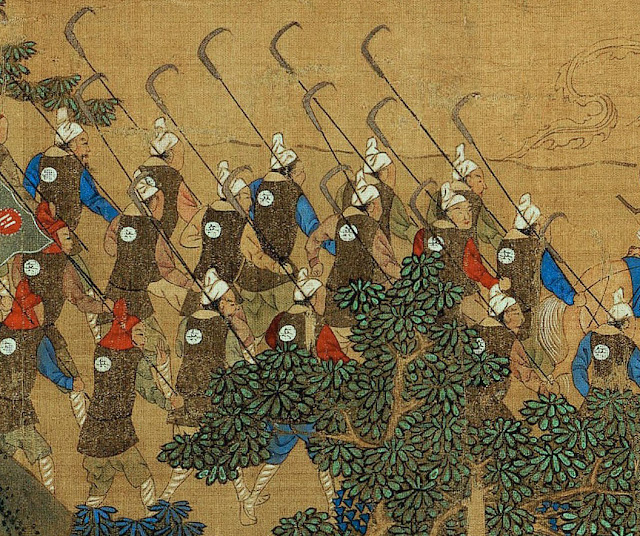
| Section of the scroll painting 'Wakō-zukan (《倭寇図巻》)', depicting Ming troops wearing white headscarves and armed with pole sickles, matching with what's been known about Tu Bing's appearance. |
Tu Bing were a type of auxiliary infantry organised
under
Tusi system. In a broader context, the term encompassed all auxiliary
troops organised under Tu Si system, including
Lang Bing (狼兵)
and
Bai Gan Bing (白桿兵). The most renowned Tu Bing came from
Yongshun
and
Baojin counties and consisted of Tu Ren (土人, later came to be
known as
Tujia people
during Qing period), although some Han Chinese and Miao people could also be
found among their ranks.
Tu Bing's long and storied history of military service dates back to Yuan period, and they had been active since the very beginning of Ming Dynasty. During mid-Ming period they were the largest auxiliary forces of Ming military along with Lang Bing, and together they formed the backbone of Ming military campaign against Wokou (倭寇), to the point Lang Bing and Tu Bing were often mentioned together as Lang Tu Bing (狼土兵, lit. 'Wolf-Tu troops'). In fact, distinction between Tu Bing and Lang Bing can be quite blurry as they were sometimes used interchangeably or confused with each other.
Tu Bing's long and storied history of military service dates back to Yuan period, and they had been active since the very beginning of Ming Dynasty. During mid-Ming period they were the largest auxiliary forces of Ming military along with Lang Bing, and together they formed the backbone of Ming military campaign against Wokou (倭寇), to the point Lang Bing and Tu Bing were often mentioned together as Lang Tu Bing (狼土兵, lit. 'Wolf-Tu troops'). In fact, distinction between Tu Bing and Lang Bing can be quite blurry as they were sometimes used interchangeably or confused with each other.
Tu Bing hailing from Yongshun and Baojin Tusi were also known as
Hu Bing (湖兵, lit. 'Lake troops'), as both Tusi were located
inside Hunan
province.
At least some Tu Bing were known to wear armour.
Equipment
Tu Bing from Yongshun and Baojin Tusi were most famous for their Gou Dao (鈎刀, lit. 'Hook knife' or 'Hook sabre'), a type of Gou Lian (鈎鐮). They also used long spears, javelins, as well as crossbows. Tu Bing did not use firearms, at least initially, although they may had adopted some firearms during late Ming period.At least some Tu Bing were known to wear armour.
Organisation
Tu Ren during Ming period lived in a highly militarised society where every able-bodied male was expected to take up arms in times of conflict. Thanks to their long service experience they had a relatively sophisticated military structure, as well as the capability to quickly mobilise large numbers of troops.
The military of Yongshun Tusi was organised using Ying-Qi
(營旗, lit. 'Camp-Banner') System, which was inspired by Wei-Suo System (衛所制) of the Ming army. Under this system, five hundred soldiers known as Cun Cheng Bing
(存城兵, lit. 'City preservation troops') formed the standing army of
Yongshun Tusi military. These full-time professional soldiers were
organised into van, middle, rear, left and right companies, collectively
known as Cun Cheng Wu Ying (存城五营, lit. 'Five
companies of city preservation'), with the middle company being the most
prestigious one directly commanded by Tusi chieftain or someone next in
the line of succession, while the other four companies were led by trusted
local leaders or the chieftain's close relatives.
As Cun Chen Bing were relatively few in numbers, they were complemented by
vast numbers of Qi Bing (旗兵, lit. 'Banner troops'),
citizen-soldiers or militia that provided their own equipment and
training. Unlike their full-time counterparts, Qi Bing were instead
organised into various Qi (旗, lit. 'Banner'), which was both a
military unit and a civilian administrative unit during peace time. During
Ming period Yongshun Tusi had a total of 75 Qi, with 58 combat-capable Qi
and 17 Qi responsible for administration and logistics.
Comparatively little is known about the military organisation of the
neighbouring Baojin Tusi, although Baojin Tusi also used Ying-Qi system
and likely closely resembled Yongshun Tusi.
Tactics
The basic combat formation of Tu Bing was also known as Qi, which
consisted of a captain known as Qi Tou (旗頭, lit. 'Banner
head') and twenty-three troops arraying in a highly aggressive 1-3-5-7-7
wedge formation. Twenty-four Qi constituted a Si (司), the basic
maneuver unit of Tu Bing. During battle a Si would usually deploy into
three battles (right, middle and left), each consisted of multiple smaller
wedge formations.
While Tu Bing were noted to be able to go toe to toe Tu Bing also
developed an unorthodox countermeasure to the deadly Japanese swords:
throwing soaked cloths at Wokou swordsmen to distract them. If the Wokou
(instinctively) tried to parry the wet cloths, the wet cloths would
quickly wrap around their blades and weigh them down, creating an opening
for the Tu Bing to rush in.
Service records
Tu Bing had the reputation of being fierce, brave and highly disciplined, but also simple minded. They were a highly versatile infantry capable of fulfilling almost any role, and in addition were also expert mountaineers and excellent sailors and swimmers. Tu Bing dutifully served Ming Dynasty in no less than sixty campaigns and battles throughout Ming period, and were instrumental in eradicating the Wokou threat. Tu Bing's crowning moment was the famed Great Victory of Wang Jiang Jing (王江涇大捷), of which they killed nearly two thousand Wokou and drowned many more in a masterfully executed funnel and ambush strategy.Reference:
明代的湖廣土司與鉤刀手
on
逸佚居
(Traditional Chinese).
were they actually fighting during imjinwar?
ReplyDeleteOr just join the war and not fighting just like wolftroop?
AFAIK they actually fought the war. About 15000 were mobilised if my memory serves.
DeleteWolf troops also fought in the war, as far as I can remember.