Showing posts with label topic. Show all posts

14 June 2024

Movie review: Noryang: Deadly Sea


The sequel to The Admiral: Roaring Currents and Hansan: Rising Dragon, and the epic finale of Yi Sun-sin trilogy, is finally released digitally! Being the Imjin War enthusiast that I am, of course I wouldn't pass up the chance to review what director Kim Han-min has in store for his audience!

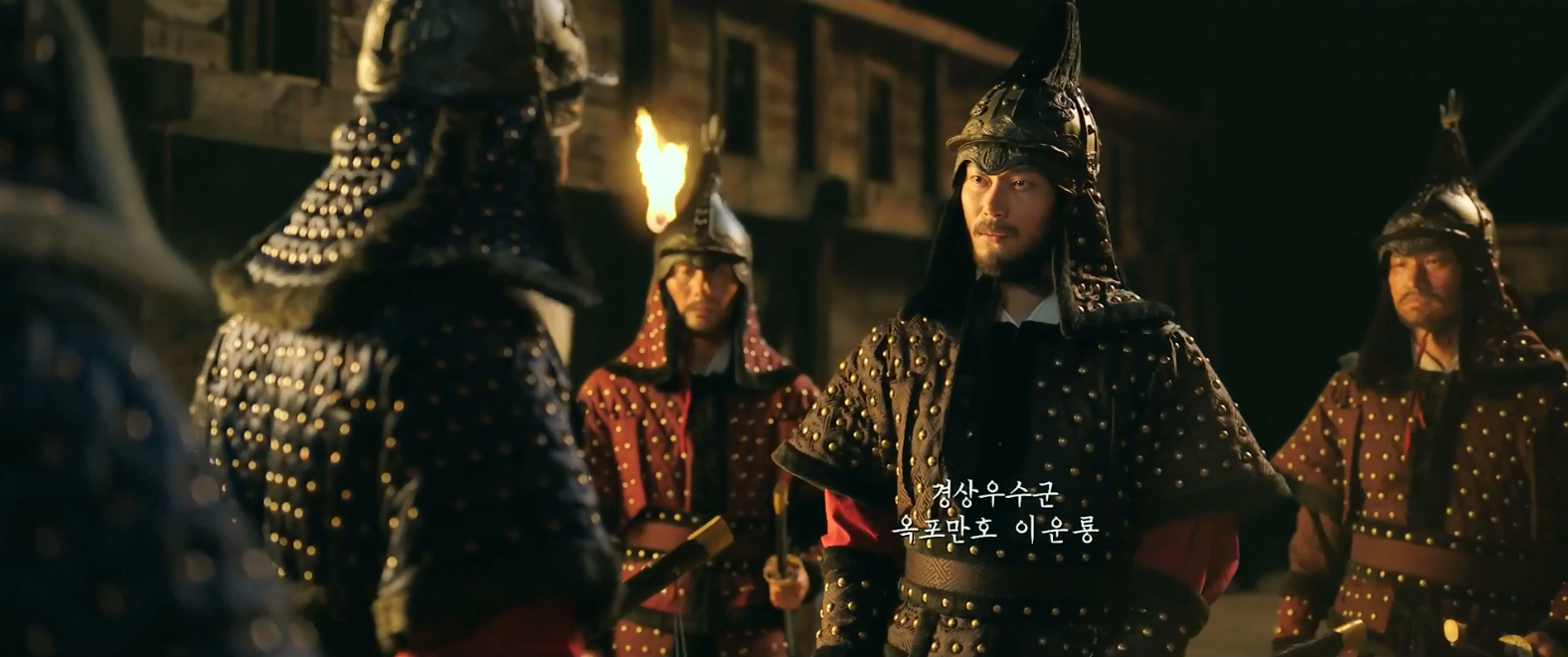
A bit of running joke: Hey, it's commander Yi Ung-ryong (이운룡 or 李雲龍) again! Reprised by the same actor! For reasons unknown he is always the first Joseon commander I recognise.
Noryang: Deadly Sea revolves around the titular Battle of Noryang, the last major battle of Imjin War and the climax of the entire war. This makes it a much easier battle to adapt into a good story/movie, which allows the movie to be largely (albeit not completely) free of the numerous narrative problems that plagued Hansan: Rising Dragon. This is not to say Noryang: Deadly Sea is superior to its prequel, however. In many ways, it is worse.

(Major spoilers ahead, be warned!)

Production issues

The perk of Hanzi writing system: Korean and Chinese communicating by writing is both historically accurate and a great chance to have narrator and actors speak Korean without looking out of place. Unfortunately, the director insisted on using cringe Chinese even when Chinese characters are not verbally communicating. 
Production issues are the least of the movie's many problems, so I am going to mention them first. My first complaint about Noryang: Deadly Sea is that the Chinese language in this movie is atrociously cringe to a native speaker, to the point that I must pause the movie to clear my head every time anyone speaks any Chinese. To be fair, this isn't really a production issue per se (all actors are Korean so it's understandable that they can't speak Chinese), although the production team really should consider hiring some Chinese actors or just dub over the Chinese part.

Yi Sun-sin vomiting blood.
Personal gripe with the language aside, there are definitely some pacing issues with the movie. This is particularly egregious during a scene where the titular character, Yi Sun-shin (이순신 or 李舜臣) suddenly sees hallucination of his deceased son, calls out the names of his comrades one by one as if bidding farewell to them, and vomits blood out of nowhere—BEFORE he was fatally shot by a Japanese gunner. I have a sneaking suspicion that executive meddling forced the director to pad out the length of his movie to the detriment of storytelling. In any case, pacing issues will likely be fixed if the director later releases a Redux/director's cut version of the movie like he did for Hansan: Rising Dragon.

Ming soldiers beating Japanese captives to a pulp.
Thirdly, remember that I said I enjoyed the build-up portion of Hansan: Rising Dragons for all the wrong reasons? Well, the build-up portion of Noryang: Deadly Sea is largely free of the narrative issues of its prequel, but this ironically means that it now bores me to death, as I no longer have any reason, not even wrong one, to enjoy this convoluted mess. I am not even sure if the flashback and minor plot of Yi Sun-sin's dead son is really necessary when the central theme of the story isn't that of personal vendetta, but "to end the war on our terms we must pursue the enemy to the very edge of the (Japanese) archipelago.". Speaking of which, I am well aware this that this is a nationalistic movie and all, but surely such vindictive message can't be the right moral to convey to the audience?

Sea of inferno: Battle of Noryang on the silver screen

Joseon fleet splitting the Japanese fleet in two. Depiction of pre-modern naval battle of such scale, in complete darkness no less, is probably an industry's first.
Historical accounts of Battle of Noryang are rather light on finer details, which give plenty of room for creative liberty. For example, there's nothing in the historical records that describes the Koreans deploying hwacha during this battle, or the Japanese using captured cannons to sink turtle ships, but there's nothing to suggest they DIDN'T either. Thus, free from historical restrictions such as Yi Sun-sin's famous Hak Ik-jin (鶴翼陣), the director was able to let his imagination run wild, and I commend him for delivering such blood-pumping battle sequences. Moreover, barring a few exceptions all characters acted in a mostly logical and coherent manner, and the battle tactics and counter-tactics sensible and convincing, both of which make for an enjoyable watching experience. Regrettably, later portion of the naval action was overshadowed by overly drawn-out, soap opera-esque montages of Yi Sun-sin's final moments and death, although this doesn't detract from the fact that it was great while it lasted.

Nevertheless, despite the enjoyable battle scenes, there are indeed some exceptions, or one might say plot holes, that detract from the overall story. Chief among them are the war fleet of Konishi Yukinaga (小西行長), Chen Lin acting out of character, and the battle that ends at dawn. They will be elaborated below:

Konishi Yukinaga's pristine war fleet

Konishi Yukinaga's fleet.
The story begins with Konishi Yukinaga holed up inside Suncheon Castle due to a joint Ming-Joseon naval blockade, with supply running so low his soldiers were on the verge of resorting to cannibalism. If that is the case, then where did he find/hide such a massive fleet of warships? And why didn't Yi Sun-sin do something about these ships before they become a problem, i.e. destroy them during the blockade?

Chen Lin acting out of character

Chen Lin ordering Ming navy to attack.
In this film, Ming admiral Chen Lin is portrayed as a calculating coward that took bribes and spent the better part of the film trying to distance himself from Yi Sun-sin's war to avoid more bloodshed. Yet during a crucial moment he suddenly ordered Ming navy to press the attack seriously, only to end up with his own flagship boarded by the Japanese. This abrupt change of mind is entirely out of character for Chen Lin's risk-averse portrayal up until that point, and it appears that the director forcibly handed him an idiot ball for no reason other than to set up a "Yi Sun-sin heroically save the Ming admiral from danger" moment.

The battle that ends at dawn

Yi Sun-sin's plan to annihilate Shimazu Yoshihiro's fleet before dawn.
Having the epic struggle to be over by daybreak gives a nice touch of symbolism, signifying the nightmare that terrorised Korea for the past seven years is finally over, and new hope arise. Historically, the turning point of  Battle of Noryang also happened around dawn (although the battle itself continued well into the morning), so that checks out. So why is this a problem?

Shimazu Yoshihiro's subordinate urges him to retreat because "time is running out".

Konishi Yukinaga sounds the retreat, leaving Shimazu Yoshihiro out to dry.
Well, the time when the battle ended isn't a problem. It's only when Yi Sun-sin explicitly set a time limit that he must defeat the Japanese before dawn, Shimazu Yoshihiro became increasingly agitated as daybreak drew near, and Konishi Yukinaga acted as if he was too late after arriving at the scene by dawn, that it become problematic. Why? Because while the battle happens to be over by dawn, there isn't any particular reason that it couldn't, or shouldn't, go on for longer. In essence, by racing against this arbitrary time limit, the characters both good and bad are making decisions based on out-of-story knowledge they couldn't possibly know.

As to why serious plot holes like this can crop up in an otherwise fairly coherent story, this brings me to my next point...

Stolen shine: a sad attempt at ego-boosting

Yi Sun-sin beating the war drum.
At its core, Noryang: Deadly Sea is a nationalistic flick under the guise of historical movie. Attempts to shape the titular hero Yi Sun-sin into a saint among men, and to a lesser extend make the Koreans look good and heroic while everyone else either bad or helpless, permeate throughout the story, dialogues, and character portrayals, some overt, other indirect and subtle. Naturally, in such work historical realities are more of a hindrance than a boon. They are inconvenient truth that must be distorted to serve the narrative, not the other way around.

Shimazu Yoshihiro reading the secret letter sent to him by Konishi Yukinaga.
To illustrate, in a secret letter Konishi Yukinaga warned Shimazu Yoshihiro that Yi Sun-sin might counter-invade Japan after the war. This obviously untrue statement may appear to be just another off-handed chest thumping to make Yi Sun-sin look good and Joseon Kingdom appear more powerful than it really was (which is usually par of the course for a nationalistic movie but relatively harmless, although not in this case), however it actually underpins much of the history distortions that shape the movie's story, and the plot holes that come with such alterations. 

You see, in the historical version of Battle of Noryang, Konishi Yukinaga simply packed up and slipped away from Suncheon Castle while the battle raged on. However, in order to glorify Yi Sun-sin, the director made him a dangerous commander that the Japanese simply could not ignore (even after they lost the war), necessitating the antagonists to hatch a nefarious plot to defeat him, which in turn necessitating Konishi Yukinaga to conjure a war fleet out of thin air to threaten Yi Sun-sin with. Thus, a plot hole came into being. 

It also necessitates Yi Sun-sin using decoys to delay Konishi Yukinaga, rather than...you know, smash his idle fleet before he had a chance to use it.
Likewise, that Chen Lin was the supreme commander that led the allied navy to victory during Battle of Noryang, and Ming navy actually did most of the legworks during the battle, are all inconvenient historical facts to the director's story that must be written off/away. There's a reason why Battle of Noryang played out so differently from Yi Sun-sin's other naval victories, for instance the unusually heavy use of incendiary weapons, little aversion to boarding combat, and the main artillery being Chinese Hu Dun Pao (虎蹲砲) rather than the usual Joseon Chongtong (총통 or 銃筒). But nope, can't have that, Yi Sun-sin must hoard all the spotlights! So Chen Lin is portrayed as a coward that tried to avoid battle at all cost, while Chinese Huo Qiu (火毬) and Pen Tong (噴筒) are being replaced by unimaginative oil pots hand-thrown by Joseon troops then ignited with fire arrows. 

Had Chen Lin not been portrayed as a coward, the scene where his ship was boarded by the Japanese and he was saved by Yi Sun-sin would've flowed far more naturally. Unfortunately, the director wanted to have his cake and eat it too, so he forced Chen Lin to abruptly change from a coward to a Leeroy Jenkins in the span of like two scenes, so that Yi Sun-sin can look good by heroically saving his inept Chinese ally from danger, plot hole be damned. Historically, it was Yi Sun-sin's ship that got surrounded by the Japanese first, then Chen Lin charged in to save Yi Sun-sin, only to cause the Japanese to switch target and surround him instead. The freed Yi Sun-sin then returned to help Chen Lin, and the two fought side by side until dawn. Alas, such moving tale of fire-forged camaraderie, butchered into a plot hole-ridden ego boosting.

And what about the dawn?

The breaking of the dawn.
By itself, various characters in the movie subconsciously racing against an arbitrary time limit is a relatively minor problem, more of a director oversight or dialogue slip than a story-ruining plot hole. However, the fact that such oversight can exist in the first place shows that the director probably did his historical homework—but chose to discard historical events that inconvenience his narrative anyway. Why? Because one notable event did take place at dawn—Deng Zilong (鄧子龍) came in gun blazing and saved the day!

Deng Zilong, an old soldier by the time of his death (he used to be a commander but was demoted to the rank of common soldier before entering Korea), was the last of the major characters to join the fray, but the first to set fire to Japanese warships. His success prompted Chen Lin and other Ming ships to follow suit with their own incendiary weapons, and this was what caused the Japanese to finally break ranks and flee. Unfortunately, his ship was hit by friendly fire during pursuit, and the ensuing chaos allowed Japanese troops to board the vessel and kill nearly all hands aboard. Due to Deng Zilong's low rank (at the time) and relative obscurity, the Japanese didn't realise they had killed someone of significance until centuries later, so no one at the time claimed credit for his death. 

Deceased son ex machina
Drum-inflicted PTSD.
Bah, can't have that either. There's no way the director will allow another heroic sacrifice to detract from Yi Sun-sin's own, so nothing in particular happened at dawn in the film (despite everyone keeping track of the time limit). Well, nothing except Yi Sun-sin suddenly saw a vision of his deceased son who prompted him to start beating the war drum, and this inspired the good guys to fight harder while inflicting a psychological meltdown on the villain Shimazu Yoshihiro so horrid he ran to cower in his room and literally start vomiting (no really).

Deng Zilong getting his head sliced off by Shimazu Yoshihiro.
As for Deng Zilong, he was reduced by director to what can be described as "Yi Sun-sin's believer", an inferior who was "redeemed" and was so devout to the hero that he put him above all others and strove to emulate him, going so far as to confronting his own superior and attacking without order. Too bad the hero's imitator is not the hero himself, so Deng Zilong died an unceremonious death without accomplishing anything.

Chen Chan died a speed bump to Shimzau Yoshihiro's villainy.
Shen Li getting shanked by Japanese troops.
Moreover, as if Deng Zilong's death still wasn't enough to rub it in, the director then decided to kill off minor Ming commander Chen Chan (陳蠶) to re-emphasise Chinese incompetence, and make another minor Ming commander Shen Li (沈理) undergo some kind of foxhole conversion (except he didn't convert to Christianity but to Yi Sun-sin), and found redemption in valiant death—better to die fighting like a Korean than live like a coward! Never mind that both of them survived the war, and Chen Chan even stayed in Korea for two more years (he returned to China in 1600). Because why let history get in the way of the stirring tall tale of our lord and saviour Yi Sun-sin?

I know, Noryang: Deadly Sea is a nationalistic movie, so some measures of embellishment and glorifications of the titular hero are inevitable. But doing it in such blatantly denigrating manner, even to allies, it just seems so uncouth...tactless and petty.

Further reading

My patrons get an one month early access to the additional commentary and trivia that I've write for this movie, which is now open to public and can be accessed here! If you like my work, please support me via Patreon!

An exclusive brief overview of Yi Sun-sin's contribution to Imjin War article is also available to my Supporter-tier Patrons!

28 November 2022

Movie review: Hansan: Rising Dragon


As someone with a deep interest in Imjin War, I actually enjoyed Hansan: Rising Dragon way more that I thought I would, even though objectively speaking Hansan: Rising Dragon isn't nearly as good as its critically acclaimed previous installment, The Admiral: Roaring Currents. The main reason, I think, is because I only had passing knowledge about Imjin War back then, so my excitement of watching historical events unfold in the movie wasn't as high as I do now.

My first "ha, I know that guy!" moment to the film is the debut of young naval commander Yi Un-ryong (이운룡 or 李雲龍). If only he was as heroic and good-looking during Siege of Ulsan as he did in this film...
As with most big-budget Korean films, production quality of Hansan: Rising Dragon is top notch, and I dare say in general Korea produces far better historical epics than both China and Japan. That said, the director Kim Han-min really picked a difficult battle to adapt. Whereas The Admiral: Roaring Currents focus on the struggle of Yi Sun-sin (이순신 or 李舜臣) against overwhelming odds during Battle of Myeongnyang, which greatly humanised the legendary hero and makes for a compelling story, Hansan: Rising Dragon is set during Battle of Hansan Island, of which the Koreans smoked the Japanese without much trouble, and there wasn't much of anything interesting to tell. Throughout the film I can really see the director pulls out all the stops and crammed as many artistic licenses as possible just to make the story more palatable. This ironically makes the planning, espionage and build-up of the first half far more interesting and entertaining to me than the climactic naval action of the second half, and for all the wrong reasons.

(Major spoilers ahead, be warned!)

27 September 2022

Patreon post: Flaws and gaps of samurai armour


This article is a continuation of my previous armour comparison blog post, exploring various gaps and weakness of Japanese armour. The article is available to my patrons one month early, but it is open to public now!

The article can be accessed here. If you like my work, please support me via Patreon!

19 September 2021

Patreon post: Total War: Warhammer III Grand Cathay impression

Warhammer Fantasy Grand Cathay
P..plate armour?
At long last, the Grand Cathay faction has finally been unveiled! Which means it's time for an impression post! The article is posted on my Patreon, but it is public and accessible to everyone. Go read it here!

As a side note, you might also want to read my previous hype/wishlist article on the faction too!

13 February 2021

Patreon post: Total War: Warhammer III Grand Cathay hype

Grand Cathay is coming!
Happy Chinese new year!

With the confirmation that Grand Cathay will be one of the starting factions of Total War: Warhammer III, as well as being introduced to the tabletop for the first time, I've decided to write something to celebrate/hype up the announcement. The article is on my Patreon, but it is public and accessible to everyone. Go read it here!

1 May 2020

Chinese arming garments: A preliminary look

UPDATED MAY 8, 2022


A recent comment from my other blog post reminds me that I have yet to write anything about Chinese arming garments, so this is the blog post that aims to provide some insight into various garments worn under and over Chinese armour. Unfortunately, there are very few written records and archaeological finds of Chinese armour padding, so I have to turn to period novels like Romance of the Three Kingdoms and Water Margin (both of which reflect the fashion of author's time) and other pictorial sources for reference. As such, be warned that this blog post is only a preliminary look and very much incomplete, although it is the best I can come out with until more information surfaces.

A divine messenger wearing the full suite of kerchief (light yellow) over Fu Tou (black), neckerchief (light yellow), Zhan Pao (green), Xiu Shan (red with blue border), Guo Du (light blue) and Han Yao (embroidered), but without visible armour. From 'San Jie Chi Fu Si Zhi Shi Zhe (《三界持符四直使者》)'.

25 September 2019

A critique of Samuel Hawley's The Imjin War: Japan's Sixteenth-Century Invasion of Korea and Attempt to Conquer China — Part 1.5: Truce and negotiations

Left: Emperor Shenzong of Ming. Right: Toyotomi Hideyoshi, regent of Japan.
Translator's Note: I originally only intended to translate the critique into a two-part article. However, it turns out that the critique is significantly longer than I anticipated, so in the end I have to separate it into a three-part blog post instead.

16 August 2019

A critique of Samuel Hawley's The Imjin War: Japan's Sixteenth-Century Invasion of Korea and Attempt to Conquer China — Part 2: The second invasion

14 August 2019

A critique of Samuel Hawley's The Imjin War: Japan's Sixteenth-Century Invasion of Korea and Attempt to Conquer China — Part 1: The first invasion


Recently, Samuel Hawley's book titled 'The Imjin War: Japan's Sixteenth-Century Invasion of Korea and Attempt to Conquer China' was translated and published in China, which marked for the first time China's readers can learn about Imjin War from a western perspective. I was only made aware of this fact after a friend of mine (who would like to remain anonymous) informed me and requested my help to translate a book review/critique of this book from China. So, with permission from the critic, here is the part one of the translated article.

10 October 2017

Traditional Chinese and Byzantine armour components: A brief introduction and analysis

Chinese and Byzantine armour glossaries
Left: An unnamed commander or guard in Chinese-style "Cataphract" armour. Middle: Wu Dao Jiang Jun (五道將軍), one of the Chinese deities of afterlife. Right: Saint Nicetas the Goth, Christian martyr and military saint of the Russian Orthodox Church.

3 June 2017

Movie review: God of War movie (《蕩寇風雲》)


The movie God of War is truly a breath of fresh air from the China's cinema scene. From the unimaginative bog that's choke-full of overused, money grabber adaptions of Romance of Three Kingdoms, Journey to the West and fictitious Wuxia stories, we finally get a proper historical war epic! This fact alone is enough to convince me to reach for my wallet, and the attention to details as well as accurate unfolding of historical events are just icing on the cake. What a pleasant surprise!

18 August 2016

Ming, Qing and Japanese armour components: A brief introduction and analysis

UPDATED NOVEMBER 10, 2022


Ming Qing Japanese Armour Glossaries
Left: An unnamed Ming Jin Yi Wei (錦衣衛, lit. 'Brocade-clad guard') in parade gear. Middle: Fu De (富德), a Manchu commander of Plain Yellow Banner. Right: Yamanaka Yukimori (山中幸盛) with his characteristic crescent moon crested helmet.
This blog post is intended to be an introductory article to Chinese armours of Ming and Qing period, their individual components, as well as a comparison between their similarities and differences. I also included a Japanese armour to the analysis in the hope that it can highlight the design considerations that went into each of these armours.

8 July 2016

Impression: Sengoku Jidai: Shadow of the Shogun

As a casual gamer, most turn-based strategy games that I've played are essentially JRPG at heart: Strong storyline, large cast of memorable characters, and awesome ultimate moves that let a single man (usually main character) to turn the tide of battle...or rearrange entire landscape. This kind of turn-based strategy games naturally revolve around pitting a few but very strong units (your main character and his sidekicks) against large number of inferior units (enemy mooks). More hardcore-ish games such as Fire Emblem series (permanent character death!) or even harder ones like Battle of Wesnoth already give me headache.

Enter Sengoku Jidai: Shadow of the Shogun.

Sengoku Jidai: Shadow of the Shogun
Awesome!
Having so used to games that give you complete control on every unit, level advantages and plot armours, a heavily rule-based game that tries to simulate historical battles as realistic as possible and let you and your opponent fight on (more or less) equal terms can feel extremely hard. I play mostly skirmish and, aside from a couple lucky victories, mostly end up with me on the losing side.

But great fun I've had.

And I especially loved the almost perfect blend of very awesome music, ukiyo-e art style, ink brush calligraphic characters and East Asian seal button interface.

Sengoku Jidai: Shadow of the Shogun is definitely a must-have for wargame enthusiasts and lovers of East Asian history. Anyone interested can grab it here or from Steam.

Opinion on various factions in game

(Revisited and updated on March 16, 2021 to reflect my current understanding of East Asian warfare.)

As befitting the nature of this blog, I will not delve too deep into the gameplay and mechanical aspects of the game, but rather spell out my impression on different factions, especially the Chinese ones in the game. I will still discuss a little bit about the game itself later on though.

I was drawn into this video game because I get to play as Ming (just look at the title of this blog), although I end up playing as Jurchens most of the time. In general, the developers really have done a good job keeping all sides balanced while maintaining a relatively high degree of historical accuracy.

Ming Chinese

I am overall impressed with the developer's decision to make a shooty Ming army, as that's how I imagine Ming Chinese fought historically (modus operandi of Ming army: Shoot'em, shoot some more. Blast with cannons and rockets when enemy get closer. Engage close combat and mopping-up. Avoid pursuing too far.) Then again, I do think there's still room for improvements:
  • Ming faction as a whole should do better in close combat. Getting slaughtered by samurai in close combat is understandable (however debatable), but they should be able to fight ashigaru on more or less equal footing at the very least. Seeing Ming troops losing to non-warrior monk Joseon infantry in close combat simply defile belief.
  • All Ming units, both on foot and mounted, should come in mixed battalions with access to ranged weaponry including bow, handgun, matchlock, salvo (to represent rocket), and regimental guns.
  • Single capability units should be limited to smaller "specialist detachment".
  • All Ming cavalry should be armoured or well-armoured, as well as of average, superior or elite quality. They should also make up the majority of Imjin War lists and Northern Army lists. 
  • No heavy European cannons in pre-1620 lists. Come to think of it, I am fine with only one type of artillery unit (medium artillery). Ming army has more than enough light artillery in the form of attached regimental guns anyway.
  • Similar to regular Ming units, tribal auxiliaries should also come in mixed battalions, except they use crossbow and javelins instead of bow and matchlock.
  • I would like to see a Wokou-era list that emphasises on unarmoured infantry, tribal auxiliaries, and Qi's army (i.e. Mandarin Duck Formation), as well as a historically accurate Ming Northern Army list with war carts, cavalry, mounted infantry, and dragoons.
  • I would also like to see various Southern Ming/Ming remnant factions being represented.

Jurchen

"...for such is the quickness and nimbleness of the Tartars (in which they excel all Nations, and idn which also they place their chief art) that in a trice, they either prevail in their Designs, or retire: and the little skill the Chineses had in the use of Musquets, was no small hinderance to this War."
Martino Martini, in his book Bellum Tartaricum.

Jurchen is my favourite faction in the game (cavalry are tons of fun!), yet it is also the least fleshed out faction. Current Jurchen just feels like a recolored Mongol to me, but this is understandable though, as very few researches had been done on early Jurchen/Manchu history. Since I don't usually discuss about Qing military history in my blog, I will take this chance to write something about them.

The biggest difference between Jurchens and Mongols was that Jurchens were NOT nomads. Jurchen people were sedentary or semi-agricultural people living in hilly and forested area, and their lifestyle naturally lend to very different military composition and tactics than the Mongols. Despite horseback archery being their best known trait, Jurchen warriors were equally deadly in close combat and on foot (as mounted infantry). Their expertise in foot combat was one of the reasons they were able to tear down Ming wagon forts and defeat them whilst the Mongols were hard-pressed to do so.

One particular feature of early Jurchen army is that they were very well-armoured. Almost the entire Jurchen army was armoured, and a significant portion used bardings and wore multiple armours at the same time. Jurchen troops utilised their war carts offensively, not just in siege but also in field battle, to counter Ming wagon forts and field fortifications.

In game terms, Jurchen faction should be a hybrid of (original) Japanese and Ming Chinese, featuring heavy emphasis on armour, shock tactic and close combat like the Japanese, but with mixed units like the Chinese. In a sense, Jurchen/Manchu should be the overpowered faction of this game. After all, they managed to roll over a militarily improved Joseon Dynasty, TWICE, with only half the troops mobilised by Japan during Imjin War, and in a much shorter time span (not to mention they also gave Ming one hell of a beating).
  • I want my Sanggiyan Bayara (lit. 'White-armoured guards') elite cavalry. Seeing my generals and their guards slaughtered by mounted samurai feels utterly ridiculous, since historically Japan had the worst cavalry out of all involved factions.
  • Jurchen cavalry should be well-armoured cavalry of superior or above quality with light lancers, swordsmen, and bow. They should no longer evade charge.
  • Jurchen (mounted) infantry should be armoured or well-armoured, with 25% spearmen, 25% heavy weapon, 50% swordsmen, and 50% bow.
  • Jurchen army should have access to offensive war cart unit that acts as damage sponge.
  • Skirmisher cavalry should be renamed Khorchin Mongol auxiliaries.

Qing

The portrayal of Qing army is generally fine, although the lack of spearmen bothers me. Historically, Qing army gradually became lighter armoured as time went on. By eighteenth century, they already ditched most of the heavy armours of their Jurchen predecessors, although some bannermen still wore light mail shirts or two-piece brigandines to battle. They also switched to Western-style cannons and had their own names for different cannons.
  • Depending on the period, a Qing army list can consist of armoured cavalry and mounted close combat infantry supported by Han Chinese artillerymen, or masses of unarmoured horse archers and matchlockmen (and a few spearmen) with even more cannons.
  • Remove all Chinese cannons and replace them with equivalent European-style cannons.
  • I would like to see the famous Tiger of War being represented.

Mongol

The game divides the Mongol faction into Western Mongol and Eastern Mongol, although I don't see many differences between the two. Mongol army lists are okay for the most part, if a little uninspiring. Historically, Mongols during this period actually received a lot of influence from the Chinese, to the extend that they actively adopted Ming-style armours and equipment such as San Yan Chong (三眼銃) and Chinese cannons.
  • Compared to Ming Chinese, a Mongol list should have lower ratio of armoured cavalry, higher ratio of superior quality cavalry, and no infantry.
  • All Mongol units should be made cheaper to reflect the superior mobility of steppe nomads and their ability to concentrate larger number of troops for any given battle.
  • I would like to see a "militarised" Mongol list with higher ratio of armoured cavalry, cavalry armed with both bow and handgun, and some mounted infantry with regimental guns.
  • A Dzungar Khanate list that has flintlock-armed cavalry, dragoons, musketeers, and camel cannons can open up highly unusual army composition and playstyle to the otherwise bland faction.

Japan

Since Sengoku Jidai: Shadow of the Shogun is a primarily a Japan-focused game, Japanese army lists in the game are fairly detailed and highly accurate. There are no outright unhistorical unit such as katana-wielding samurai or female samurai in this game (unlike certain other Total War game).

I do, however, have serious issue with Japanese cavalry. Japan is the only faction in game with access to all-superior and elite cavalry, all of them armoured. This put the faction above not only Chinese and Koreans, but Mongols and Jurchens in cavalry warfare!

Historically, mounted samurai made up as little as 5% of the army's combatants, and even armies with higher numbers of mounted samurai rarely went above 15%. Moreover, many mounted samurai took up commanding roles, and those that actively engaged in combat usually fought together with their foot retainers, or formed the mounted element of a larger, mixed formation. Only a very minuscule number of mounted samurai actually fought as true cavalry, and these were usually formed on an ad-hoc basis. As such, Japan was seriously lacking in the experience of large scale cavalry tactics and warfare. 
  • The basic unit of Japan faction should be sonae, a mixed battalion that can do a little bit of everything. 
  • Single capability units should be limited to smaller "specialist detachment".
  • Nerf mounted samurai, no so much in their quality, but in their numbers. Mounted samurai should come in significantly smaller units (50~300 men per unit, in contrast to Ming cavalry that can go as high as 1,000~3,000 men in a single unit), and there should be fewer of them. 

Wokou

I will only touch a little on Wokou, as more detailed information about them can be found here.
  • A Wokou list should be made up of massed of unarmoured warriors and mobs of varying qualities, supported by small numbers of superior quality crack troops (i.e. rōnin).
  • Wokou units should be small in size (i.e. fewer troops in a single unit), but cheap enough that the player can field a lot of them.

Joseon Korean

Despite Ming and Joseon being close ally during this time period, my knowledge regarding Joseon military is fairly limited, since I can't read Korean at all. Generally speaking, Joseon army during the onset of Imjin War was extremely weak, so much so that it simply crumbled before the might of Japanese warriors without putting up much of a fight, losing seven out of eight Korean provinces in mere months. Nevertheless, at least a portion of Joseon army was retrained by officers of Ming Southern Army during the interbellum of Imjin War, and took on a more Chinese characteristic afterwards.
  • Considering the abysmal performance of Joseon army durin the Imjin War, I find the notion that Joseon troops overpowering Ming troops in close combat difficult to swallow.
  • Joseon regulars should be of raw to average quality across the board, but come in fairly large unit size.
  • Righteous army infantry should be represented by superior quality warriors with no noteworthy combat capabilities to better reflect their high motivation/determination but poor training and organisation.
  • Joseon cavalry (especially cavalry from Hamgyong Province) should be comparable to Ming cavalry in quality, but with poorer equipment and less access to handgun.
  • Joseon army should only have access to light artillery in the form of jincheonroe bombard and/or hwacha. 

These opinions will probably completely overturn current game balance. I was probably asking for too much.

Other Tidbits

  • While I understand the current game rule is based on Pike and Shot, which is itself based on Field of Glory tabletop wargaming system, I do wish for more control of my unit, especially during the melee phase and automated pursue. Even a simple "rally" option from nearby commanders (with a leadership based success rate) can give me much more sense of control.
  • Option to toggle off reactive shooting for unit in hiding.
  • As archery still played a major role in warfare in this part of the world, I think a clearer distinction between different types of bow (just like Field of Glory: Renaissance did with arquebus and musket) can make the game much more interesting. Generally speaking, Ming, Mongol and Joseon bows have longer range and consistent damage (even more so if we take Pyeonjeon into consideration), whereas Manchu and Japanese bows have shorter range, but extremely powerful up close.
  • Both Japanese and Mongol/Jurchen horses are said to be very adaptable to rough terrain, perhaps this should be reflected in game.
  • I hope the game simulates enfilade fire with archers and crossbowmen, instead of just artillery.
  • Equivalent of Honjin or camp for other factions, preferably something that other unit may "park" inside. 
  • Native names for Jurchen and Mongol units. Manchu units can keep their Chinese names though.
  • Weather effect that affect gameplay, such as heavy downpour or strong wind.

11 January 2016

Interesting parallels between Chao Xian Shi Fa (朝鮮勢法) and European swordsmanship

**Disclaimer**
I do not practise martial arts, but I do love to read about them. That being said, I am aware that researching martial arts based on scholarly texts alone is totally insufficient. There might be mistakes and oversights in this blog post that will be immediately noticeable by someone trained in HEMA or Chinese martial arts, but oblivious to someone that doesn't. If you happen to find one (or more), feel free to correct me in the comment section.


Recently I took a more in-depth look into Ming period martial arts, particularly swordsmanship, and found many interesting parallels between Chinese and European systems.

Recorded in seventeenth century military treatise Wu Bei Zhi (《武備志》), Chao Xian Shi Fa (朝鮮勢法, lit. 'Joseon stance techniques') is the only surviving Ming period martial arts that teaches two-handed jian techniques. Mao Yuan Yi (茅元儀), the author of Wu Bei Zhi, claimed that he acquired the manual from Korea, but later contradicted himself by stating that he acquired the manual "across the sea*".

*Note: China and Korea are connected by land.

Although Chao Xian Shi Fa was named after Korea, there's a high probability that it had a Chinese origin, based on the following evidences:
  • Some of the terms in the manual show heavy trace of Song and Yuan period language practise.
  • Korean martial arts manuals that predate Wu Bei Zhi, such as Muyejebo (《무예제보》 or 《武藝諸譜》), make no mention of Chao Xian Shi Fa. In fact, Muyejebo only records imported Chinese martial arts.
  • The author of Muyejebo explicitly stated that Koreans had no other martial arts (or had lost all of their martial arts) other than archery. 
  • The author of Muyedobotongji (《무예도보통지》 or 《武藝圖譜通志》), an eighteenth century Korean martial arts manual that contains Chao Xian Shi Fa, denied both of Mao Yuan Yi's claims. He went on to suggest that Mao Yuan Yi wrote the manual himself but falsely attributed it to the Koreans.


A brief introduction to the stances of Chao Xian Shi Fa
The stances of Chao Xian Shi Fa can be categorised into Ji (擊, strike), Ci (刺, thrust), Ge (格, guard) and Xi (洗, wash) techniques. However, not all stances are categorised, some stances are recorded but not explained, and some stances are mentioned in the explanation of other stances but found nowhere else.

There is a total of twenty-four illustrated stances in Chao Xian Shi Fa, most of which I found equivalent stances in European swordsmanship. However, this does not necessary mean that Chinese swordsmanship is compatible or even comparable with European swordsmanship, as Chinese jian lacks the large crossguard found on European longsword which is integral to many binds, strikes and parries in longsword fencing.

Note that the while I use "stance" as the translation for Chinese term Shi (勢), it is not a perfect translation. In martial arts term, Chinese shi is different from the concept of "Guard" in European swordsmanship or "Kamae (構え)" in Japanese swordsmanship. A more literal (but still inaccurate in this context) translation for shi would be "momentum" or "form".

(Special thanks to zigzagmax for pointing out my error on Shi (勢). Although I can't read Japanese, several books quoted in his article are written in Chinese. Checking out those books is enough to make me realise my error.)


Stances that are exact or near exact match
You Jia Shi (右夾勢, lit. 'Right flanking stance') and right Pflug (Plow) guard
Codex Danzig Pflug

1 July 2015

Interesting comparison between different warships of the Far East in the sixteenth and seventeenth century

I came across this interesting comparison at Baidu Tieba, although the original post has since been deleted. The original comparison is a simple table written entirely in Chinese, so I translated the table to English and added a few commentaries.


Weight of Cannon (lbs)*
<500
500
1000
1500
2000
3000
4000>
Sixteenth Century Portuguese Galley
34+


Ming Dynasty Feng Zhou (early)
30+


Ming Dynasty Feng Zhou (late)
14+


Mark 1 Warship of Qi Ji Guang's fleet (early)
9+1


Mark 1 Warship of Qi Ji Guang's fleet (late)
14+
2


Tekkōsen
48 – 70
3


Geobukseon**
20 – 30+


Advanced Ming Dynasty War Junk
30+14 – 22

6 – 8
Koxinga-era Gong Chuan
100 – 200+20+


1
Dutch Hired Vessel 'Graaf Hendrik'
??810882
Mông Đồng


1 – 2
* Although weight of shot is a more reliable measure of firepower, Chinese records seldom mention them. Chinese gunners also frequently loaded their guns with multiple smaller shots in addition to the main shot (which made them less powerful), making measurement purely by weight of shot very misleading.
** This assume a late variant of Geobukseon/Turtle ship with significantly improved armaments, due to the fact that very little is known about the early, Imjin War-era Geobukseon.

Feng Zhou (封舟, lit. 'Investiture ship')

Chinese Feng Zhou
A Qing Dynasty Feng Zhou, from 'Ce Feng Liu Qiu Tu (《冊封琉球圖》)'.

Random Quotes & Trivia

GREAT MING MILITARY © , All Rights Reserved. BLOG DESIGN BY Sadaf F K.