Showing posts with label Korea. Show all posts

14 June 2024

Movie review: Noryang: Deadly Sea


The sequel to The Admiral: Roaring Currents and Hansan: Rising Dragon, and the epic finale of Yi Sun-sin trilogy, is finally released digitally! Being the Imjin War enthusiast that I am, of course I wouldn't pass up the chance to review what director Kim Han-min has in store for his audience!

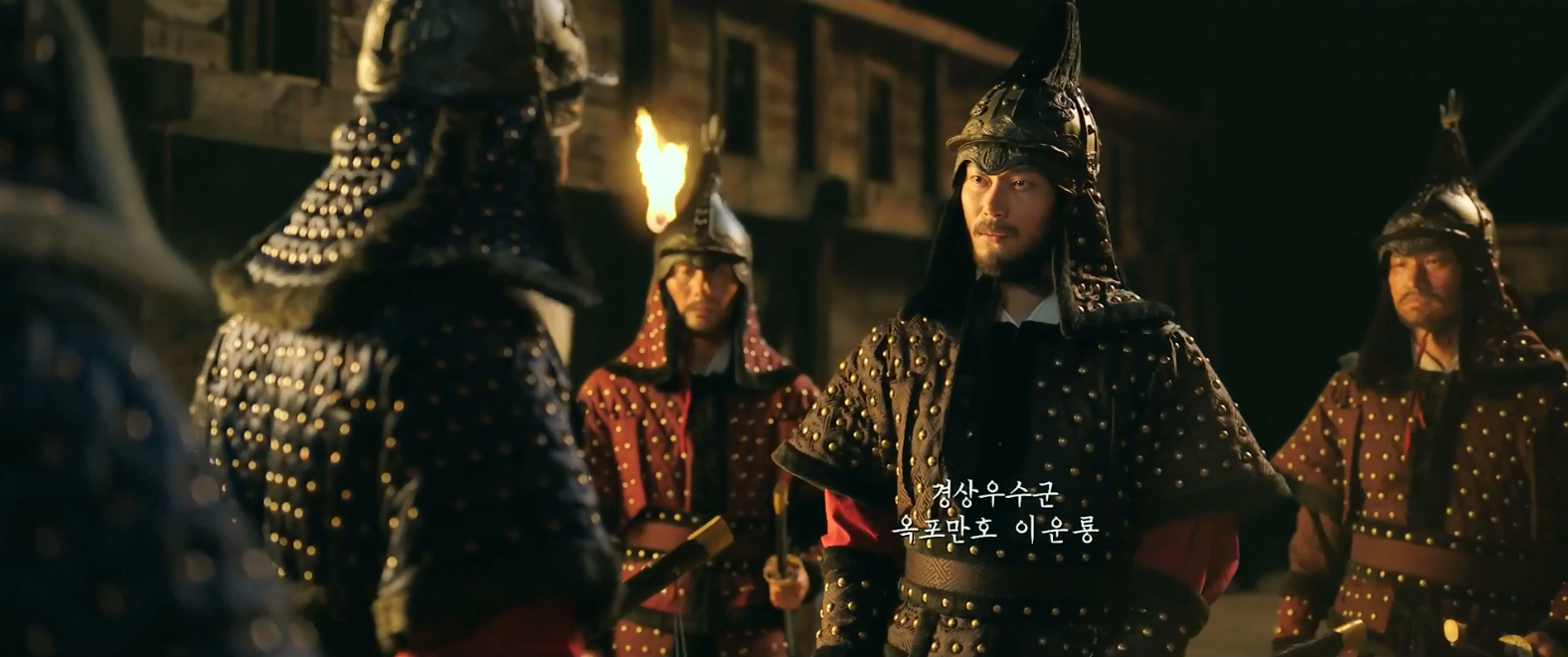
A bit of running joke: Hey, it's commander Yi Ung-ryong (이운룡 or 李雲龍) again! Reprised by the same actor! For reasons unknown he is always the first Joseon commander I recognise.
Noryang: Deadly Sea revolves around the titular Battle of Noryang, the last major battle of Imjin War and the climax of the entire war. This makes it a much easier battle to adapt into a good story/movie, which allows the movie to be largely (albeit not completely) free of the numerous narrative problems that plagued Hansan: Rising Dragon. This is not to say Noryang: Deadly Sea is superior to its prequel, however. In many ways, it is worse.

(Major spoilers ahead, be warned!)

Production issues

The perk of Hanzi writing system: Korean and Chinese communicating by writing is both historically accurate and a great chance to have narrator and actors speak Korean without looking out of place. Unfortunately, the director insisted on using cringe Chinese even when Chinese characters are not verbally communicating. 
Production issues are the least of the movie's many problems, so I am going to mention them first. My first complaint about Noryang: Deadly Sea is that the Chinese language in this movie is atrociously cringe to a native speaker, to the point that I must pause the movie to clear my head every time anyone speaks any Chinese. To be fair, this isn't really a production issue per se (all actors are Korean so it's understandable that they can't speak Chinese), although the production team really should consider hiring some Chinese actors or just dub over the Chinese part.

Yi Sun-sin vomiting blood.
Personal gripe with the language aside, there are definitely some pacing issues with the movie. This is particularly egregious during a scene where the titular character, Yi Sun-shin (이순신 or 李舜臣) suddenly sees hallucination of his deceased son, calls out the names of his comrades one by one as if bidding farewell to them, and vomits blood out of nowhere—BEFORE he was fatally shot by a Japanese gunner. I have a sneaking suspicion that executive meddling forced the director to pad out the length of his movie to the detriment of storytelling. In any case, pacing issues will likely be fixed if the director later releases a Redux/director's cut version of the movie like he did for Hansan: Rising Dragon.

Ming soldiers beating Japanese captives to a pulp.
Thirdly, remember that I said I enjoyed the build-up portion of Hansan: Rising Dragons for all the wrong reasons? Well, the build-up portion of Noryang: Deadly Sea is largely free of the narrative issues of its prequel, but this ironically means that it now bores me to death, as I no longer have any reason, not even wrong one, to enjoy this convoluted mess. I am not even sure if the flashback and minor plot of Yi Sun-sin's dead son is really necessary when the central theme of the story isn't that of personal vendetta, but "to end the war on our terms we must pursue the enemy to the very edge of the (Japanese) archipelago.". Speaking of which, I am well aware this that this is a nationalistic movie and all, but surely such vindictive message can't be the right moral to convey to the audience?

Sea of inferno: Battle of Noryang on the silver screen

Joseon fleet splitting the Japanese fleet in two. Depiction of pre-modern naval battle of such scale, in complete darkness no less, is probably an industry's first.
Historical accounts of Battle of Noryang are rather light on finer details, which give plenty of room for creative liberty. For example, there's nothing in the historical records that describes the Koreans deploying hwacha during this battle, or the Japanese using captured cannons to sink turtle ships, but there's nothing to suggest they DIDN'T either. Thus, free from historical restrictions such as Yi Sun-sin's famous Hak Ik-jin (鶴翼陣), the director was able to let his imagination run wild, and I commend him for delivering such blood-pumping battle sequences. Moreover, barring a few exceptions all characters acted in a mostly logical and coherent manner, and the battle tactics and counter-tactics sensible and convincing, both of which make for an enjoyable watching experience. Regrettably, later portion of the naval action was overshadowed by overly drawn-out, soap opera-esque montages of Yi Sun-sin's final moments and death, although this doesn't detract from the fact that it was great while it lasted.

Nevertheless, despite the enjoyable battle scenes, there are indeed some exceptions, or one might say plot holes, that detract from the overall story. Chief among them are the war fleet of Konishi Yukinaga (小西行長), Chen Lin acting out of character, and the battle that ends at dawn. They will be elaborated below:

Konishi Yukinaga's pristine war fleet

Konishi Yukinaga's fleet.
The story begins with Konishi Yukinaga holed up inside Suncheon Castle due to a joint Ming-Joseon naval blockade, with supply running so low his soldiers were on the verge of resorting to cannibalism. If that is the case, then where did he find/hide such a massive fleet of warships? And why didn't Yi Sun-sin do something about these ships before they become a problem, i.e. destroy them during the blockade?

Chen Lin acting out of character

Chen Lin ordering Ming navy to attack.
In this film, Ming admiral Chen Lin is portrayed as a calculating coward that took bribes and spent the better part of the film trying to distance himself from Yi Sun-sin's war to avoid more bloodshed. Yet during a crucial moment he suddenly ordered Ming navy to press the attack seriously, only to end up with his own flagship boarded by the Japanese. This abrupt change of mind is entirely out of character for Chen Lin's risk-averse portrayal up until that point, and it appears that the director forcibly handed him an idiot ball for no reason other than to set up a "Yi Sun-sin heroically save the Ming admiral from danger" moment.

The battle that ends at dawn

Yi Sun-sin's plan to annihilate Shimazu Yoshihiro's fleet before dawn.
Having the epic struggle to be over by daybreak gives a nice touch of symbolism, signifying the nightmare that terrorised Korea for the past seven years is finally over, and new hope arise. Historically, the turning point of  Battle of Noryang also happened around dawn (although the battle itself continued well into the morning), so that checks out. So why is this a problem?

Shimazu Yoshihiro's subordinate urges him to retreat because "time is running out".

Konishi Yukinaga sounds the retreat, leaving Shimazu Yoshihiro out to dry.
Well, the time when the battle ended isn't a problem. It's only when Yi Sun-sin explicitly set a time limit that he must defeat the Japanese before dawn, Shimazu Yoshihiro became increasingly agitated as daybreak drew near, and Konishi Yukinaga acted as if he was too late after arriving at the scene by dawn, that it become problematic. Why? Because while the battle happens to be over by dawn, there isn't any particular reason that it couldn't, or shouldn't, go on for longer. In essence, by racing against this arbitrary time limit, the characters both good and bad are making decisions based on out-of-story knowledge they couldn't possibly know.

As to why serious plot holes like this can crop up in an otherwise fairly coherent story, this brings me to my next point...

Stolen shine: a sad attempt at ego-boosting

Yi Sun-sin beating the war drum.
At its core, Noryang: Deadly Sea is a nationalistic flick under the guise of historical movie. Attempts to shape the titular hero Yi Sun-sin into a saint among men, and to a lesser extend make the Koreans look good and heroic while everyone else either bad or helpless, permeate throughout the story, dialogues, and character portrayals, some overt, other indirect and subtle. Naturally, in such work historical realities are more of a hindrance than a boon. They are inconvenient truth that must be distorted to serve the narrative, not the other way around.

Shimazu Yoshihiro reading the secret letter sent to him by Konishi Yukinaga.
To illustrate, in a secret letter Konishi Yukinaga warned Shimazu Yoshihiro that Yi Sun-sin might counter-invade Japan after the war. This obviously untrue statement may appear to be just another off-handed chest thumping to make Yi Sun-sin look good and Joseon Kingdom appear more powerful than it really was (which is usually par of the course for a nationalistic movie but relatively harmless, although not in this case), however it actually underpins much of the history distortions that shape the movie's story, and the plot holes that come with such alterations. 

You see, in the historical version of Battle of Noryang, Konishi Yukinaga simply packed up and slipped away from Suncheon Castle while the battle raged on. However, in order to glorify Yi Sun-sin, the director made him a dangerous commander that the Japanese simply could not ignore (even after they lost the war), necessitating the antagonists to hatch a nefarious plot to defeat him, which in turn necessitating Konishi Yukinaga to conjure a war fleet out of thin air to threaten Yi Sun-sin with. Thus, a plot hole came into being. 

It also necessitates Yi Sun-sin using decoys to delay Konishi Yukinaga, rather than...you know, smash his idle fleet before he had a chance to use it.
Likewise, that Chen Lin was the supreme commander that led the allied navy to victory during Battle of Noryang, and Ming navy actually did most of the legworks during the battle, are all inconvenient historical facts to the director's story that must be written off/away. There's a reason why Battle of Noryang played out so differently from Yi Sun-sin's other naval victories, for instance the unusually heavy use of incendiary weapons, little aversion to boarding combat, and the main artillery being Chinese Hu Dun Pao (虎蹲砲) rather than the usual Joseon Chongtong (총통 or 銃筒). But nope, can't have that, Yi Sun-sin must hoard all the spotlights! So Chen Lin is portrayed as a coward that tried to avoid battle at all cost, while Chinese Huo Qiu (火毬) and Pen Tong (噴筒) are being replaced by unimaginative oil pots hand-thrown by Joseon troops then ignited with fire arrows. 

Had Chen Lin not been portrayed as a coward, the scene where his ship was boarded by the Japanese and he was saved by Yi Sun-sin would've flowed far more naturally. Unfortunately, the director wanted to have his cake and eat it too, so he forced Chen Lin to abruptly change from a coward to a Leeroy Jenkins in the span of like two scenes, so that Yi Sun-sin can look good by heroically saving his inept Chinese ally from danger, plot hole be damned. Historically, it was Yi Sun-sin's ship that got surrounded by the Japanese first, then Chen Lin charged in to save Yi Sun-sin, only to cause the Japanese to switch target and surround him instead. The freed Yi Sun-sin then returned to help Chen Lin, and the two fought side by side until dawn. Alas, such moving tale of fire-forged camaraderie, butchered into a plot hole-ridden ego boosting.

And what about the dawn?

The breaking of the dawn.
By itself, various characters in the movie subconsciously racing against an arbitrary time limit is a relatively minor problem, more of a director oversight or dialogue slip than a story-ruining plot hole. However, the fact that such oversight can exist in the first place shows that the director probably did his historical homework—but chose to discard historical events that inconvenience his narrative anyway. Why? Because one notable event did take place at dawn—Deng Zilong (鄧子龍) came in gun blazing and saved the day!

Deng Zilong, an old soldier by the time of his death (he used to be a commander but was demoted to the rank of common soldier before entering Korea), was the last of the major characters to join the fray, but the first to set fire to Japanese warships. His success prompted Chen Lin and other Ming ships to follow suit with their own incendiary weapons, and this was what caused the Japanese to finally break ranks and flee. Unfortunately, his ship was hit by friendly fire during pursuit, and the ensuing chaos allowed Japanese troops to board the vessel and kill nearly all hands aboard. Due to Deng Zilong's low rank (at the time) and relative obscurity, the Japanese didn't realise they had killed someone of significance until centuries later, so no one at the time claimed credit for his death. 

Deceased son ex machina
Drum-inflicted PTSD.
Bah, can't have that either. There's no way the director will allow another heroic sacrifice to detract from Yi Sun-sin's own, so nothing in particular happened at dawn in the film (despite everyone keeping track of the time limit). Well, nothing except Yi Sun-sin suddenly saw a vision of his deceased son who prompted him to start beating the war drum, and this inspired the good guys to fight harder while inflicting a psychological meltdown on the villain Shimazu Yoshihiro so horrid he ran to cower in his room and literally start vomiting (no really).

Deng Zilong getting his head sliced off by Shimazu Yoshihiro.
As for Deng Zilong, he was reduced by director to what can be described as "Yi Sun-sin's believer", an inferior who was "redeemed" and was so devout to the hero that he put him above all others and strove to emulate him, going so far as to confronting his own superior and attacking without order. Too bad the hero's imitator is not the hero himself, so Deng Zilong died an unceremonious death without accomplishing anything.

Chen Chan died a speed bump to Shimzau Yoshihiro's villainy.
Shen Li getting shanked by Japanese troops.
Moreover, as if Deng Zilong's death still wasn't enough to rub it in, the director then decided to kill off minor Ming commander Chen Chan (陳蠶) to re-emphasise Chinese incompetence, and make another minor Ming commander Shen Li (沈理) undergo some kind of foxhole conversion (except he didn't convert to Christianity but to Yi Sun-sin), and found redemption in valiant death—better to die fighting like a Korean than live like a coward! Never mind that both of them survived the war, and Chen Chan even stayed in Korea for two more years (he returned to China in 1600). Because why let history get in the way of the stirring tall tale of our lord and saviour Yi Sun-sin?

I know, Noryang: Deadly Sea is a nationalistic movie, so some measures of embellishment and glorifications of the titular hero are inevitable. But doing it in such blatantly denigrating manner, even to allies, it just seems so uncouth...tactless and petty.

Further reading

My patrons get an one month early access to the additional commentary and trivia that I've write for this movie, which is now open to public and can be accessed here! If you like my work, please support me via Patreon!

An exclusive brief overview of Yi Sun-sin's contribution to Imjin War article is also available to my Supporter-tier Patrons!

28 January 2024

Du Huo Fei Pao (毒火飛砲)

Drawing of a paper fuse (top right), paper sealing tube (middle right), wooden fuse (top bottom), shell casing (top left) and bombard (bottom left), from 'Wu Bei Ji Yao (《武備集要》)'.
Du Huo Fei Pao (毒火飛砲, lit. 'Poisonous fire flying cannon') was a bombard-launched explosive shell designed to be launched from Wan Kou Pao (碗口砲, lit. 'Bowl-muzzle cannon'), an ordinary stone-throwing bronze bombard already in widespread use since the founding of Ming Dynasty.

First appeared in late 15th/early 16th century and entered mass production by 1544 at the latest, Du Huo Fei Pao was a spherical cast iron shell filled with black powder and up to five liang of sulfur, arsenic and other poisonous substance/irritants (hence the name "poisonous fire"), and was equipped with a fuse known as Mu Xin (木信, lit. 'Wooden fuse'), which consisted of burning fuse(s) winded around a screw-threaded wooden rod and sealed inside a thick paper tube to prevent premature contact between the fuse and bursting charge inside the shell. A cleverly designed ignition device, Mu Xin allowed for easy adjustment of time-delay before detonation through increasing or decreasing the number of threads on the wooden rod (and thus the length of the burning fuse).

Despite its ingenuity, Mu Xin did have some drawbacks, namely It was a fairly complicated device assembled from three different components (burning fuse, wooden rod and paper tube), not to mention hand-carving screw threads onto a wooden rod took considerable amount of skill and time. Fortunately, an alternative that offered similar level of consistency whilst being far easier to made was later discovered. Known as Zhi Xin (紙信, lit. 'Paper fuse'), this alternative fuse was simply the motor part of a Chinese rocket being adapted into a fuse.

EXTRA: Bigyeok Jincheonroe (비격진천뢰 or 飛擊震天雷)

Drawing of a large Bigyeok Jincheonroe, from 'Yungwon pilbi (《융원필비》 or 《戎垣必備》)'.
Bigyeok Jincheonroe was a cast iron shrapnel shell invented in Joseon Dynasty Korea by weapon engineer Yi Jangson (이장손 or 李長孫) in 1591, and proved instrumental in the liberation of Gyeongju city from Japanese invaders during Imjin War that broke out one year after its invention.

Named after another Chinese weapon, Bigyeok Jincheonroe bore a striking resemblance to Du Huo Fei Pao even down to design of the fuse based on screw-threaded wooden rod, which suggests that its invention may be inspired by Du Huo Fei Pao. Nevertheless, there were some notable differences between the two as well, chief among them material of the sealing tube—the Koreans used a bamboo tube whereas the Chinese used a paper tube—which likely influenced the design of the fuse hole as well. Specifically, Bigyeok Jincheonroe had a large rectangular fuse hole with a matching iron lid, but this was not found on Du Huo Fei Pao (which had a normal round fuse hole). This was due to the fact that bamboo is relatively rigid and smooth-surfaced, which may cause the fuse to slip out of the hole if it is not pinned in place by the iron lid. In contrast, paper is supple and coarse and serves as natural wadding, allowing the fuse to fit snugly into the hole like a stopper.

Bamboo sealing tube (left), iron lid (middle), and bomb casing of a Bigyeok Jincheonroe with a squarish fuse hole (right).
Interestingly, the Koreans also never appeared to adopt the more convenient Zhi Xin fuse.

28 November 2022

Movie review: Hansan: Rising Dragon


As someone with a deep interest in Imjin War, I actually enjoyed Hansan: Rising Dragon way more that I thought I would, even though objectively speaking Hansan: Rising Dragon isn't nearly as good as its critically acclaimed previous installment, The Admiral: Roaring Currents. The main reason, I think, is because I only had passing knowledge about Imjin War back then, so my excitement of watching historical events unfold in the movie wasn't as high as I do now.

My first "ha, I know that guy!" moment to the film is the debut of young naval commander Yi Un-ryong (이운룡 or 李雲龍). If only he was as heroic and good-looking during Siege of Ulsan as he did in this film...
As with most big-budget Korean films, production quality of Hansan: Rising Dragon is top notch, and I dare say in general Korea produces far better historical epics than both China and Japan. That said, the director Kim Han-min really picked a difficult battle to adapt. Whereas The Admiral: Roaring Currents focus on the struggle of Yi Sun-sin (이순신 or 李舜臣) against overwhelming odds during Battle of Myeongnyang, which greatly humanised the legendary hero and makes for a compelling story, Hansan: Rising Dragon is set during Battle of Hansan Island, of which the Koreans smoked the Japanese without much trouble, and there wasn't much of anything interesting to tell. Throughout the film I can really see the director pulls out all the stops and crammed as many artistic licenses as possible just to make the story more palatable. This ironically makes the planning, espionage and build-up of the first half far more interesting and entertaining to me than the climactic naval action of the second half, and for all the wrong reasons.

(Major spoilers ahead, be warned!)

19 May 2016

Some random mythbustings

There are many false information about Ming Dynasty military (and ancient Chinese military in general) floating around on the internet. Here are some of the more well known ones, and the truth behind these myths.

Myth 1. Rattan shield is bulletproof.

Qing Dynasty Rattan Shield
A Chinese rattan shield, late Qing (Boxer rebellion) period. (Source: Zemanek-Münster)

8 November 2015

101st Post: Commonly available visual references for Ming army (and why you shouldn't trust them)

This blog post was originally meant to be part of my 100th post rant, but that one kind of drag on for too long, so I decided to write a separate one. 

I think I have to apologise beforehand if my tone in this blog post sounds too condescending. I know most illustrators are not historians, and it's very hard to reconstruct a historically accurate illustration with the information (which erred plenty) given to them. With that in mind, I have to say they had done a commendable job bringing the past to life.

Men-At-Arms 251 Medieval Chinese Armies 1260 - 1520
Even though I know Wu Bei Zhi (《武備志》) is usually the go-to resource for researching Ming Dynasty military, I still find it odd to use a seventeenth century military manual as the reference to research and reconstruct Ming army of the fourteenth and fifteenth century. Then again, we have very few pre-sixteenth century sources to work with.


PAGE E
Ming Light Infantry

29 October 2015

Shen Qiang (神鎗)

Early Ming variant

Ming Dynasty Handgonne
Drawing of a dart-shooting Shen Qiang, from 'Wu Bei Zhi (《武備志》)'.
Shen Qiang (神鎗, lit. 'Divine gun' or 'Divine spear'), also known as Shen Ji Chong (神機銃, lit. 'Divine engine gun') and Shen Ji Huo Qiang (神機火鎗, lit. 'Divine engine fire lance'), was a  handgonne of the early Ming Dynasty. It was primarily designed to shoot a heavy metal-tipped dart made of Ceylon ironwood, said to be powerful enough to punch through two men and a horse at the same time, although it could also shoot lead shots or shrapnel.

24 September 2015

Unique weapon of the Ming Dynasty — Zhu Ge Nu (諸葛弩)

Repeating crossbow is one of the unique inventions of China. Although the invention is commonly attributed to Zhu Ge Liang (诸葛亮), the basic design actually predates him by several centuries.

Liang Shi Bing She Lian Fa Nu (兩矢并射連發弩, lit. 'Double-shot rapid fire crossbow')

Chu State Repeating Crossbow
Earliest surviving example of a repeating crossbow, excavated from a Chu tomb. Currently kept at Jingzhou Museum.

15 September 2015

Bian Jian (邊箭)

MINOR UPDATE OCTOBER 9, 2024


Ming Chinese Majra Solenarion
Drawing of a Bian Jian, from 'Bing Lu (《兵錄》)'.
A Bian Jian (邊箭, lit. 'Border arrow' or 'Side arrow'), formerly known as Tong Jian (筒箭, lit. 'Tube-arrow') during Tang period, was a special short arrow that had a long history of use in China. Designed to be used in conjunction with an arrow-guide/overdraw device, the tiny arrow could achieve a much higher velocity and range compared to an ordinary arrow, and therefore difficult to spot and even harder to dodge. Furthermore, it could not be reused by the enemy unless they brought arrow-guides of their own.

2 August 2015

Fei Meng Pao (飛礞砲)

Ming Chinese Hand Mortar
Drawing of a Fei Meng Pao, from 'Wu Bei Zhi (《武備志》)'.
Fei Meng Pao (飛礞砲, lit. 'Flying lapis stone cannon') was a type of handgonne that shot a small iron canister grenade instead of the usual stone or lead ball. It can be considered a primitive predecessor to hand mortar and grenade launcher.

1 July 2015

Interesting comparison between different warships of the Far East in the sixteenth and seventeenth century

I came across this interesting comparison at Baidu Tieba, although the original post has since been deleted. The original comparison is a simple table written entirely in Chinese, so I translated the table to English and added a few commentaries.


Weight of Cannon (lbs)*
<500
500
1000
1500
2000
3000
4000>
Sixteenth Century Portuguese Galley
34+


Ming Dynasty Feng Zhou (early)
30+


Ming Dynasty Feng Zhou (late)
14+


Mark 1 Warship of Qi Ji Guang's fleet (early)
9+1


Mark 1 Warship of Qi Ji Guang's fleet (late)
14+
2


Tekkōsen
48 – 70
3


Geobukseon**
20 – 30+


Advanced Ming Dynasty War Junk
30+14 – 22

6 – 8
Koxinga-era Gong Chuan
100 – 200+20+


1
Dutch Hired Vessel 'Graaf Hendrik'
??810882
Mông Đồng


1 – 2
* Although weight of shot is a more reliable measure of firepower, Chinese records seldom mention them. Chinese gunners also frequently loaded their guns with multiple smaller shots in addition to the main shot (which made them less powerful), making measurement purely by weight of shot very misleading.
** This assume a late variant of Geobukseon/Turtle ship with significantly improved armaments, due to the fact that very little is known about the early, Imjin War-era Geobukseon.

Feng Zhou (封舟, lit. 'Investiture ship')

Chinese Feng Zhou
A Qing Dynasty Feng Zhou, from 'Ce Feng Liu Qiu Tu (《冊封琉球圖》)'.

14 April 2015

Rocket carts of the Ming Dynasty

IMPORTANT UPDATE NOVEMBER 15, 2024


Ever since the founding of Ming Dynasty, the Chinese had been an avid user of rocket weapon. Early Ming Dynasty rocket cart could have an upward of six hundred rockets, but subsequent redesigns reduced the number of rockets to make the cart more mobile.

Huo Jian Che (火箭車, rocket cart)

Ming Chinese Multiple rocket launcher
Drawing of a Huo Jian Che, from 'Si Zhen San Guan Zhi (《四鎮三關志》)'.

Random Quotes & Trivia

GREAT MING MILITARY © , All Rights Reserved. BLOG DESIGN BY Sadaf F K.