Showing posts sorted by date for query Qi Ji Guang. Sort by relevance Show all posts

17 April 2026

The Great General Cannon of the Ming Dynasty

Bombard-type Great General Cannon (bottom right) and its various sub-types. Illustration taken from 'Si Zhen San Guan Zhi (《四鎮三關志》)'. 
The Great General Cannon, known in Chinese as Da Jiang Jun Pao (大將軍砲), stood as one of the Ming Dynasty’s most powerful indigenously developed artillery pieces. The name encompassed a class of heavy cannons that evolved over the dynasty's course, with several distinct types emerging as a result of both improvements to and evolution of the original design, and the introduction of new designs that gained popularity and adopted the same name.

The principal variants that emerged under this name are examined in the sections below:

1. Cast Bronze Great General Cannon (Bombard Type)

(Early to mid-Ming Dynasty — up to around 1584)

The bombard-type Great General Cannon was representative of the early and original variant of indigenous muzzle-loading cannon. It was typically made from cast bronze, though occasionally from cast iron, and featured a roughly bottle-shaped profile.

A cast-bronze bombard, probably a "Shorty General", preserved in Xuzhou Museum.
The cannon featured a nearly untapered profile and lacked a flared muzzle, with several reinforcing rings cast integrally along its length to strengthen the barrel against the pressures of firing, and optional lugs for lifting rings similarly cast as part of the barrel for easier handling and positioning. At the rear, a bulbous section served as an enlarged powder chamber. At the base was a flat, flared foot, which enabled the cannon to stand vertically for cleaning and reloading — a standard practice for Chinese muzzle-loaders, which were handled upright rather than horizontally.

A rare cast-iron version of the bombard-type Great General Cannon, preserved at Dingzhou Ancient City. Source
The bombard-type Great General Cannons were graded hierarchically using a typical numerical system: the largest and heaviest cannon was designated Da Jiang Jun (大將軍, lit. 'Great General'), followed by Er Jiang Jun (二將軍, lit. 'Secondary General') or Sai Jiang Jun (賽將軍, lit. 'Near-matching General'), then San Jiang Jun (三將軍, lit. 'Tertiary General') or Ai Jiang Jun (矮將軍, lit. 'Shorty General'), reflecting descending tiers of length, weight, calibre, and firepower within the class.

A cast-iron "Shorty General" bombard, preserved at Dingzhou Ancient City. Source
Regrettably, most surviving cast bronze bombard-type Great General Cannons are small to medium sized, whereas ironically a handful of large-sized cast iron examples have survived despite iron being rarer in this form. This difference likely stems from bronze being more valuable and more easily re-smelted or recycled than iron. Based on surviving examples, bombard-type Great General Cannons range from 50 cm to 180 cm in length, 35 kg to 600 kg in weight, and 6 cm to 25 cm in bore size, although written records mention some as long as 7 chi 2 cun (roughly 230 cm). Nevertheless, from the surviving cast-iron specimens, lengths around 170 cm and bore sizes around 20 cm appear typical for full-sized bombard-type Great General Cannons.

1.1 Wu Di Da Jiang Jun (無敵大將軍)

(Around 1560 — early seventeenth century)

The Wu Di Da Jiang Jun (無敵大將軍, lit. 'Invincible Great General') and its slightly smaller-bore naval/Southern China variant, the Wu Di Shen Fei Pao (無敵神飛砲, lit. 'Invincible Divine Flying Cannon'), represented a significant evolution from the original bombard-type Great General Cannon. These breech-loading designs drew direct inspiration from the Fo Lang Ji (佛朗機) guns — Portuguese-style breech-loaders that had spread from Europe to China in the early 16th century. Designed by the renowned Ming commander Qi Ji Guang (戚繼光), the Wu Di Da Jiang Jun retained much of the original barrel profile but replaced the bulbous powder chamber with an open breech to accept detachable, mug-shaped loading chambers, sacrificing some raw firepower in exchange for markedly easier handling and a substantially higher rate of fire. These chambers were typically forged from wrought iron and fitted with reinforcing hoops for added strength.

Since upright reloading was no longer necessary, the flared foot of the original bombard-type Great General Cannon was removed or, in some cases, replaced with an additional lug for lifting ring similar to those sometimes fitted on other parts of the barrel.

A Wu Di Da Jiang Jun, from 'Lian Bing Shi Ji (《練兵實紀》)'.

To date, no surviving Ming cannon has been definitively identified as a Wu Di Da Jiang Jun, even though numerous breech-loading cannons from the period — including some exceedingly heavy pieces — have survived. As a result, its precise dimensions, bore size, and shot weight remain largely unknown. Written records, however, give an approximate barrel weight of roughly 1,000 jin (about 597 kg), a chamber weight of roughly 50–150 jin (about 30–90 kg), and a powder charge of 4–6 jin of gunpowder (about 2.4–3.6 kg) per shot, indicating that it was scaled to match the heaviest class of bombard-type Great General Cannons. Unlike the earlier muzzle-loading bombard-types, the Wu Di Da Jiang Jun typically fired hundreds of iron pellets as its primary ammunition, propelled with the aid of a wooden sabot; for naval combat, it could also employ a mixed load of a single stone cannonball combined with a reduced amount of iron pellets.

2. Forged Wrought Iron Great General Cannon

(Around 1584 — end of the Ming Dynasty)

Designed by military innovator Ye Meng Xiong (葉夢熊) around 1584, the wrought-iron Great General Cannon, also called Da Shen Pao (大神砲, lit. 'Great Divine Cannon') and Ye Gong Shen Chong (葉公神銃, lit. 'Lord Ye's Divine Gun'), was created by redesigning the wrought-iron loading chamber of the earlier Wu Di Da Jiang Jun into a single, full-length standalone cannon, adapting existing expertise in forging wrought-iron guns such as the Hu Dun Pao (虎蹲砲) to a significantly heavier artillery piece.

Wrought-iron type Great General Cannon displayed atop the Great Wall at Juyongguan Pass.
Constructed entirely from wrought iron, this type of Great General Cannon featured a nearly untapered profile and lacked a flared muzzle, though a reinforcing hoop protecting the muzzle created the subtle appearance of one. Its barrel was girded along its length by a series of forged wrought-iron hoops that could optionally incorporate trunnions, lifting rings, or simple iron sights — replacing the integrally cast reinforcing rings of earlier bombard-type designs — while the breech featured a distinctive abacus-bead-shaped enlargement that formed a reinforced powder chamber. The cannon retained its characteristic flared foot — now made slightly taller — to facilitate stable upright reloading, although it was now also designed for mounting on a gun carriage and could be loaded horizontally.

3D render of a wrought-iron type Great General Cannon mounted on a Ming-style gun carriage. From 《中国古代兵器大百科》.
Cannons of this type were graded hierarchically using characters from the Thousand Character Classic and the Yijing: the largest and most powerful was designated Tian Zi Hao Da Jiang Jun (天字號大將軍), followed in descending order of size, calibre, and firepower by Di Zi Hao Da Jiang Jun (地字號大將軍) and Xuan Zi Hao Da Jiang Jun (玄字號大將軍). A fourth grade, called Ren Zi Hao Da Jiang Jun (仁字號大將軍), also existed, which was seemingly comparable to Tian Zi Hao Da Jiang Jun. Far more examples of this type have survived than of the earlier bombard-type, making it the most representative variant of the Great General Cannon. Most surviving specimens measure between 110 cm and 195 cm in length, with bore diameters ranging from 8 cm to 14.5 cm and weights from 88.5 kg to 300 kg — though written records indicate that some reached as much as 600 kg. Many surviving examples are around 140–145 cm long, with bore diameters typically in the 11–12 cm range.

The wrought-iron Great General Cannon represented a revolution in indigenous Chinese artillery technology. Unlike Western wrought-iron guns, which were typically constructed using thin longitudinal iron staves bound together by shrunk-on hoops, Chinese wrought-iron cannons employed a fundamentally different forging method: multiple curved iron plates (either two or four per layer) were forge-welded together over a solid cylindrical mandrel to form an initial tube segment, with the seams slightly overlapped rather than butted edge-to-edge for added strength and better weld integrity. Additional layers of curved plates were then applied — seams carefully offset between successive layers — until the barrel reached the desired wall thickness. Multiple shorter tubes produced in this manner were subsequently forge-welded end-to-end to achieve the full desired barrel length, after which the assembled barrel was carefully cold-worked and ground to refine the bore, smooth the interior surface, and ensure uniformity, before reinforcing hoops were added.

Left: Boxted Bombard with visible inner stave seams. Right: A Great General Cannon preserved in Korea, brazenly arrogated as a Korean invention.
Compared to the Western hoop-and-stave method — which suffered from bore inconsistencies due to stave misalignment, long continuous longitudinal seams prone to splitting under pressure, risk of hoop failure over time, and uneven stress distribution that could cause sudden catastrophic bursting—the Chinese layered-plate approach produced a more monolithic, uniform, and resilient barrel with superior resistance to hoop stress and reduced risk of longitudinal failure, while also cutting down on overall weight compared to equivalent cast bronze or cast iron guns. Despite being called a “wrought-iron” gun, the metal used in forging the barrel of the Great General Cannon can actually be considered low-carbon steel; only the reinforcing hoops were true wrought iron. This enabled the wrought-iron Great General Cannon to deliver exceptional power for its weight: typical examples (with bore diameters around 11–12 cm) could be loaded with 1.2–1.5 kg of gunpowder per shot, propelling cannonballs weighing as much as 5 kg (roughly 11 pounder), although it was more typically loaded with a bore-matching lead or iron cannonball plus smaller grapeshot and lead/iron pellets to increase the total projectile weight, combining the penetrating power of the solid ball with the wider anti-personnel spread of the scatter load. In fact, it was later discovered that the cannon was so overbuilt that its reinforcing hoops weren't even needed and had become dead weight, leading to the development of a hoopless version called the Wei Yuan Pao (威遠砲).

2.1 Long-barrelled Great General Cannon

(Probably around 1620 — end of the Ming Dynasty)

For most of the Ming period, heavier Chinese artillery typically functioned as a superheavy regimental gun: lightweight and mobile, offering firepower comparable to a full-sized field piece, yet relatively short-barrelled and short-ranged. These cannons were deployed when the enemy breached the overlapping fields of fire from matchlocks, handgonnes, and lighter anti-personnel pieces, or served as a devastating close-range counter-charge weapon against advancing forces.

By the 17th century, however, the arrival of long-barrelled Hong Yi Pao (紅夷砲) — European-style muzzle-loading smoothbore culverins (many of which also bore the title “Great General Cannon” but were not recognised as a distinct class under that name) — combined with the growing military threat posed by the rising Jurchen/Manchu forces, brought about a renewed emphasis on accurate long-range fire. This change was mirrored in native wrought-iron cannons, which increasingly adopted length-to-bore ratios approaching those of European designs. Regrettably, the Ming Dynasty fell before this evolution of wrought-iron cannons could fully mature, and as a result there were only a few surviving pieces of these later designs.

A late Ming period long-barrelled wrought iron cannon preserved at Shanxi Province Art Museum.
The long-barrelled wrought-iron cannon preserved at the Shanxi Province Art Museum (pictured above) is one of the few surviving pieces from the late Ming period. It measures 260 cm in length, with a barrel diameter of 20 cm and a bore of 9.5 cm, giving a bore-to-length ratio of approximately 27:1. It has an untapered low-carbon steel barrel reinforced with seven wrought-iron hoops, lacks the abacus-bead-shaped powder chamber found on earlier wrought-iron Great General Cannons, and has a flat wrought iron rear cap instead of the flared foot. The cannon is uninscribed, so its exact forging date and location are unknown. Due to this (and lacking some characterising features), it is uncertain whether it is truly a Great General Cannon or another type of Ming wrought-iron cannon, although it certainly has the firepower to match and a longer range than a standard wrought-iron Great General Cannon, and is treated as one by researchers.

30 October 2025

Military systems and hierarchies of the Ming Dynasty — Part 2: Ying Bing System

Note: English translation of the titles are taken from Chinese-English Dictionary of Ming Government Official Titles, Third Edition, supplemented with some translations of my own.

Note that my own translations and translations taken from elsewhere are italicised.


As the Ming Dynasty began to decline in the sixteenth century, the Wei-Suo System also became increasingly dysfunctional. Corruption, land consolidation, and ever-increasing varieties of corvee labours placed a heavy burden on Wei-Suo servicemen, leading to rampant desertions among able-bodied servicemen, while those who remained were often too old or too weak to desert, and likewise unable to perform military duties. The ailing Wei-Suo System necessitated a reform to salvage the military preparedness of the Ming army, thus a new system known as Ying Bing System (營兵制) was introduced, so-named because soldiers were now organised into regiments known as Ying (營, lit. 'Camp, battalion') instead of Guards and Garrisons.

At its core, Ying Bing System was devised to better manage Mu Bing (募兵, lit. 'Recruited soldier')—a new type of hired soldiery that were recruited and paid a salary for the duration of a military campaign—on a more permanent basis. However, it'd be a reductive misinterpretation to view Ying Bing as some sort of mercenaries, and that the new Ying Bing System superseded the old Wei-Suo System.

In actuality, the bulk of Ying Bing regiments actually comprised of military household servicemen, and both systems ran in parallel and supplemented each others till the very end of the Ming Dynasty. Essentially, Ying Bing System took over the operational functions of the military, allowing Wei-Suo System to be shifted to a primarily administrative role. Under this new system, able-bodied servicemen were drawn from Guards and Garrisons and reorganised into battle-ready regiments, with any vacancies filled by civilian recruits and other sources. This also led to an interesting and unique phenomenon where hereditary military household servicemen, often referred to as Jun (軍, lit. 'Military', i.e. serviceman), and regimented soldiers, often referred to as Bing (兵, lit. 'Soldier'), were seen as two distinct but strongly overlapping entities during Ming period.

Nevertheless, since the Ying Bing System was introduced rather haphazardly as an ad hoc workaround for the ailing Wei-Suo System, and its initial implementation was immature and far from seamless, the system underwent continuous tweaking and refinement until the end of the Ming Dynasty, making it challenging to generalise.

As an institutionalised field formation, leadership positions of the Ying Bing System were directly dispatched and appointed by the central government, and denoted roles rather than formal titles. As such, none of the positions had either a rank or a salary, and it was not unusual for one person to assume several positions concurrently. In addition, there were also numerous one-off titles created for specific purposes.

1. Military Overseers

A unique aspect of the Ying Bing System was that its highest command echelon was dominated not by military officials but by civil officials, who assumed the role of military overseers. Initially, military overseers managed the strategic planning and administrative aspects of the military; however, some were soon granted authority to command military forces, even though planning and administration remained their primary responsibilities.

Military overseers with command authority recruited their soldiers independently of standard regiments, which were directly subordinate to them. These regiments, known as Biao Bing Ying (標兵營), were often made up of the cream of the crop of soldiers, trained to a comparable standard to Jia Ding (家丁).

Du Shi (督師)/Overseer of the Armed Force

Belatedly established during the final years of the Ming Dynasty, Overseer of the Armed Force was the highest-ranking military officer of the Ming Dynasty's military, and was granted the authority to command all military assets in a given theatre, usually four to seven Sheng (省), or provinces.

Overseer of the Armed Force was not a permanent position and could be appointed and dismissed on an as-needed basis, which, given the position's extensive geographical jurisdiction, usually meant the empire was facing a major crisis.

Jing Lue (經略)/Military Affairs Commissioner

A Military Affairs Commissioner was a high-ranking military overseer primarily tasked with coordinating military operations involving either the Japanese or the Jurchens/Manchu, and was granted authority to command Grand Coordinators and Regional Commanders involved in a given military campaign. Military Affairs Commissioner slightly outranked Supreme Commander, the next-highest position, although it lacked the authority to issue direct orders to Supreme Commander. On the occasions when both Military Affairs Commissioner and Supreme Commander were present in the same military campaign, decisions were made through discussion and collective agreement between the two.

Similar to Overseer of the Armed Force, Military Affairs Commissioner was not a permanent position and could be appointed and dismissed on an as-needed basis. By and large, this position was only needed when there was a wartime emergency or important military campaign.

Zong Du (總督)/Supreme Commander

A Supreme Commander was a senior military overseer with the authority to coordinate and command Grand Coordinators and Regional Commanders from two to three adjacent provinces, defence regions, or a combination of the two.

For the most part, Supreme Commander was also not a permanent position and could be appointed or dismissed on an as-needed basis, although there were some notable exceptions such as Supreme Commander of Liangguang (兩廣總督), Supreme Commander of Military Affairs in the Three Frontiers of Shaanxi (三邊總督) and a few others, which were functionally permanent posts.

Xun Fu (巡撫)/Grand Coordinator

A Grand Coordinator was a official tasked with overseeing the Provincial Administration Commission (布政司), Provincial Surveillance Commission (按察司), and Regional Military Commission of a designated area, usually but not always a province, thus making him functionally the highest-ranking governing official of that area. Unlike the Overseer of the Armed Force, Military Affairs Commissioner, and Supreme Commander, Grand Coordinator was not a strictly military position, although its responsibility and authority could be, and often was, further expanded to encompass military roles within its province, ranging from administrative and advisory positions to full authority to command Military Superintendents and Regional Commanders.

Originally an imperial auditor dispatched by the emperor to evaluate and, if necessary, intervene in the operations of provincial governments, the Grand Coordinator was made a permanent post with its own government office during mid-Ming period, as it was found to be effective in enabling the central government to exert direct control over its provinces.

Circuit official

A Dao (道), or circuit, was a supervising institution established by the provincial governments to oversee and monitor the operations of prefecture-level governments, although over time it also gradually assumed governing and administrative responsibilities. Many types of circuits existed, often with confusingly overlapping roles and responsibilities. However, by far the most common were Fen Shou Dao (分守道), or the General Administration Circuit, primarily responsible for administration, finance and taxation; and Fen Xun Dao (分巡道), or the General Surveillance Circuit, primarily responsible for law enforcement, public order, and governance oversight.

Regarding military matters, the circuit primarily responsible was Bing Bei Dao (兵備道), or the Military Defence Circuit, although it sometimes shared this role with General Administration Circuit and General Surveillance Circuit. Military Defence Circuit was charged with training Wei-Suo servicemen and militia, manufacturing and maintaining weapons and equipment, building and maintaining fortifications and city walls, managing logistics, soldier's pay, and military household farmlands, law enforcement and public safety, river and coastal patrols, fostering smoother cooperation between Wei-Suo System and Ying Bing System, and many more. During wartime, circuit officials served in a similar role as Grand Coordinator but in a lesser capacity, reporting to the former and assisting field commanders of lower ranks such as Vice Regional Commanders and Assistant Regional Commanders.

Less commonly, Xun Hai Dao (巡海道), or the Coastal Patrol Circuit, which was more specialised in coastal patrols, combating piracy, and regulating maritime trade, would also be involved in military affairs, especially against naval threats.

Military-related circuits also served an important secondary function—that is, serving in these circuits allowed low-ranking civil officials to accustom themselves to military matters early in their careers. This ensured that a cadre of military-trained civil officials was always available to serve, thereby reducing the likelihood of unqualified officials with no practical military experience being abruptly promoted into senior military roles.

2. Field Commanders

In contrast to military overseers, the role of field commanders was exclusively held by military officials. Their primary duty was to lead battlefield operations, with secondary responsibilities including overseeing training, maintaining fortifications, and even managing canal dredging.

Ti Du (提督)/Military Superintendent

A Military Superintendent was a commanding officer who was granted additional authority over military assets beyond his designated area of responsibility. Typically, this referred to a Regional Commander or Vice Regional Commander who also commanded a few Garrisons in an adjacent province (because a country's defence disposition does not always align with its administrative division), in such cases his original title took precedence as his primary responsibility outweighed his secondary one. However, for major military campaigns, a Regional Commander who was granted the title of Military Superintendent could even command other Regional Commanders subordinated to him, and in such cases he would adopt the title of Military Superintendent as his new primary title, although only for the duration of that campaign.

Elsewise, a Grand Coordinator who was granted full military authority over a province would also receive the same title (the title of Grand Coordinator still took precedence).

Zong Bing (總兵)/Regional Commander

A Regional Commander was a commanding officer with operational authority over a designated area, either a province or a Zhen (鎮), or defence region. Barring the provisional Military Superintendent, it was the highest attainable position for a military official.

The full title of a Regional Commander was actually Zhen Shou Zong Bing Guan (鎮守總兵官, lit. 'Region-defending commander'), with the prefix of Zhen Shou (鎮守, lit. 'Regional defence') indicating that he was responsible for the defence of the entire province or defence region. Naturally, a Regional Commander and the regiments under his command would be stationed at a fortress-settlement called Zhen Cheng (鎮城, lit. '[Defence] Region-city'), which also served as the military headquarters of the entire defence region.

A regiment under direct command of a Regional Commander was known as a Zheng Bing Ying (正兵營, lit. 'Orthodox soldier regiment'). However, after the practice of raising Biao Bing Ying became widespread, Regional Commanders also gradually switched to raising their own Biao Bing Ying.

Fu Zong Bing (副總兵)/Vice Regional Commander

A Vice Regional Commander, as the title suggests, was the second-in-command to the Regional Commander. The position came in two main types, one with the prefix Xie Shou (協守, lit. 'Assisting defence'), who was stationed together with and assisted the Regional Commander; the other with the prefix Fen Shou (分守, lit. 'Separate defence'), who guarded a sub-region within a defence region, called Lu (路), or route. Usually, a Sub-regional Vice Commander and the regiments under his command would be stationed at a smaller fortress-settlement called Lu Cheng (路城, lit. 'Route-city').

A regiment under direct command of a Vice Regional Commander was known as a Qi Bing Ying (奇兵營, lit. 'Unorthodox soldier regiment'). True to its namesake, Qi Bing Ying often engaged in unorthodox tactics such as ambush and flanking attack, and was considered the most elite among the standard regiments.

Can Jiang (參將)/Assistant Regional Commander

An Assistant Regional Commander was a commanding officer ranked below Vice Regional Commander, who advised and assisted the Regional Commander. Like Vice Regional Commander, it also came in Xie Shou and Fen Shou variety, although the majority were Sub-regional Assistant Commanders (i.e. Fen Shou prefix) that guarded either a single route or a strategic choke point (such as a major gateway of the Great Wall). An Assistant Regional Commander outranked a Mobile Corps Commander but did not have the authority to issue direct orders to the latter, as both answered only to Regional Commander.

A regiment under direct command of an Assistant Regional Commander was known as a Yuan Bing Ying (援兵營, lit. 'Succoring soldier regiment'), which focused on safeguarding its designated route, as well as supporting, reinforcing, and acting in concert with other regiments during a larger military campaign.

You Ji (游擊)/Mobile Corps Commander

A Mobile Corps Commander was a commanding officer who had no designated area of responsibility, and could be deployed anywhere within the defence region as the Regional Commander deemed fit. He also had limited authority to engage the enemy or reinforce other commanders at his discretion, without awaiting orders from higher command.

A regiment under direct command of a Mobile Corps Commander was known as a You Bing Ying (游兵營, lit. 'Roaming soldier regiment'), which functioned as a rapid response force.

Du Si (都司)/Supervising Commander

Originally a short form of Regional Military Commission, Du Si or Supervising Commander had since become a title of a military officer during mid-to-late Ming period, primarily responsible for leading and managing Zhong Jun (中軍, lit. 'Army of the Centre'), the headquarters unit of a regiment. Occasionally, Supervising Commander also served as either acting Assistant Regional Commander or acting Mobile Corps Commander.

Supervising Commander outranked Municipal Military Commander, despite the title being introduced later. It did not have the authority to issue direct orders to Municipal Military Commander.

Shou Bei (守備)/Municipal Military Commander

A Municipal Military Commander was a commanding officer who was responsible for the defence of a single settlement or fortress, and was usually stationed at a Wei Cheng, a Suo Cheng (i.e. existing Wei-Suo System fortress-settlements), or an even smaller fortress-settlement called Bao Cheng (堡城, lit. 'Fort-town'). Most Municipal Military Commanders were subordinate to an Assistant Regional Commander, although there were some that answered directly to the Regional Commander, or even Supreme Commander.

Soldiers under the command of Municipal Military Commanders were known as Shou Cheng Bing (守城兵, lit. 'City-defending soldier'), who were often drawn from Cheng Chao Jun (城操軍, lit. 'City-defending and drilling serviceman')— that is, Wei-Suo servicemen selected for city defence duty and underwent regular training, blurring the line between the two. Shou Cheng Bing were considered the lowest quality soldiers and rarely form regiments, although they still met minimum combat-capable standards. In time of need, Shou Cheng Bing also acted as a reservist force and provided replacement personnel for other regiments.

3. Junior Military Officers

Junior military officers were grassroots-level officers that assisted field commanders in various operational duties. They were appointed by the local Grand Coordinators or (rarely) Supreme Commanders, rather than the central government, and thus were not generally considered Jiang Guang (將官, lit. 'General-official') or "commander", although this wasn't a hard rule (Municipal Military Commander for example could be appointed by a Supreme Commander).

Since local Grand Coordinators or Supreme Commanders appointed their respective junior military officers, there was little standardization in their titles and responsibilities. Nevertheless, junior military officers could still be broadly grouped into two categories, namely Guang Ying Guan (管營官) and Shou Tu Guan (守土官), which will be elaborated below.

3.1 Guan Ying Guan (管營官)/Regiment-managing Officers

Regiment-managing Officers were junior military officers subordinate to their respective Regiment Commanders, responsible for leading small units, executing command orders, managing troop training and so on. Nevertheless, it should be noted that there was little standardisation at the regimental level, as different commanders organised and structured their respective regiments differently. There were also clear differences between regiments raised in North China and regiments raised in South China.

For example, unit hierarchy of the Qi Jia Jun (戚家軍) was as follow:
  • Wu (伍, five personnel) — Dui (隊, 12 personnel) — Shao (哨, 49 personnel) — Guan (官, 297 personnel) — Zong (總, roughly 940 personnel) — Da Ying (大營, roughly 4,000 personnel)
For comparison, Ji Defence Region Infantry Regiment led by the same commander was organised as follow:
  • Wu (伍, five personnel) — Dui (隊, 12 personnel) — Qi (旗, 37 personnel) — Ju (局, 112 personnel) — Si (司, 449 personnel) — Bu (部, 889 personnel) — Ying (營, 2,699 personnel)
This shows that there could be considerable variations between regiments, even those led by the same commander at different times. As such, the following list of Regiment-managing Officers only represented the most generic structure of a North China defence region regiment.

Ying Jiang (營將)/Regiment Commander

A Regiment Commander, as its name suggests, was a commanding officer appointed to lead a single regiment on behalf of a higher-ranked commander who had multiple regiments under his command, and thus could not personally lead each one. Usually, Regiment Commanders led Biao Bing Ying on behalf of military overseers, who generally lacked combat training.

(Note: Regiment Commander was not a junior military officer)

Zhong Jun Guan (中軍官)/Officer of the Army of the Centre

An Officer of the Army of the Centre was one of the positions that a Supervising Commander could hold, with the primary responsibilities of relaying orders from the commander to the rest of the regiment.

Zuo Ying Guan (坐營官)/Military Official on-duty

A Military Official on-duty was another position that a Supervising Commander could hold, the primary responsibilities of which were to manage and lead the regiment. Oftentimes, Officer of the Army of the Centre and Military Official on-duty were merged into one position, called Zuo Ying Zhong Jun Guan (坐營中軍官), and held by a single officer.

Qian Zong (千總)/Battalion Officer

A Battalion Officer typically commanded a military unit of two companies, totalling one thousand soldiers, called a Shao (哨, lit. 'Sentry'), or Battalion.

Ba Zong (把總)/Company Officer

A Company Officer typically commanded a military unit of ten platoons, totalling five hundred soldiers, called a Si (司, lit. 'Bureau') or Company.

Guan Dui (管隊)/Platoon Officer

A Platoon Officer typically commanded a military unit of ten teams, totalling fifty soldiers, called a Dui (隊) or Platoon. Sometimes a single platoon could have up to two Platoon Officers.

Wu Zhang (伍長)/Team Leader

A Team Leader commanded a small military unit of five soldiers, called a Wu (伍), or Team.


Other than troop leaders, there were also many specialist officers, including but not limited to:
  • Qi Gu Guan (旗鼓官, lit. 'Banner and drum officer'), an officer who managed the relaying of orders with flag and drum signals;
  • Qi Pai Guan (旗牌官, lit. 'Banner and badge officer'), an officer who managed communication with runners;
  • Tang Bao Guan (塘報官, lit. 'Scout officer'), a scout officer;
  • Shen Qi Ba Zong (神器把總, lit. 'Divine tool officer'), and officer who managed the firearms division and attached artillery.

3.2 Shou Tu Guan (守土官)/Territory-defending Officers

Territory-defending Officers were junior military officers subordinate to Municipal Military Commanders, and were tasked with defending various forts, fortlets, watch towers, and villages. They came in all sort of titles with little to no standardisation, including but not limited to:
  • Cao Shou (操守, Military Officer in Charge of Training and Defense Affairs)
  • Bei Yu (備禦, lit. 'Warder')
  • Ti Diao (提調, lit. 'Promoter')
  • Fang Shou Guan (防守官, lit. 'Defence officer')
  • Qian Zong (千總) and Ba Zong (把總), sharing the same titles with Battalion Officer and Company Officer respectively, but with very different duties.

24 November 2023

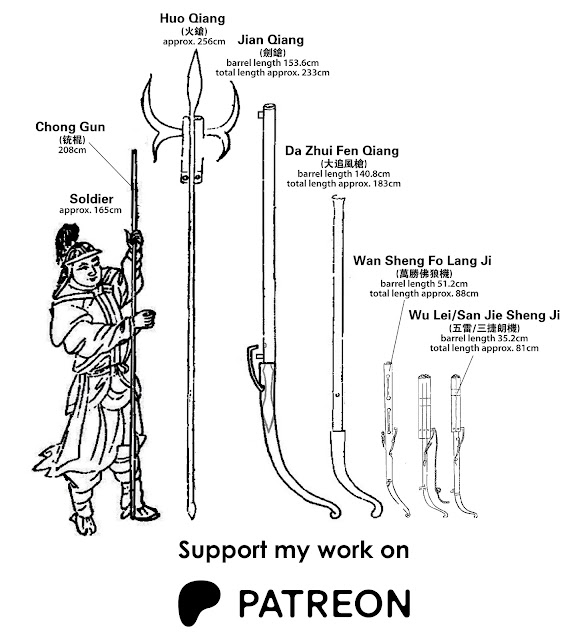
Patreon supporter only: Firearms regiment of Wen brothers

Some firearms commonly used in Northwest China (in particular Shaanxi and Xuanfu Garrison) around 1600s, roughly to-scale to the soldier.

The reluctance of various garrisons in North China to adopt matchlock gun on a large scale, criticism by renowned Ming commander Qi Ji Guang (戚繼光) regarding Ming northern troops' impatience and indiscipline, and the bad impression northern troops left on the Koreans during Imjin War, sometimes give an impression that northern troops were somehow unsophisticated, close-minded and hidebound compared to their southern brethren who eagerly absorbed European science and technology.

However, this is evidently untrue. Ming northern troops were very much shaped by their environment (i.e. strong winds common in North China often blow away gunpowder inside priming pan, whcih makes matchlock gun unreliable), limitations (i.e. difficulties in acquiring good quality iron ore which were mostly produced in Fujian) as well as challenges they faced (i.e. Mongols horsemen), and refined their tactics and equipment along a very different path.

14 July 2023

Equipment of a Ming soldier — Xian Mei (銜枚)

Ancient Chinese military bit gag
Drawing of the flat back side of a Xian Mei, with placeholder soldier and military unit names written on it. From 'Ji Xiao Xin Shu (《紀效新書》)'.
Xian Mei (銜枚, lit. 'Bit stick') or simply Mei (枚) was a simple wooden or bamboo stick used as a gag for soldiers, both to prevent unnecessary chattering while the army was on the move, as well as an aid for observing noise discipline during special military operation such as night raid and ambush. Such device had a very long history of military use in ancient China—records of soldiers conducting night raids with Xian Mei between their teeth can be found in some of the earliest Chinese texts such as Rites of Zhou and Records of the Grand Historians

Ming Dynasty iteration of Xian Mei, its design largely finalised by famous commander Qi Ji Guang (戚繼光), was a 4 cun (12.8 cm/5 in) long and 5 fen (16 mm/0.6 in) wide bamboo stick that came with a lanyard so that it could be worn around the neck or hung from the side of a helmet when not in use. Qi Ji Guang also specifically preferred semi-cylindrical slip over a round rod so as to have a writable surface, as he intended Xian Mei to double as identification tag for his soldiers.

29 April 2023

Zhao Shi Zhen's Hu Tou Che (虎頭車) and Hu Yi Che (虎翼車)

Hu Tou Che (left) and Hu Yi Che (right) on the move, from 'Xu Shen Qi Pu (《續神器譜》)'. Note that while the protective screen of Hu Tou Che has to be dismantled and transported on the wheelbarrow, the blanket of Hu Yi Che can be simply rolled-up and carried by a soldier.
Hu Tou Che (虎頭車) and Hu Yi Che (虎翼車) were two types of war wheelbarrows meant to be used together in a formation. They were comparatively simple designs devised by Ming firearm specialist Zhao Shi Zhen (趙士楨) before he went on to develop the more complex Ying Chang Che (鷹揚車).

Hu Tou Che (虎頭車, lit. 'Tiger head cart')

Drawing of a Hu Tou Che and its sloped protective screen (highlighted), from 'Xu Shen Qi Pu (《續神器譜》)'.
Hu Tou Che was essentially a wheelbarrow of a fairly typical Chinese design, with two handle bars and a large single wheel placed at the bottom of the barrow. Unlike its civilian counterpart, Hu Tou Che was fitted with a front wooden rack to mount the protective screen, as well as two water tanks beside its wheel that doubled as counterweights. Its sloped protective screen—reminiscence of frontal armour of modern tank—was the most unique component of the war wheelbarrow. Made of two layers of wooden planks, plus a row of split bamboos nailed to its outward-facing side, the lightweight yet sturdy protective screen was constructed in such a way that there was empty space between its two wooden layers that could be filled with dirt (as a defence against firearms). It was usually equipped with two large gun ports designed to accommodate the powerful Ying Yang Pao (鷹揚砲), although some variants may have one additional gun port for either heavy Fo Lang Ji (佛朗機) or Hu Dun Pao (虎蹲砲).

Hu Yi Che (虎翼車, lit. 'Tiger wings cart')

Drawing of a Hu Yi Che and its protective blanket, from 'Xu Shen Qi Pu (《續神器譜》)'.
Hu Yi Che was similar to Hu Tou Che in most respects, only differ in that it had an additional set of handle bars, two wooden racks so that its protective screen could be hung on either side of the wheelbarrow, as well as only one water tank to act as counterbalance to its protective screen. In place of rigid wood-and-bamboo composite plating, Hu Yi Che used a large rectangular blanket as its protective screen, made in the exact same way as the canopy of Ju Ma San (拒馬傘).

Proposed wheelbarrow regiment

Hu Tou Che and Hu Yi Che deployed together, from 'Xu Shen Qi Pu (《續神器譜》)'.

Zhao Shi Zhen proposed a powerful regiment-sized unit for his war wheelbarrows, likely as a throwback to the then-active Ji Defence Region war cart regiments raised by Qi Ji Guang (戚繼光) decades before. A detailed breakdown of Zhao Shi Zhen's proposed regiment is available on my Patreon!

22 February 2023

Ships of Zhezhi during the Ming period

UPDATED DECEMBER 31, 2025


While not as prominent as the formidable Fu Chuan (福船) and Guang Chuan (廣船), warships from Zhezhi (浙直)—that is, the regions of Zhejiang and Nanzhili (南直隸, present-day Jiangsu, Anhui, and Shanghai)—were nevertheless a critical backbone of Ming naval power. 

Being adapted to the complex mix of riverine environments of the Yangtze estuary and the shallow coastal and archipelagic waters of the southeastern seaboard, including the numerous islets of the Zhoushan archipelago, ships from Zhezhi exhibited a greater variety in designs, although they were generally characterised by their relatively small size (compared to the Fu Chuan and Guang Chuan), flat bottoms, and use of cloth sails.

Cang Shan Chuan (蒼山船, lit. 'Mount Cang's ship')

Drawing of a Cang Shan Chuan, from 'Bing Lu (《兵錄》)'.
Cang Shan Chuan, also known as Cang Shan Tie (蒼山鐵, lit. 'Mount Cang's iron') and often shortened to Cang Chuan (蒼船), was the most representative ship of Zhezhi. It originated from Zhejiang Province, in particular Taiping County (太平縣, present-day Wenling City).

Being an extinct ship type, much less is known about the Cang Shan Chuan than about other Chinese ships like the Four Great Ancient Ships, although information gleaned from written materials reveals that Cang Shan Chuan had a V- or S-bottom hull that was narrower than the Fu Chuan but wider than the Sha Chuan (沙船), as well as wide prow and stern. It had two decks, the lowest level of the ship served as its ballast, while the main deck right above served as accommodation for the ship crew. All nautical operations of the Cang Shan Chuan, as well as primary fighting compartment of the militarised version of the ship, were located on its main deck, although a reinforced superstructure could still be installed for better protection. A true hybrid sail-and-yuloh ship, the Cang Shan Chuan typically featured cloth sails, and also came equipped with ten yuloh sculling oars, each sculled by four oarsmen. Unusually, all of its yulohs were mounted at the port and starboard quarters, rather than being evenly spread over the entire length of the ship.

Originally built as a fishing vessel, Cang Shan Chuan quickly gained favour in the Ming navy during the Wokou campaign due to its general robustness (which also gave rise to its "iron" moniker), all-weather mobility, and ability to traverse shallow waters unreachable by Fu Chuan. Unfortunately, being one of the smallest Ming warships, the Cang Shan Chuan was seen as merely on par, rather than superior to, Japanese warships, and therefore ill-suited for direct ramming attack and boarding action, as it could neither plough through Japanese ships like its larger cousins from Fujian and Guangdong, nor carry enough combatants to overwhelm the dangerous Japanese warriors in close combat. Nevertheless, Cang Shan Chuan excelled in the roles of patrolling, scouting, rescue operations, providing harassing firepower, pursuing fleeing ships, as well as picking dead bodies out of water after a naval engagement. 

Chong Mu Chuan (艟𦪞船)

Drawing of a Chong Mu Chuan, from 'Deng Tan Bi Jiu (《登壇必究》)'.
Chong Mu Chuan was essentially an upsized Cang Shan Chuan that had its bamboo palisades removed (presumably to cut down on weight). Devised by famous Ming commander Qi Ji Guang (戚繼光) to better combat the Wokou, Chong Mu Chuan's greater size allowed it to overpower Japanese ships more easily without sacrificing the great mobility of the smaller Cang Shan Chuan.

Tie Tou Chuan (鐵頭船, lit. 'Iron-headed ship')

Drawing of a Tie Tou Chuan, from 'Liang Zhe Hai Fang Lei Kao Xu Bian (《兩浙海防類考續編》)'.
Tie Tou Chuan was a newer and slightly downsized version of the Chong Mu Chuan.

Similar to the Cang Shan Chuan it was based on, Tie Tou Chuan was described as being smaller and narrower than a Fu Chuan yet wider than a Sha Chuan, having a draught of four to five chi, a wide prow and stern, hybrid sail-and-yuloh propulsion with its six yulohs mounted at the port and starboard quarters, general robustness, all-weather mobility, and suitability for both shallow and deep waters.

Ba Jiang Chuan (八槳船, lit. 'Eight oar boat')

Drawing of a Ba Jiang Chuan, from 'Wu Bei Zhi (《武備志》)'.

The second-most representative ship of Zhezhi, the Ba Jiang Chuan was a agile vessel fitted with sixteen oars, eight on each side, a stern-mounted yuloh, and (presumably) two masts. While poorly suited for direct combat, it excelled patrolling, scouting, and harassing enemy ships.

Shao Chuan (哨船, lit. 'Sentry ship')

Drawing of a Shao Chuan, from 'Liang Zhe Hai Fang Lei Kao Xu Bian (《兩浙海防類考續編》)'.

Shao Chuan was an oceangoing sail-and-yuloh ship characterised by its V-bottom hull, high and pointed prow, wide stern, huge and tall sails, and large number of equipped yulohs. Originally used by fishermen from Ouhai (甌海) for deep-sea fishing, the ship's superb handling, speed, and agility also made it an excellent military vessel.

Ke Shao Chuan (殼哨船, lit. 'Shell sentry ship')

Drawing of a Ke Shao Chuan, from 'Liang Zhe Hai Fang Lei Kao Xu Bian (《兩浙海防類考續編》)'.

Ke Shao Chuan, also known as Ke Chuan (殼船, lit. 'Shell ship') and Ke Cao (殼艚, lit. 'Shell barge'), was, as its name suggests, an oceangoing fishing ship commonly used by clam-diggers from Wenzhou, characterised by its slender hull with minimal sheer and a V-bottom, as well as a wide stern.

Owing to the nature of clam-digging activities, these fishing vessels frequently fell prey to Wokou hijacking, the pirates preferring them over their own Japanese craft. Ming authorities eventually began to modify small Shao Chuan (see above) into decoy Ke Shao Chuan and mingle them with the ordinary fishing fleet to ambush the pirates.

Wang Suo Chuan (網梭船, lit. 'Net shuttle boat')

Drawing of a Wang Suo Chuan, from 'Liang Zhe Hai Fang Lei Kao Xu Bian (《兩浙海防類考續編》)'.
Wang Suo Chuan was a small fishing boat commonly used by fishermen from Dinghai (定海), Linhai Garrison (臨海衛), Guanhai Garrison (觀海衛), and Xiangshan County (象山縣) to fish at Xiabashan (下八山, part of the Zhoushan archipelago). It was the smallest of Zhezhi's fishing vessels, characterised by a hull that resembled a weaving shuttle, a bamboo mast, and a cloth sail. Despite its extremely small size (only fit for two or three crew members) and shallow 7–8 cun draught, the Wang Suo Chuan was surprisingly seaworthy, able to traverse open ocean just as well as the narrowest brooks and channels—not to mention that this shallow draught, combined with the vessel’s lightweight construction, allowed the boat to be readily dragged ashore by its small crew, offering a reliable way to evade severe weather.

While poorly suited for direct combat, the Wang Suo Chuan excelled in patrolling, scouting, and harassing enemy ships. Furthermore, thanks to its low cost, hundreds of Wang Suo Chuan—each carrying one or two matchlockmen—could be amassed easily to swarm a single ship.

Niao Zui Chuan (鳥嘴船, lit. 'Bird's beak ship')

Drawing of a Niao Zui Chuan, from 'Wu Bei Zhi (《武備志》)'.
Niao Zui Chuan was a small fishing ship originating from Wenzhou (溫州), Taizhou (台州), Songmen (松門), and Haimen (海門) of Zhejiang Province. The ship was characterised by a distinctive prow that resembled a bird's beak. Normally propelled by sail, it could also be sculled by its single stern-mounted yuloh when there was no wind.

Shui Ju Chuan (水艍船)

Drawing of a Shui Ju Chuan, from 'Shui Shi Ji Yao (《水師輯要》)'.
Shui Ju Chuan was a new type of Zhejiang warship that came into prominence in the final years of the Ming Dynasty and remained in use well into Qing period. It appeared to be a downsized version of the Gan Zeng Chuan (趕繒船), possibly as a result of transmission Fu Chuan technology into Zhejiang, or a fusion of the two shipbuilding traditions. Shui Ju Chuan was primarily equipped with breech-loading swivel guns and heavy matchlocks instead of heavier ordnance like its larger cousin.

10 October 2022

Fu Chuan (福船)

UPDATED AUGUST 17, 2025


Drawing of a Fu Chuan with full bamboo palisade, from 'Jing Guo Xiong Lue (《經國雄略》)'. Note its rolled, rather than folded, sails.
The Fu Chuan (福船, lit. 'Fujian ship'), also known as Bai Cao (白艚, lit. 'White junk'), was a class of Chinese sailing junk originating in Fujian. It was the most widely used and well-known of the "Four Great Ancient Ships" of China, and served as the mainstay of the Ming and Qing navies.

24 May 2022

Infantry formations of the Imjin War — Part 1

1. Zhejiang infantry formation

『遂命諸技, 一時呈技, 隊長在前, 橙牌居次, 砲手又居次, 筤筅、長搶、三枝搶, 又次次居之, 迭相進退, 左旋右抽, 各臻其妙。』
"(He) then ordered various branches to perform (their) skills together, captain at the front, (rattan) shields formed the next rank, gunners formed the rank after next, and Lang Xian, pikes, tridents formed subsequent ranks. Then (they) arrayed in intervals (and) advanced and retreated by turn, spun left and drawn right, each had its own ingeniousness."
Korean description of Ming infantry formation under Chen Yin (陳寅) during a military demonstration.

『南兵每隊原有銅鍋外,每名椰瓢一箇,每隊斧二把,鎬頭一把。除銃兵牌手原有腰刀外,其筅、鎗、鎲手各要快利腰刀一把,不拘一式。狼筅鎲兵各帶火箭十枝。』
“Beside the copper pot originally given to every Southern troop squad, every (soldier) (should be given) a coconut ladle, every squad (should be given) two axes (and) one pickaxe. Beside the swords originally owned by gunners and shieldbearers, every other Lang Xian, pike, and Tang Pa troop should be given a sharp sword, irrespective of the types (of swords). Every Lang Xian and Tang Pa troop (should) carry ten rockets.”
— Excerpt of Jing Lue Fu Guo Yao Bian (《經略復國要編》), detailing various equipment provided to Ming Southern troops during the first invasion.

Conjectured Imjin War-era Ming Southern infantry formation. This image is cropped, edited and pieced together from various Ming military treatises and training manuals by myself.

13 June 2019

Chinese fortification: an overview of parts and terminology — Part 1: The wall

UPDATED JUNE 10, 2024, minor update JULY 9, 2025


A recent discussion in the comment section of my previous blog post has sparked my interest in learning more about Chinese fortification (that and marathoning Castles! YouTube video series). To my surprise, despite having some of the most well-known fortifications in the world such as the Great Wall of China, Chinese fortification is very little studied and understood, and researching for information proved more difficult than my anticipation due to various reasons. Chief among the reasons is the large-scale movement to demolish old city walls in the 1920 to 1950s as China tried to modernise (in fact there are only three places with authentic and relatively intact major city walls: Pingyao, Jingzhou, and some parts of Xi'an), meaning that many historical sites, along with the knowledge about their designs, were wiped out. Modern historians also tend to overlook military history, so many design features on the surviving walls are either misunderstood, misnamed, or forgotten altogether. It doesn't help that many available information are diluted for tourist consumption, and tour guides certainly don't make good historians!

Overview

For most of its long history, China was ruled by a centralised bureaucratic government and had a highly nationalised military establishment. As China's centralised government could mobilise more resources and form cohesive defence strategy on a grand scale, Chinese fortification strategy focused on building up an interconnected network of fortified settlements, military fortresses, outposts, chokepoints, postal/relay stations, watchtowers, and most importantly, the Great Wall. As such, Chinese people generally did not build fortified private residence in the manner of European medieval castle (barring a few notable exceptions, such as the late Ming-high Qing period House of the Huangcheng Chancellor), and the state would've actively discourage such practise.

Due to the emphasis on protecting the settlement, fortified wall became the centrepiece of Chinese fortification. A wall was the last line of defence against the attackers, and very often the first line as well. Thus it is no surprise that Chinese people became the world's greatest wall builders. Virtually all cities and towns in China, as well as a significant numbers of villages, were walled. In contrast, Chinese fortification layout tend to be very simple. The vast majority of Chinese walled cities were nothing more than settlements surrounded by a wall and a moat, with the main city gate almost always placed facing the south.

Parts of a Chinese fortification

Basic layout of a Chinese city gate, from 'Wu Bei Zhi (《武備志》)'.

1 August 2018

Ye Meng Xiong's Qing Che (輕車)

Ming Chinese Light gun cart
Drawing of Ye Meng Xiong's Qing Che, from 'Deng Tan Bi Jiu (《登壇必究》)'.

19 November 2017

Arrows of the Ming Dynasty

Archery had always been one of the most important cultural aspects of China. Considered one of the Six Gentlemanly Arts in Confucian philosophy, archery played important roles in military, hunting, communication, and entertainment. China was also the first to create formalised ceremonial archery in Asia (which later influenced/inspired similar customs in Korea and Japan), and one of the last to gave up archery as a serious military weapon.

Naturally, Chinese people's high regard of archery led to the development of various specialised arrows suitable for different purposes. By Ming period, there was already a wide variety of arrows in use, with a peculiar focus on anti-horse arrow.

Bow-launched arrow

Drawing of a Dian Tong Jian (highlighted), from 'San Cai Tu Hui (《三才圖會》)'.
  • Dian Tong Jian (點銅箭, lit. 'Bronze head arrow'): A general term applicable to any arrow with a bronze arrowhead.

3 June 2017

Movie review: God of War movie (《蕩寇風雲》)


The movie God of War is truly a breath of fresh air from the China's cinema scene. From the unimaginative bog that's choke-full of overused, money grabber adaptions of Romance of Three Kingdoms, Journey to the West and fictitious Wuxia stories, we finally get a proper historical war epic! This fact alone is enough to convince me to reach for my wallet, and the attention to details as well as accurate unfolding of historical events are just icing on the cake. What a pleasant surprise!

8 May 2017

Military rations of the Ming Dynasty

UPDATED MARCH 7, 2024


As Napoleon Bonaparte once said "an army marches on its stomach.", the importance of military logistics simply cannot be overstated. In a sense, military logistics can be seen as the single most important factor that decides whether a war is won or lost, even more so than military stratagem or technology.

Due the fact that Chinese fought most of their wars on their own soil or on barren steppes and deserts, foraging was either impractical (nothing to forage) or strongly discouraged/outright banned. Thanks to China's centralised governance and military organisation, it had a remarkably sophisticated logistical system for its time that could provision its armies effectively and remove the dependency on foraging (although foraging/pillaging still happened from time to time). Unfortunately, even the most robust logistical system had its failings. As such, emergency rations were issued to supplement regular military rations, and generals were taught survival skills in case of severe food shortage.

Military ration, known as Qiu Bei (糗糒, lit. 'Dry food') and Ji Liang (齎糧, lit. 'Supplied food') in Classical Chinese, generally remained consistent throughout many dynasties as dietary culture changes slowly. In fact, Ming Chinese inherited most of their standardised military rations from their Song ancestors.

Random Quotes & Trivia

GREAT MING MILITARY © , All Rights Reserved. BLOG DESIGN BY Sadaf F K.