Showing posts with label experimental. Show all posts

14 April 2026

Guo Chu San Yan Qiang (國初三眼鎗) and Guo Chu Shuang Tou Qiang (國初雙頭鎗)

Note: The content of this blog post was originally taken from my other articles. However, I decided to write a separate article for cleaner navigation, tidier organization, and easier reading and digestion.

Guo Chu Shuang Tou Qiang (left) and Guo Chu San Yan Qiang (centre), from 'Shen Qi Pu (《神器譜》)'.
The Guo Chu San Yan Qiang (國初三眼鎗, lit. 'Founding-era three-eyed spear') and the Guo Chu Shuang Tou Qiang (國初雙頭鎗, lit. 'Founding-era double-headed spear') were two elusive firearms mentioned by the mysterious old Daoist priest whom the Ming firearm specialist Zhao Shi Zhen (趙士楨) met in front of the Gongde Temple (功德寺). 

27 February 2026

Zhao Shi Zhen's handgonnes

Note: The content of this blog post was originally taken from my other articles. However, I decided to write a separate article for cleaner navigation, tidier organization, and easier reading and digestion.

Although originally an advocate of universal adoption of matchlock firearms, Ming Dynasty firearm specialist and inventor Zhao Shi Zhen (趙士楨) later reconsidered his views after a chance meeting and and conversation with a mysterious Daoist priest in front of the Gongde Temple (功德寺) while on a fowling trip on Kunming Lake. Thereafter, he adopted a more nuanced position and began to seriously explore various advantages that traditional Chinese handgonnes had to offer, and to refine and improve them.

Ma Shang San Yan Chong (馬上三眼銃, lit. 'Horseback three-eyed gun')

Ming Chinese San Yan Chong with Spearhead
Drawing of a Ma Shang San Yan Chong (highlighted), from 'Shen Qi Pu (《神器譜》)'.
Known in full as the Xin Gai Ma Bu Xiang Yi San Yan Qiang (新改馬步相宜三眼鎗, lit. 'Newly modified three-eyed spear suitable on foot and on horseback'), this weapon was Zhao Shi Zhen's improved design of the classic San Yan Chong (三眼銃), which he developed just as the classic San Yan Chong began to see widespread adoption by the Ming military.

The biggest improvement made by Zhao Shi Zhen was replacing the original barrel of the San Yan Chong—which was typically made from three cast iron barrels forge-welded/cast together, making it top heavy and prone to overheating—with his own design, which used three separate longer barrels forged in the same way as matchlock gun barrels (i.e., rolled from skelp or iron strips and hammer-welded along a seam for a stronger, more uniform tube, double-layered for better integrity, plus individual screw-in breech plugs), all mounted on a grooved wooden bedding. This arrangement reduced the weapon's overall weight for easier handling, improved balance through the lighter construction, and allowed for easier maintenance and replacement of individual barrels.

Ming Dynasty Upgraded Triple barrel Handgonne
Various components of the Xin Gai Ma Bu Xiang Yi San Yan Qiang, from 'Shen Qi Pu (《神器譜》)'.
Zhao Shi Zhen also mounted a tanged blade and disc guard to the butt of the weapon, transforming the Ma Shang San Yan Chong into a versatile hybrid firearm. The tanged blade allowed the user to wield the weapon as a close-quarters polearm for thrusting and slashing after discharging the barrels, with the barrels themselves serving as a counterweight for better balance. Meanwhile, the heavy clustered barrels themselves could serve as an improvised bludgeon for blunt strikes, providing a fallback option where reloading wasn't feasible.

Furthermore, Zhao Shi Zhen tailored the weapon into two variants to accommodate different combat roles. The infantry version featured a longer overall length of approximately 5 chi 5 cun, while the cavalry version was shorter, measuring around 4 chi 4 cun.

Xian Chong (鍁銃, spade gun) and Jue Chong (镢銃, hoe gun)

Highlighted Xian Chong (above) and Jue Chong (below), from 'Shen Qi Pu (《神器譜》)'.
Zhao Shi Zhen further adapted the Ma Shang San Yang Chong by replacing its tanged blade with spade- or hoe-shaped heads in specialized variants, known as Xian Chong and Jue Chong respectively. Both variants retained the firearm's volley capability while while serving as practical tools for frontier engineering.

San Shen Tang (三神鎲, lit. 'Three divine Tangpa')

Ming Dynasty Matchlock Handgonne Trident
Drawing of a San Shen Tang and its detachable matchlock trigger, from 'Shen Qi Pu (《神器譜》)'.

The San Shen Tang can be considered to represent Zhao Shi Zhen's further refinement of the Ma Shang San Yan Chong, as it went beyond merely accommodating different combat roles for infantry and cavalry to also adapt to the habits of soldiers from both southern and northern China.

The primary modification made by Zhao Shi Zhen was the incorporation of a detachable matchlock trigger mechanism—likely borrowed from the Xun Lei Chong (迅雷銃)— which enabled the weapon to be braced and aimed like a matchlock gun by soldiers already familiar with such firearms, particularly those from southern China (although its accuracy still fell somewhat short of that of a true matchlock's), while retaining the flexibility to be used like a traditional handgonne by soldiers unfamiliar with matchlocks, particularly those from northern China. A second key modification was the replacement of the tanged blade of Ma Shang San Yan Chong with the head of a pronged Tang Pa (鎲鈀), which was far more versatile on a shorter polearm than a simple spearhead.

Top: A soldier aiming a trigger-attached San Shen Tang. Bottom: A soldier using a Ma Shang San Yan Chong on horseback. From 'Shen Qi Pu (《神器譜》)'.
In a sense, the San Shen Tang can be considered a simpler and more practical successor of the Xun Lei Chong.

Bu Xia Yi Hu Chong (步下翼虎銃)

Bottom and side view of Bu Xia Yi Hu Chong, from 'Shen Qi Pu (《神器譜》)'.
The Bu Xia Yi Hu Chong was a very unusual double-barrelled handgonne configured like a tonfa or arm shield.

Click here for more information about this handgonne.

Huo Dan Tong (火彈筒, lit. 'Fire bullet tube')

Drawing of a Huo Dan Tong (highlighted), from 'Shen Qi Pu (《神器譜》)'
The Huo Dan Tong was a hand-mortar-style flare gun and one of the earliest of its kind in the world, predating the Very pistol by nearly three centuries and being predated only by the flare launcher of the Xun Lei Chong (迅雷銃), which was also designed by Zhao Shi Zhen.

Click here for more information about this flare gun.

20 February 2026

Bu Xia Yi Hu Chong (步下翼虎銃)

Bottom and side view of Bu Xia Yi Hu Chong (highlighted), from 'Shen Qi Pu (《神器譜》)'.
Among the many ingenious and unconventional firearms crafted by the renowned Ming firearm specialist Zhao Shi Zhen (趙士楨), the Bu Xia Yi Hu Chong (步下翼虎銃, lit. 'Infantry Winged Tiger Gun') stood out as particularly enigmatic and elusive.

Unlike Zhao Shi Zhen's other designs, which he described in detail in his writings, this peculiar weapon survived only through two illustrations in his work, as well as a single brief, off-hand remark—that it was suitable only for use in Southern China—leaving its exact design, function, and mechanism largely unknown, most likely because any fuller written description has been lost to time.

Nevertheless, while any description must remain conjectural due to the absence of Zhao Shi Zhen’s documentation, the two surviving illustrations allow us to make an educated guess on the nature of this weapon.
From the illustrations, the Bu Xia Yi Hu Chong appeared to be a forearm-mounted firearm in a configuration similar to a tonfa. It featured a grip handle with a hand guard near the forward end of the assembly, though it was unclear whether the grip was oriented perpendicular to the barrel (resembling the classic tonfa’s cross-handle) or horizontal (resembling a shield grip). Complementing the grip was an elbow loop that enabled the firearm to be strapped or braced securely along the forearm.

The Bu Xia Yi Hu Chong incorporated two gun barrels aligned side by side and running slightly longer than the length of the forearm, with their muzzles positioned at the rearward end (in the direction of the elbow when braced). These were handgonnes without any mechanical trigger or lock mechanism, relying instead on primitive touch holes—likely located on the underside of the weapon—for ignition, making it, ironically, the only handgonne that Zhao Shizhen deemed suitable for use in Southern China only. Owing to its design, the user probably had to bend his elbow to aim the weapon and gain access to the touch holes before he could fire it—using a posture that might not have been too far removed from the modern sniper cradle position.

A soldier firing Bu Xia Yi Hu Chong, from 'Shen Qi Pu (《神器譜》)'.
Interestingly, the weapon also incorporated a prominent spike projecting from the rearward end—in the same direction as its muzzles. Its precise purpose remained unclear, as it could scarcely have served for forward thrusting and was most likely intended to aid aiming.

3 February 2026

Zhao Shi Zhen's fire lances

Note: The content of this blog post was originally taken from my other articles. However, I decided to write a separate article for cleaner navigation, tidier organization, and easier reading and digestion.

Although normally focused on more advanced weapons, Ming firearm specialist Zhao Shi Zhen (趙士楨) also devised several devised several comparatively simpler and more primitive fire lances. These functioned primarily as close-combat supplements to his advanced war carts, with their gunpowder bursts designed to disrupt Mongol cavalry charges and Wokou swordsmen, allowing the fire lancers to then finish off disorganised foes in melee easily.

Li Hua Qiang (梨花鎗)

Chinese Fire Spear
Zhao Shi Zhen's Li Hua Qiang, from 'Shen Qi Pu (《神器譜》)'.
Zhao Shi Zhen's modified Li Hua Qiang was simply a slightly enhanced version of the original fire lance, featuring two additional fire tubes to to extend the duration of the flame and incendiary discharge.

Tian Peng Chan (天蓬鏟)

Ming Dynasty Fire Spade
Zhao Shi Zhen's Tian Peng Chan (highlighted), from 'Shen Qi Pu (《神器譜》)'.
Zhao Shi Zhen also modified the Tian Peng Chan, transforming it into a fire lance by attaching two Peng Tong (噴筒) to the shaft.

28 January 2026

Bai Zi Fo Lang Ji (百子佛郎機)

Note: This blog post was originally part of my Breech-loading Cannons of the Ming Dynasty article. However, I decided to split (and slightly modify) this section into its own separate article for cleaner navigation, tidier organization, and easier reading and digestion.


Drawing of a Bai Zi Fo Lang Ji, its gun carriage, and three loading chambers. From Qing period 'Yi Hai Zhu Chen (《藝海珠塵》)'.
The Bai Zi Fo Lang Ji (百子佛狼機, lit. 'Hundred-bullet Fo Lang Ji') was an advanced variant of the heavier type of Fo Lang Ji breech-loading cannon designed by Ming firearms specialist Zhao Shi Zhen (趙士楨), who made several key improvements to the weapon. Namely, Zhao Shi Zhen lengthened and reinforced the gun barrel and mounted it on a wooden tiller, while also designing a wheeled gun carriage for the weapon.

The design of the wheeled gun carriage was where Zhao Shi Zhen truly demonstrated his genius. The unique gun carriage was of two-wheeled design (though the wheels were detached prior to firing), equipped with four swing-down stands, paired thills at the rear, along with two L-shaped anchoring irons at the front that anchored the carriage to the ground to counteract recoil.

In addition, Zhao Shizhen also fitted an iron bucket densely packed with cotton at the rear of the gun carriage to act as a recoil absorber, and replaced the deck planks of the gun carriage with wooden conveyor rollers, so that upon firing, the cannon slid rearward along the rollers against the bucket, compressing the cotton buffer to dampen the recoil—in essence, he had invented an early form of sliding recoil mechanism in the early 17th century.

29 April 2023

Zhao Shi Zhen's Hu Tou Che (虎頭車) and Hu Yi Che (虎翼車)

Hu Tou Che (left) and Hu Yi Che (right) on the move, from 'Xu Shen Qi Pu (《續神器譜》)'. Note that while the protective screen of Hu Tou Che has to be dismantled and transported on the wheelbarrow, the blanket of Hu Yi Che can be simply rolled-up and carried by a soldier.
Hu Tou Che (虎頭車) and Hu Yi Che (虎翼車) were two types of war wheelbarrows meant to be used together in a formation. They were comparatively simple designs devised by Ming firearm specialist Zhao Shi Zhen (趙士楨) before he went on to develop the more complex Ying Chang Che (鷹揚車).

Hu Tou Che (虎頭車, lit. 'Tiger head cart')

Drawing of a Hu Tou Che and its sloped protective screen (highlighted), from 'Xu Shen Qi Pu (《續神器譜》)'.
Hu Tou Che was essentially a wheelbarrow of a fairly typical Chinese design, with two handle bars and a large single wheel placed at the bottom of the barrow. Unlike its civilian counterpart, Hu Tou Che was fitted with a front wooden rack to mount the protective screen, as well as two water tanks beside its wheel that doubled as counterweights. Its sloped protective screen—reminiscence of frontal armour of modern tank—was the most unique component of the war wheelbarrow. Made of two layers of wooden planks, plus a row of split bamboos nailed to its outward-facing side, the lightweight yet sturdy protective screen was constructed in such a way that there was empty space between its two wooden layers that could be filled with dirt (as a defence against firearms). It was usually equipped with two large gun ports designed to accommodate the powerful Ying Yang Pao (鷹揚砲), although some variants may have one additional gun port for either heavy Fo Lang Ji (佛朗機) or Hu Dun Pao (虎蹲砲).

Hu Yi Che (虎翼車, lit. 'Tiger wings cart')

Drawing of a Hu Yi Che and its protective blanket, from 'Xu Shen Qi Pu (《續神器譜》)'.
Hu Yi Che was similar to Hu Tou Che in most respects, only differ in that it had an additional set of handle bars, two wooden racks so that its protective screen could be hung on either side of the wheelbarrow, as well as only one water tank to act as counterbalance to its protective screen. In place of rigid wood-and-bamboo composite plating, Hu Yi Che used a large rectangular blanket as its protective screen, made in the exact same way as the canopy of Ju Ma San (拒馬傘).

Proposed wheelbarrow regiment

Hu Tou Che and Hu Yi Che deployed together, from 'Xu Shen Qi Pu (《續神器譜》)'.

Zhao Shi Zhen proposed a powerful regiment-sized unit for his war wheelbarrows, likely as a throwback to the then-active Ji Defence Region war cart regiments raised by Qi Ji Guang (戚繼光) decades before. A detailed breakdown of Zhao Shi Zhen's proposed regiment is available on my Patreon!

8 February 2022

Zhao Shi Zhen's Ju Ma San (拒馬傘) and Ruan Pai (軟牌)

Beside improving and designing various advanced firearms, Ming firearm specialist Zhao Shi Zhen (趙士楨) also came out with many innovative ideas to improve the effectiveness of other equipment. Ju Ma San (拒馬傘, lit. 'Horse-repelling umbrella') and Ruan Pai (軟牌, lit. 'Soft shield') were two such creations. Zhao Shi Zhen was well aware of the protective qualities and usefulness of soft fabric shields like Gun Bei (滾被), Ruan Bi (軟壁) and Gang Rou Pai (剛柔牌), but he also knew that flexible protective equipment can be awkward to handle and difficult to deploy, so he designed the aforementioned Ju Ma San and Ruan Pai as portable, convenient, and easy-to-use improvements to existing flexible shields.

Ju Ma San (拒馬傘)

Components of a Ju Ma San, from 'Xu Shen Qi Pu (《續神器譜》)'.

28 December 2021

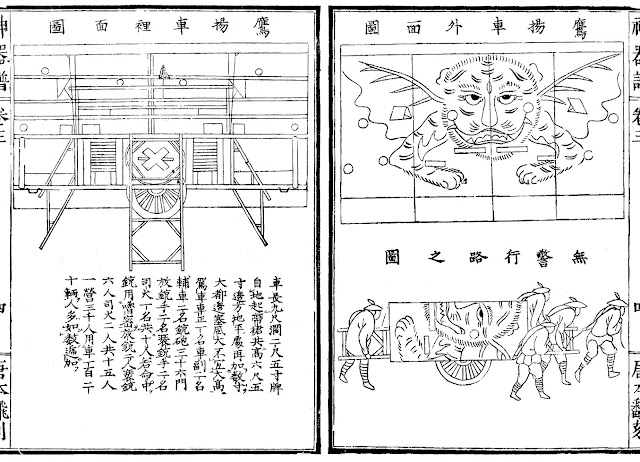
Zhao Shi Zhen's Ying Yang Che (鷹揚車)

UPDATED MAY 14, 2023


Left: Inner side of Ying Yang Che. Top Right: Outer side of Ying Yang Che. Bottom Right: A Ying Yang Che with folded protective screens for ease of transportation. From 'Shen Qi Pu (《神器譜》)'.

14 May 2017

Zhao Shi Zhen's multipurpose shield

Ming Chinese mobile bunker
Left: Back view of the multipurpose shield, wheel turned sideways. Centre: Back view of the multipurpose shield. Right: Front view of the multipurpose shield. From 'Shen Qi Pu (《神器譜》)'.
Besides designing new and innovative firearms, Ming firearm specialist Zhao Shi Zhen (趙士禎) also concerned himself with other aspects of Ming warfare. Notably, he was well aware of the common tactics and equipment employed by Ming armies of both the North and the South, and sought to improve their combat effectiveness.

21 February 2016

Yu Da You's Du Lun Che (獨輪車) — Part 5

Other war carts in Yu Da You's division

Du Lun Che (獨輪車) was not the only type of war cart in the war cart division. Yu Da You (俞大猷) also designed several other war carts to be used together with Du Lun Che.

Shuang Lun Zhan Che (雙輪戰車, lit. 'Two wheeled war cart')

Ming Chinese Two Wheeled War Wagon
Basic layout of Shuang Lun Zhan Che, from 'Zhen Qi Tang Ji (《正氣堂集》)'.
Shuang Lun Zhan Che was more stable and compact that its one wheeled counterpart. It was pushed by six crews instead of eight, with two of the pushers stationed inside the cart. Yu Da You mentioned that it had the same armament as Du Lun Che, however the illustration shows that it had seven spearheads instead of the usual four.

Shuang Lun Liang Che (雙輪糧車, lit. 'Two wheeled grain cart')

Ming Dynasty Supply Wagon
Basic layout of Shuang Lun Liang Che, from 'Zheng Qi Tang Ji (《正氣堂集》)'.
Shuang Lun Liang Che was the supply cart of the war cart division. It was  almost identical to Shuang Lun Zhan Che, except slightly smaller and only had five spearheads. It was not known whether this supply cart was armed with firearms or not.

Xin Zhi Shuang Lun Zhan Che (新製雙輪戰車, lit. 'New model two wheeled war cart')

Ming Chinese Imperial Guard War Cart
Basic layout of the Xin Zhi Shuang Lun Zhan Che, from 'Zheng Qi Tang Ji (《正氣堂集》)'.
After the success of war cart at Datong Defence Region (大同鎮), Yu Da You also tried to introduce the war cart to Jing Ying (京營, lit. 'Capital Regiment') stationed at the capital. He succeeded in raising a sixty thousand strong war cart army in his elderly years.

Xin Zhi Shuang Lun Zhan Che was the war cart designed for imperial guards. It was slightly larger than its Datong Defence Region counterparts, had two wooden screens instead of leather shields, and came equipped with five spearheads and three Fo Lang Ji (佛狼機) cannons. It also had two iron chains that were used to link multiple war carts together.


Other blog posts in my Du Lun Che series:

Yu Da You's Du Lun Che (獨輪車) — Part 1
Yu Da You's Du Lun Che (獨輪車) — Part 2
Yu Da You's Du Lun Che (獨輪車) — Part 3
Yu Da You's Du Lun Che (獨輪車) — Part 4
Yu Da You's Du Lun Che (獨輪車) — Part 5

28 December 2015

Weatherproofed arquebuses of the Ming Dynasty

UPDATED MAY 5, 2022


One of the major hurdles that prevented matchlock guns from being adopted on a large scale in North China was the complain that strong wind could blow away priming powder in the flash pan (an opinion apparently shared by Sir John Smythe from England), making the weapon very unreliable. Nevertheless, whilst the opinion had some merits, the advantages of choosing matchlock gun over primitive handgonne far outweighed any downside. To encourage the adoption of matchlock gun in North China, Ming Dynasty firearm specialist Zhao Shi Zhen (趙士楨) designed two arquebuses that were less susceptible to the elements (and to refute and shut up the detractors).

Xuan Yuan Chong (軒轅銃, lit. 'Xuanyuan arquebus')

Named after the legendary forefather of all Chinese people, Xuan Yuan Chong was Zhao Shi Zhen's first matchlock gun not derived from any foreign designs. Drawing from his experience researching and reverse engineering European and Turkish matchlocks, Zhao Shi Zhen created a new weapon suitable for use in both the dry, windy North China, and the humid, rainy South China.

Ming Dynasty Weatherproofed Matchlock Gun
A Xuan Yuan Chong (top) and components of its rack and pinion mechanism (bottom), from 'Shen Qi Pu (《神器譜》)'.

28 November 2015

Huo Jian Dao Liu Xing (火箭刀溜形)

Drawing of a Huo Jian Dao Liu Xing (highlighted), from 'Shen Qi Pu Huo Wen (《神器譜或問》)'

24 November 2015

Huo Dan Tong (火彈筒)

Drawing of a Huo Dan Tong (highlighted), from 'Shen Qi Pu (《神器譜》)'.
The Huo Dan Tong was a hand-mortar-style flare gun designed by Ming Dynasty firearm specialist Zhao Shi Zhen (趙士楨) to be used in conjunction with the Jiu Tou Niao (九頭鳥) during night fighting, shooting Huo Dan (火彈) to illuminate targets for the heavy matchlock gun.

21 November 2015

Dian Guang Jian (電光劒)

Ming Chinese Lightning Sword
Drawing of a Dian Guang Jian, from 'Shen Qi Pu (《神器譜》)'.
Dian Guang Jian (電光劒, lit. 'Lightning sword') was an unusual fire lance designed by Zhao Shi Zhen (趙士楨). It was a formidable pole-sword with a broad, double-edged chopping blade mounted on a shaft with a disc guard, and came with two barrelsone handgonne and one Pen Tong (噴筒)mounted on either flat of the blade.

30 April 2015

Multiple-barrel arquebuses of the Ming Dynasty

UPDATED MARCH 30, 2022


Zhen Die Chong (震疊銃, lit. 'Terror gun')

Ming Dynasty Double-Barreled Matchlock Gun
Drawing of a Zhen Die Chong, from 'Shen Qi Pu (《神器譜》)'.

9 April 2015

Firelock firearms of the Ming Dynasty

UPDATED JULY 04, 2022, minor update March 6, 2026


Firelock guns—such as the wheellock, snaphaunce, miquelet lock, and true flintlock—represented the pinnacle of small-arms technology in the sixteenth and seventeenth centuries, offering superior reliability, weather resistance, and firing speed compared with matchlocks. Although the Ming Dynasty ultimately failed to adopt this advanced firearm on a large scale before its demise, various contemporary records and pieces of evidence suggest that knowledge of firelock guns was surprisingly widespread in late Ming China and that they may have entered limited service with the Ming military.

Zi Sheng Huo Chong (自生火銃, lit. 'Self-fire generating gun') (ca. 1635)

Ming Chinese Flintlock Musket
Drawing of a Zi Sheng Huo Chong, from 'Jun Qi Tu Shuo (《軍器圖說》)'.
The seventeenth-century military treatise Jun Qi Tu Shuo (《軍器圖說》) authored by Bi Mao Kang (畢懋康) is the only Ming military treatise to record a firelock gun, likely a miquelet lock, with a clear illustration. This weapon, called Zi Sheng Huo Chong, was said to be weatherproof and more convenient than a matchlock gun. 

Qian Li Chong (千裡銃, lit. 'Thousand li gun') (ca. 1565)

The Qian Li Chong was a type of handheld firearm—likely a firelock pistol—that was said to be a simple yet accurate weapon, worn on the belt and capable of being drawn and fired at a moment’s notice.

This weapon was introduced by Zhang Gong Fu (張公輔), the Regional Investigating Censor of Jiangxi (江西巡按), and was approved for mass production by the Ming court in 1565, with the Liaodong Defence Region noted as being capable of producing its own. This may possibly have been the only firelock gun to enter full (albeit likely still limited) military service with the Ming army.

Pi Li Huo Chong (霹靂火銃, lit. 'Thunderclap gun') (ca. 1599)

Ming firearm enthusiast and specialist Zhao Shi Zhen (趙士楨) may have been the first to discuss the pros and cons of a firelock gun—which he called the Pi Li Huo Chong—in detail. Regrettably, although he successfully reverse-engineered the weapon for his own use, he did not elaborate on the details of its ignition mechanism and considered the gun too expensive and complex for large-scale adoption.

Xu Guang Qi's attestation (exact date unknown, possibly 1605)

The firelock gun was also attested by the Ming polymath and military reformer Xu Guang Qi (徐光啟) in one of his memorials to the throne. Although he did not specifically describe a firelock gun or make a clear distinction between matchlock and firelock weapons, he did attest to the existence of particularly well-crafted arquebuses that could “use stone (i.e. either flint or pyrite) to ignite fire”.

Arquebuses and muskets mentioned in Bing Lu (《兵錄》) (ca. 1630)

In a section discussing arquebuses and muskets, the seventeenth-century military treatise Bing Lu also attests that both weapons could be equipped with either a matchlock or a firelock mechanism.

Fu Shou Ji (伏手機, lit. 'Concealed hand machine') (ca. 1632)

The Fu Shou Ji was a firearm of unknown type encountered by Chen Zi Yi (程子頤), author of the military treatise Wu Bei Yao Lue (《武備要略》), during a military operation to suppress a rebellion. He later reverse-engineered the weapon, renamed it Li Gong Guai (李公拐, lit. 'Lord Li's crutch'), and attempted to promote it to the Ming army.

Although the Fu Shou Ji was evidently not a firelock gun, Chen Zi Yi compared it favourably to both matchlock and firelock guns and lamented that even the rebels had access to superior firearms that the Ming army lacked. This suggests that firelock guns had already entered limited service with the Ming army by his time.

16 November 2014

Unique weapon of the Ming Dynasty — Xun Lei Chong (迅雷銃)

MINOR UPDATE FEBRUARY 5, 2026


Ming Chinese Five Barrel Matchlock Shield Gun
Drawing of a soldier firing Xun Lei Chong, from 'Shen Qi Pu (《神器譜》)'.
One of the most complex weapons developed by Ming Dynasty firearm specialist Zhao Shi Zhen (趙士楨),  and his signature work, the Xun Lei Chong (迅雷銃, lit. 'Quick thunder gun') was a self-contained weapon system that incorporated a five-barrelled matchlock gun with a detachable trigger mechanism, a layered leather-and-cotton composite gun shield, an axe that doubled as a musket rest, and a spear with a flare launcher mounted on its butt—allowing adaptation to a variety of combat situations.

12 November 2014

Breech-loading arquebuses of the Ming Dynasty

UPDATED JANUARY 7, 2022, minor update MAY 14, 2023


One of the major weaknesses of early black powder firearms was the abysmal firing rate. Chinese people certainly weren't strangers to this problem, and showed remarkable ingenuity in their attempts to solve the issue. The most prominent figure in the development of breech-loading matchlock gun was Ming firearms specialist Zhao Shi Zhen (趙士楨), who pioneered the idea of combining Fo Lang Ji (佛狼機) breech-loading swivel gun and matchlock gun into one weapon.

Che Dian Chong (掣電銃, lit. 'Lightning arquebus')

Variant 1

Ming Dynasty Breechloading Arquebus
Drawing of a Che Dian Chong, from a Wanli period print of 'Shen Qi Pu (《神器譜》)'.

21 August 2014

Unique weapon of the Ming Dynasty — Huo Jian Liu (火箭溜)

UPDATED APRIL 29, 2022

Drawing of a Huo Jian Liu and its rack-and-pinion matchlock mechanism (highlighted), from 'Shen Qi Pu (《神器譜》)'.
China was the first civilisation in the world to field rocket weaponry in warfare. Early rocket was nothing more than a simple, black powder-filled paper tube attached to the shaft of an arrow, hence the name Huo Jian (火箭, lit. 'Fire arrow'). Although devastating, primitive unguided rocket could not be aimed like a crossbow or arquebus due to limitations of its launching platforms, and thus had pretty bad accuracy. Chinese military innovators attempted to solve this problem by developing various types of multiple rocket launchers that could shoot large numbers of rockets at once. While this "spray and pray" approach alleviated the accuracy problem somewhat, it was also very wasteful.

During the late 16th century, Ming firearms specialist Zhao Shi Zhen (趙士楨) proposed a much more refined solution to early rocket's accuracy problem in the form of Huo Jian Liu (火箭溜, lit. 'Fire arrow slide'). Huo Jian Liu was, for all intents and purposes, a matchlock gun that shot rocket instead of the usual lead ball, and featured the same barrel, front and rear sight, shoulder stock as well as trigger as an ordinary musket. However, instead of a standard matchlock mechanism, Zhao Shi Zhen equipped the weapon with a Chinese rack and pinion matchlock mechanism identical to that of late Ming variant Lu Mi Chong (嚕密銃). To ensure gunner safety, the matchlock mechanism was mounted at the middle portion of the gun (farther away from the gunner), with a large gun shield installed behind it to deflect rocket backblast.

Huo Jian Liu allowed its user to aim and launch rocket with greater accuracy. It also had greater range, less recoil, and significantly faster rate of fire than typical musket (due to the elimination of pouring powder charge, loading and ramming the ball down the barrel, and priming the flash pan steps in the reloading process). On top of that, the gun was cheaper to manufacture, as it did not need a strong barrel to withstand high chamber pressure, nor ramrod (although this was offset by its more costly rocket ammunition).

Regrettably, Zhao Shi Zhen's invention failed to catch the attention of Ming government, and never went beyond prototype stage.

Random Quotes & Trivia

GREAT MING MILITARY © , All Rights Reserved. BLOG DESIGN BY Sadaf F K.