UPDATED MAY 14, 2023
Showing posts sorted by relevance for query wheelbarrow. Sort by date Show all posts
28 December 2021
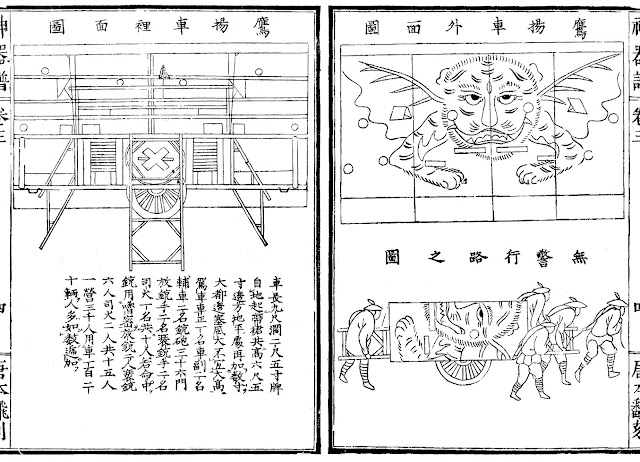
Zhao Shi Zhen's Ying Yang Che (鷹揚車)
Labels:
cart and wagon,
experimental,
late Ming Dynasty,
Zhao Shi Zhen
+ SHARE
Zhao Shi Zhen's Ying Yang Che (鷹揚車)
24 September 2019
Zhao Shi Zhen's Chong Feng Lei Dian Che (衝鋒雷電車)
![]() |
| From left to right: front view, side view and rear view of Chong Feng Lei Dian Che, from 'Shen Qi Pu (《神器譜》)'. |
Labels:
cart and wagon,
late Ming Dynasty,
Zhao Shi Zhen
+ SHARE
Zhao Shi Zhen's Chong Feng Lei Dian Che (衝鋒雷電車)
29 April 2023
Zhao Shi Zhen's Hu Tou Che (虎頭車) and Hu Yi Che (虎翼車)
Hu Tou Che (虎頭車) and Hu Yi Che (虎翼車) were two types of war wheelbarrows
meant to be used together in a formation. They were comparatively simple
designs devised by Ming firearm specialist Zhao Shi Zhen (趙士楨) before he
went on to develop the more complex Ying Chang Che (鷹揚車).
Hu Tou Che (虎頭車, lit. 'Tiger head cart')
|
| Drawing of a Hu Tou Che and its sloped protective screen (highlighted), from 'Xu Shen Qi Pu (《續神器譜》)'. |
Hu Tou Che was essentially a wheelbarrow of a fairly typical Chinese design, with two handle bars and a large single wheel placed at the bottom of the
barrow. Unlike its civilian counterpart, Hu Tou Che was fitted with a front
wooden rack to mount the protective screen, as well as two water tanks
beside its wheel that doubled as counterweights. Its sloped protective
screen—reminiscence of frontal armour of modern tank—was the most unique
component of the war wheelbarrow. Made of two layers of wooden planks, plus
a row of split bamboos nailed to its outward-facing side, the lightweight
yet sturdy protective screen was constructed in such a way that there was
empty space between its two wooden layers that could be filled with dirt (as
a defence against firearms). It was usually equipped with two large gun
ports designed to accommodate the powerful Ying Yang Pao (鷹揚砲), although some variants may have one additional gun port for either heavy
Fo Lang Ji (佛朗機)
or
Hu Dun Pao (虎蹲砲).
Hu Yi Che (虎翼車, lit. 'Tiger wings cart')
|
| Drawing of a Hu Yi Che and its protective blanket, from 'Xu Shen Qi Pu (《續神器譜》)'. |
Proposed wheelbarrow regiment
Zhao Shi Zhen proposed a powerful regiment-sized unit for his war
wheelbarrows, likely as a throwback to the then-active
Ji Defence Region war cart regiments
raised by Qi Ji Guang (戚繼光) decades before. A detailed breakdown of Zhao
Shi Zhen's proposed regiment is available on my Patreon!
Labels:
cart and wagon,
experimental,
late Ming Dynasty,
Zhao Shi Zhen
+ SHARE
Zhao Shi Zhen's Hu Tou Che (虎頭車) and Hu Yi Che (虎翼車)
14 April 2015
Rocket carts of the Ming Dynasty
IMPORTANT UPDATE NOVEMBER 15, 2024
Ever since the founding of Ming Dynasty, the Chinese had been an avid user of
rocket weapon. Early Ming Dynasty rocket cart could have an upward of six
hundred rockets, but subsequent redesigns reduced the number of rockets to
make the cart more mobile.
Huo Jian Che (火箭車, rocket cart)
|
| Drawing of a Huo Jian Che, from 'Si Zhen San Guan Zhi (《四鎮三關志》)'. |
Labels:
Joseon Dynasty,
Korea,
Ming Dynasty,
photo,
rocket cart,
weapon
+ SHARE
Rocket carts of the Ming Dynasty
14 May 2017
Zhao Shi Zhen's multipurpose shield
![]() |
| Left: Back view of the multipurpose shield, wheel turned sideways. Centre: Back view of the multipurpose shield. Right: Front view of the multipurpose shield. From 'Shen Qi Pu (《神器譜》)'. |
Labels:
experimental,
mantlet,
mid Ming Dynasty,
photo,
weapon,
Zhao Shi Zhen
+ SHARE
Zhao Shi Zhen's multipurpose shield
11 February 2016
Yu Da You's Du Lun Che (獨輪車) — Part 1
While mentions of Ming period war wagons are plentiful, famous Ming general Yu Da You (俞大猷) was one of the earliest pioneers to discuss in detail the deployment and tactics of these war machines. He also designed Du Lun Che (獨輪車, lit. 'One wheeled cart'), which was basically a giant armed and armoured wheelbarrow.
Early Version
This version of Du Lun Che was designed by Yu Da You before his transfer to Datong Defence Region (大同鎮). Early Du Lun Che was a simple cart armed with two long spears, manned by ten crews and supported by ten infantries, twenty horsemen and twenty packhorses. The infantries were armed with Gou Lian Dao (鉤鐮刀), Hu Cha (虎叉, lit. 'Tiger fork', a trident that was similar but much larger than Tang Pa (鎲鈀). Its use was more common during Qing period.), Long Dao Qiang (龍刀鎗), as well as round shields paired with Huan Dao (環刀, lit. 'Ring sabre', this is an archaic Yuan period term referring to a sabre. Korean continued to use this terminology in the form of Hwando or 환도 to refer to their sabre).
Unlike its more advanced variant, early Du Lun Che was not equipped with shield or firearm.
Late Version
Labels:
cart and wagon,
featured,
mid Ming Dynasty,
rare,
weapon,
Yu Da You
+ SHARE
Yu Da You's Du Lun Che (獨輪車) — Part 1
26 July 2014
Wu Di Shen Pai (無敵神牌)
![]() |
| Drawing of a Wu Di Shen Pai, from sixteenth century military treatise 'Wu Bian Qian Ji (《武編前集》)'. |
8 November 2015
101st Post: Commonly available visual references for Ming army (and why you shouldn't trust them)
This blog post was originally meant to be part of my 100th post rant, but that one kind of drag on for too long, so I decided to write a separate one.
I think I have to apologise beforehand if my tone in this blog post sounds too condescending. I know most illustrators are not historians, and it's very hard to reconstruct a historically accurate illustration with the information (which erred plenty) given to them. With that in mind, I have to say they had done a commendable job bringing the past to life.
Men-At-Arms 251 Medieval Chinese Armies 1260 - 1520
Even though I know Wu Bei Zhi (《武備志》) is usually the go-to resource for researching Ming Dynasty military, I still find it odd to use a seventeenth century military manual as the reference to research and reconstruct Ming army of the fourteenth and fifteenth century. Then again, we have very few pre-sixteenth century sources to work with.
PAGE E
Labels:
featured,
gallery,
Joseon Dynasty,
Korea,
Osprey Publishing,
photo,
rambling,
screen painting,
scroll painting,
wargaming,
woodblock print
+ SHARE
101st Post: Commonly available visual references for Ming army (and why you shouldn't trust them)
4 September 2015
Rocket weaponry of the Ming Dynasty
UPDATED DECEMBER 9, 2024
Overview
While first rocket was believed to be invented around twelfth century and had been fielded in battle almost as soon as it became viable, it was not until Ming period that rocket was employed en mass as a practical battlefield weapon. Ming weapon engineers constantly sought to create more deadly rocketry, and developed many platforms to better utilise this devastating weapon, whether stationary, handheld or mobile.
Labels:
featured,
Ming Dynasty,
rocket,
weapon
+ SHARE
Rocket weaponry of the Ming Dynasty
5 February 2017
Qi Ji Guang's Che Ying (車營) — Part 1
The Mongol Threat
It was no secret that the Mongols were formidable and extremely dangerous warriors. Being an all-cavalry army, their strength lay way beyond just simple mobility and deadly horse archery, but also their unpredictability and force concentration. It is quite unfathomable, at least to modern minds that are more exposed and accustomed to Western (particularly European) style of medieval warfare, that a nomadic people with but a small fraction of Chinese population and wealth could muster a vastly larger, better trained and better equipped army than the Chinese, yet for most of the Chinese-Mongol conflicts, Chinese soldiers frequently found themselves not only outmanoeuvred but also outnumbered. In fact, it was not unusual in any given conflict to have a Mongol force that fielded more horsemen than Chinese had footmen, even though a horseman was several times more expensive to train and maintain than a foot soldier.
The ability of the Mongols to concentrate their forces essentially forced the Chinese into passive defensive warfare—utilising fortresses and strongholds to balance out the force multiplier created through concentration of force. Yet due to their superior mobility the Mongols could strike at more places than Chinese could defend them, and at times of their choosing. It was under such circumstance that the Chinese invented and pioneered wagon fort tactics to defend against nomadic raids, as war carts served as "fortress that moves" that allowed Chinese troops to operate away from the protection of their fortresses.
Yet even war cart alone could not adequately defend against Mongol horsemen, whom were equally deadly in horse archery as they were in cavalry charge, and often had numerical advantage on their side. For most of China's history, Chinese troops had to rely on massed crossbows, whether handheld or vehicle-mounted, to repel these horsemen. While undoubtedly effective, Chinese crossbow was hard-pressed to match the Mongol bow.
Several types of war carts were used in Che Ying, which will be detailed below:
The ability of the Mongols to concentrate their forces essentially forced the Chinese into passive defensive warfare—utilising fortresses and strongholds to balance out the force multiplier created through concentration of force. Yet due to their superior mobility the Mongols could strike at more places than Chinese could defend them, and at times of their choosing. It was under such circumstance that the Chinese invented and pioneered wagon fort tactics to defend against nomadic raids, as war carts served as "fortress that moves" that allowed Chinese troops to operate away from the protection of their fortresses.
Yet even war cart alone could not adequately defend against Mongol horsemen, whom were equally deadly in horse archery as they were in cavalry charge, and often had numerical advantage on their side. For most of China's history, Chinese troops had to rely on massed crossbows, whether handheld or vehicle-mounted, to repel these horsemen. While undoubtedly effective, Chinese crossbow was hard-pressed to match the Mongol bow.
Qi Ji Guang's Che Ying (車營, lit. 'Cart regiment')
Che Ying formed the war cart branch of the reformed Ji Defence Region army devised by Qi Ji Guang (戚繼光), and was arguably the most important unit of his reform. While it was intended to operate alongside the infantry, cavalry and logistic branch of the army, Che Ying was actually self-sufficient even when deployed alone.Pian Xiang Che (偏廂車, lit. 'Side cabin cart')
![]() |
| Drawing of a Pian Xiang Che, from 'Si Zhen San Guan Zhi (《四鎮三關志》)'. |
Labels:
cart and wagon,
featured,
mid Ming Dynasty,
military unit,
Qi Ji Guang
+ SHARE
Qi Ji Guang's Che Ying (車營) — Part 1
11 December 2020
Chinese siege defence
Per the request of my long time reader Yevon, and also due to my recent interest
in
Stronghold Warlords, let's talk about Chinese siege defence!
What set them apart from other cultures was that larger Chinese walls allowed the defenders to set up heavier and more complex machinery on the battlement, even moving their own siege engines onto the wall to counter enemy siege engines, without the need of artillery positions prebuilt into the wall.
Overview
The art of siegecraft in the pre-modern era was incredibly sophisticated and complex, often involving meticulous planning on logistics, morale, tactics, intelligence, diplomancy, and so on. However, when it came to taking direct action against a fortification, the options were surprisingly few. The vast majority of siege tactics all over the pre-modern world generally revolved around contravallation, artillery bombardment, tunnelling and sapping, escalade, siege tower, battering ram as well as thermal attack, and China was no exception. As such, Chinese countermeasures to most siege tactics were more or less identical to strategies developed elsewhere.What set them apart from other cultures was that larger Chinese walls allowed the defenders to set up heavier and more complex machinery on the battlement, even moving their own siege engines onto the wall to counter enemy siege engines, without the need of artillery positions prebuilt into the wall.
1. Contravallation countermeasure
Contravallation, known as Ju Yin (距堙 or 距闉) and Chang Wei (長圍, lit. 'Long encirclement') in Chinese language, was a tactic used by pretty much all pre-modern armies to lay siege to a fortified position by constructing a line of siegeworks to partially or completely surround the target fortification. Contravallation allowed the attacking party to enforce blockade more effectively, reconnoitre enemy defensive layout from a high position, and even pour suppressive fire against defending troops on the wall. It could also serve as a base for launching assaults against enemy fortification, or for constructing further earthworks such as siege ramps or tunnels. Chinese contravallation tactics range from simple Jin Lang (井闌) towers built atop artificial mounds and ditches, to more elaborate palisades and fortified arrow towers, to full-blown encirclement with networked siege castles.1.1 Sortie
Due to the limitations of pre-gunpowder siege weapons (stone throwers had limited range and generally could not demolish fortified structures faster than they could be repaired/rebuilt), it was extremely difficult to stop a contravallation attempt once the construction process began. As such, the best countermeasure to enemy contravallation was to sortie out to destroy enemy fortifications, siege engines and earthworks before their completion, preferably with armed escorts and covering fire from friendly troops on the wall. While undoubtedly effective, this tactic was not without downsides, as it was extremely risky and wasn't always viable against numerically superior enemy.1.2 Counter-tunnel
Just as tunnelling could be used to bring down a fortification, so too it was an effective countermeasure against contravallation. Countermining tactics will be discussed in section 3.2 Countermining.1.3 Tower hoarding
|
| Multi-storey hoarding built on the wall to offset the height advantage of enemy contravallation. |
Labels:
Ming Dynasty,
photo,
siege defence,
Song Dynasty
+ SHARE
Chinese siege defence
Subscribe to:
Comments (Atom)