28 January 2024

Du Huo Fei Pao (毒火飛砲)

Drawing of a paper fuse (top right), paper sealing tube (middle right), wooden fuse (top bottom), shell casing (top left) and bombard (bottom left), from 'Wu Bei Ji Yao (《武備集要》)'.
Du Huo Fei Pao (毒火飛砲, lit. 'Poisonous fire flying cannon') was a bombard-launched explosive shell designed to be launched from Wan Kou Pao (碗口砲, lit. 'Bowl-muzzle cannon'), an ordinary stone-throwing bronze bombard already in widespread use since the founding of Ming Dynasty.

First appeared in late 15th/early 16th century and entered mass production by 1544 at the latest, Du Huo Fei Pao was a spherical cast iron shell filled with black powder and up to five liang of sulfur, arsenic and other poisonous substance/irritants (hence the name "poisonous fire"), and was equipped with a fuse known as Mu Xin (木信, lit. 'Wooden fuse'), which consisted of burning fuse(s) winded around a screw-threaded wooden rod and sealed inside a thick paper tube to prevent premature contact between the fuse and bursting charge inside the shell. A cleverly designed ignition device, Mu Xin allowed for easy adjustment of time-delay before detonation through increasing or decreasing the number of threads on the wooden rod (and thus the length of the burning fuse).

Despite its ingenuity, Mu Xin did have some drawbacks, namely It was a fairly complicated device assembled from three different components (burning fuse, wooden rod and paper tube), not to mention hand-carving screw threads onto a wooden rod took considerable amount of skill and time. Fortunately, an alternative that offered similar level of consistency whilst being far easier to made was later discovered. Known as Zhi Xin (紙信, lit. 'Paper fuse'), this alternative fuse was simply the motor part of a Chinese rocket being adapted into a fuse.

EXTRA: Bigyeok Jincheonroe (비격진천뢰 or 飛擊震天雷)

Drawing of a large Bigyeok Jincheonroe, from 'Yungwon pilbi (《융원필비》 or 《戎垣必備》)'.
Bigyeok Jincheonroe was a cast iron shrapnel shell invented in Joseon Dynasty Korea by weapon engineer Yi Jangson (이장손 or 李長孫) in 1591, and proved instrumental in the liberation of Gyeongju city from Japanese invaders during Imjin War that broke out one year after its invention.

Named after another Chinese weapon, Bigyeok Jincheonroe bore a striking resemblance to Du Huo Fei Pao even down to design of the fuse based on screw-threaded wooden rod, which suggests that its invention may be inspired by Du Huo Fei Pao. Nevertheless, there were some notable differences between the two as well, chief among them material of the sealing tube—the Koreans used a bamboo tube whereas the Chinese used a paper tube—which likely influenced the design of the fuse hole as well. Specifically, Bigyeok Jincheonroe had a large rectangular fuse hole with a matching iron lid, but this was not found on Du Huo Fei Pao (which had a normal round fuse hole). This was due to the fact that bamboo is relatively rigid and smooth-surfaced, which may cause the fuse to slip out of the hole if it is not pinned in place by the iron lid. In contrast, paper is supple and coarse and serves as natural wadding, allowing the fuse to fit snugly into the hole like a stopper.

Bamboo sealing tube (left), iron lid (middle), and bomb casing of a Bigyeok Jincheonroe with a squarish fuse hole (right).
Interestingly, the Koreans also never appeared to adopt the more convenient Zhi Xin fuse.
24 November 2023

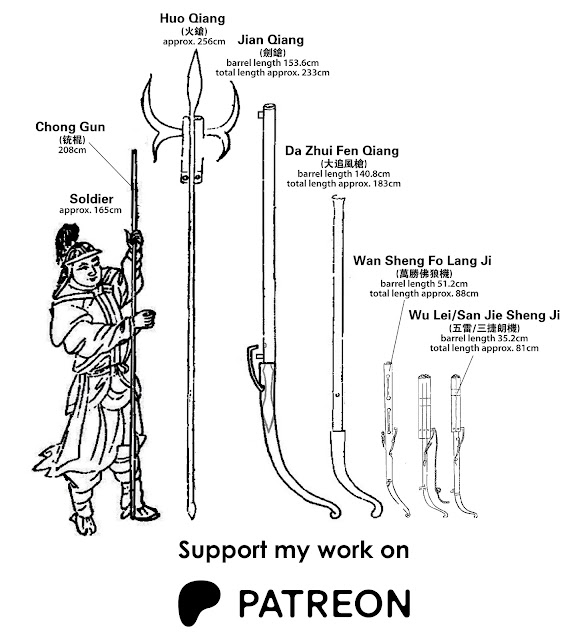
Patreon supporter only: Firearms regiment of Wen brothers

Some firearms commonly used in Northwest China (in particular Shaanxi and Xuanfu Garrison) around 1600s, roughly to-scale to the soldier.

The reluctance of various garrisons in North China to adopt matchlock gun on a large scale, criticism by renowned Ming commander Qi Ji Guang (戚繼光) regarding Ming northern troops' impatience and indiscipline, and the bad impression northern troops left on the Koreans during Imjin War, sometimes give an impression that northern troops were somehow unsophisticated, close-minded and hidebound compared to their southern brethren who eagerly absorbed European science and technology.

However, this is evidently untrue. Ming northern troops were very much shaped by their environment (i.e. strong winds common in North China often blow away gunpowder inside priming pan, whcih makes matchlock gun unreliable), limitations (i.e. difficulties in acquiring good quality iron ore which were mostly produced in Fujian) as well as challenges they faced (i.e. Mongols horsemen), and refined their tactics and equipment along a very different path.

Di Lei Lian Pao (地雷連砲) and Xun Lei Pao (迅雷砲)

Di Lei Lian Pao (地雷連砲, lit. 'Ground thunder rapid cannon')

Drawing of three soldiers firing three Di Lei Lian Pao, from 'Wu Bei Zhi (《武備志》)'.

Di Lei Lian Pao was a small volley gun that consisted of 10 small cannons brazed to a solid iron stock in a fan shape. Originated from Shaanxi (陝西) region of Northwest China, Di Lei Lian Pao was a very lightweight weapon weighing only twenty jin (11.8 kg or 26 lbs) which allowed the weapon to be easily deployed and transported without a wheeled gun carriage—an important feature allowing the weapon to be used more effectively against fast-paced Mongol horsemen. Despite being a volley gun that fired its shots in a spread, Di Lei Lian Pao was still fitted with an iron sight.

To prevent the huge recoil generated by all ten barrels firing simultaneously from throwing off such a light weapon, potentially even hurting its user, the iron stock of Di Lei Lian Pao had an integrated ring that allowed the weapon to be staked to the ground during use.

Drawing of one soldier firing multiple Di Lei Lian Pao, from 'Wu Bei Zhi (《武備志》)'.
Di Lei Lian Pao was originally a tripwire gun that uses Gang Lun Fa Huo (鋼輪發火) as its triggering mechanism (hence 'Di Lei [地雷]' in its name), although this was later changed to having a gunner to manually fire the volley gun, as this was found to be much more convenient and responsive.

Di Lei Lian Pao utilised a two-stage fuse, which consisted of a very short section of normal fuse (i.e. Chinese paper fuse), known as Zou Xian (走線, lit. 'Walking thread'), connecting to a much longer section of flat quickmatch fuse, known as Bian Xian (扁線, lit. 'Flat thread') that extended all the way to the touch hole of the volley gun. The use of long fuse to ignite Di Lei Lian Pao allowed the gunner to stand at a safe distance from the weapon, as well as for a single gunner to operate multiple guns by himself.

Xun Lei Pao (迅雷砲, lit. 'Quick thunder cannon')

Drawing of a Xun Lei Pao, from 'Li Qi Jie (《利器解》)'.
Xun Lei Pao was basically a larger, lighter, more powerful, but single shot version of Di Lei Lian Pao. It was a small iron cannon weighing only 10 jin (6 kg or 13 lbs) and came with a slightly flared muzzle, front and back iron sight, as well as an extended solid portion behind the cannon breach with a hole punched through it to allow the cannon to be staked to the ground during use much like its multi-shot counterpart.

Xun Lei Pao should not to be confused with Xun Lei Chong (迅雷銃), a weapon with similar name.
< > Home

Random Quotes & Trivia

GREAT MING MILITARY © , All Rights Reserved. BLOG DESIGN BY Sadaf F K.