UPDATED JULY 11, 2024
Tian Gong Kai Wu (《天工開物》) variant
 |
| Drawing of Wan Ren Di in action, from 'Tian Gong Kai Wu (《天工開物》)'. |
Wan Ren Di (萬人敵, lit. 'Rivaling ten thousand men') was a type of improvised incendiary devise developed during the twilight years of the Ming Dynasty. Recorded in late Ming encyclopedia
Tian Gong Kai Wu, it was meant to be used to defend relatively small and remote cities and fortresses where ponderous cannons wouldn't be of much use.
Wan Ren Di was a relatively simple weapon that could be cheaply and easily manufactured. It consisted of two components: a hollowed clay ball filled with various types of propellants and gunpowder (usually incendiary or poison smoke), as well as a boxy wooden frame. Alternatively, a wooden barrel with its inside fireproofed with clay could be used in place of the wooden frame.
Like
Fei Huo Xiang Mo Chui (飛火降魔槌), the bomb did not detonate after being thrown. Instead, the clay ball would start spinning inside the wooden frame (which was used to prevent the clay ball from breaking apart during impact) and projecting fire all around it, effectively deny the area to the enemy for an extended period of time.
Zhan Shou Quan Shu (《戰守全書》) variant
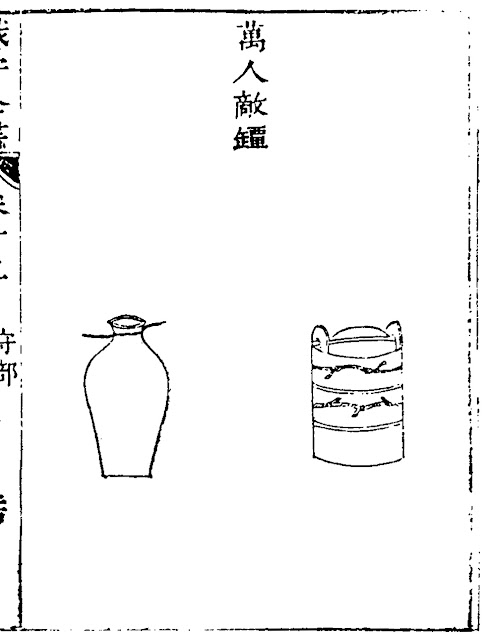 |
| Drawing of two different containers for Wan Ren Di, from 'Zhan Shou Quan Shu (《戰守全書》)'. |
A completely different Wan Ren Di, also called
Wan Ren Di Guan (萬人敵罐, lit. 'Rivaling ten thousand men jar'), can be found in another late Ming military treatise, Zhan Shou Quan Shu.
A throwback to ancient
thunder crash bomb, this version of Wan Ren Di was originally a fused grenade or bomb used to attack enemy troops and siege engines at the base of the wall, although the risk of yet-to-explode grenades being picked up and thrown back at the defenders eventually led to simplification of the weapon into a simple container filled with gunpowder and other incendiaries akin to
Huo Tong (火桶), that had to be set off separately. The simplified Wan Ren Di could either be dropped or lowered via iron chain to the base of the wall.


